
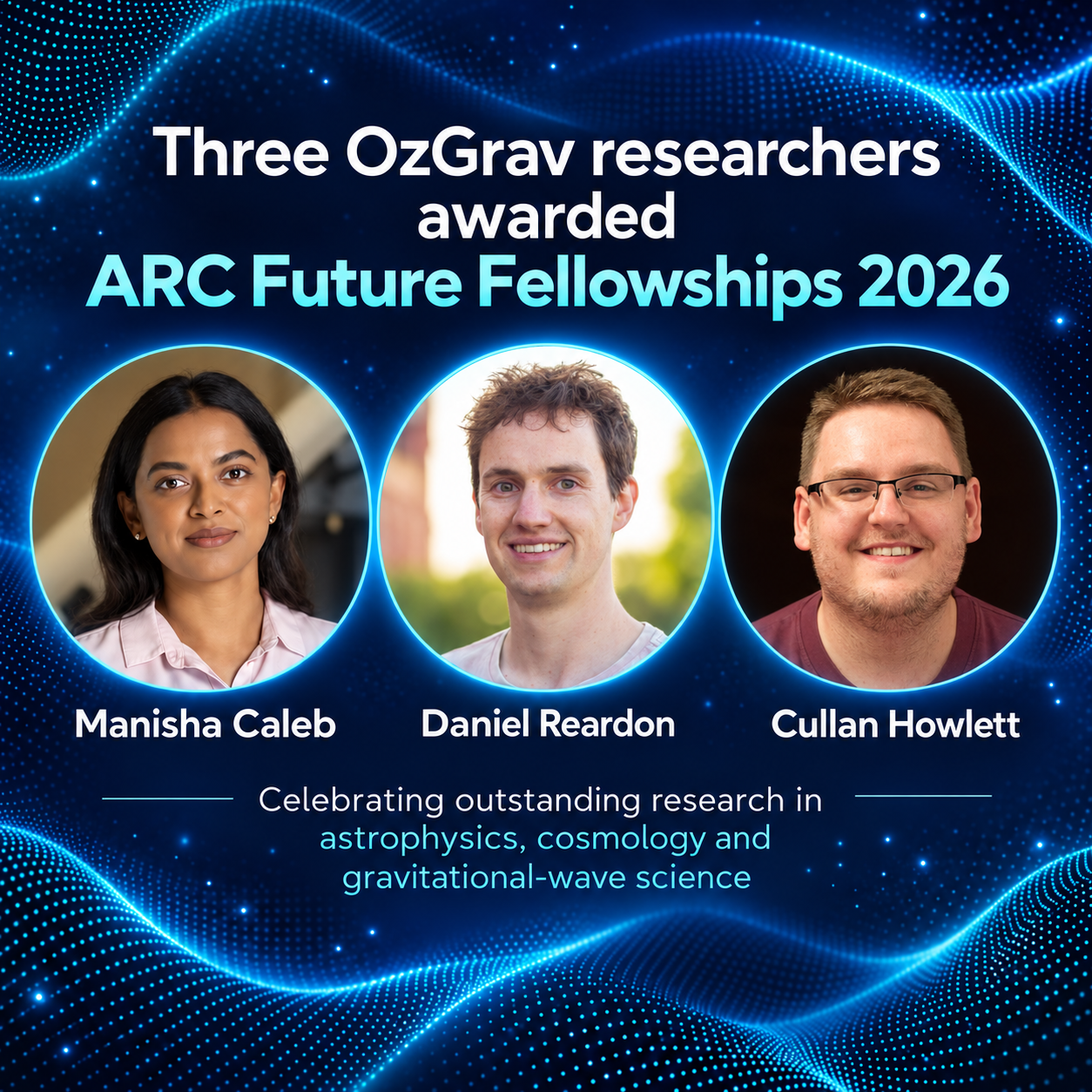
Three OzGrav researchers have been awarded prestigious Australian Research Council (ARC) Future Fellowships, supporting ambitious research across fast radio bursts, gravitational waves and dark energy. Congratulations to Dr Manisha Caleb, Dr Daniel Reardon and Dr Cullan Howlett, who were named among the recipients of the 2026 Future Fellowships funding round. ARC Future Fellowships support outstanding […]
Three OzGrav researchers have been awarded prestigious Australian Research Council (ARC) Future Fellowships, supporting ambitious research across fast radio bursts, gravitational waves and dark energy.
Congratulations to Dr Manisha Caleb, Dr Daniel Reardon and Dr Cullan Howlett, who were named among the recipients of the 2026 Future Fellowships funding round.
ARC Future Fellowships support outstanding mid-career researchers to undertake high-quality, innovative research and build Australia’s research capability.
Fast radio bursts as tracers of baryons, galaxies and the evolving Universe
Dr Manisha Caleb, University of Sydney
Fast radio bursts (FRBs) are extremely bright, short-lived flashes of radio waves originating from across the Universe. Manisha’s project will use these powerful signals as cosmic probes to investigate how ordinary matter is distributed throughout the Universe and how galaxies evolve.
By connecting FRBs with their host galaxies and studying the matter their signals encounter as they travel through space, the research will provide new insights into both the origins of these mysterious bursts and the large-scale structure of the Universe.
Tuning a Galactic Gravitational-Wave Detector using Pulsar Scintillation
Dr Daniel Reardon, Swinburne University of Technology
Daniel’s project will develop new methods to detect ultra-low-frequency gravitational waves by using pulsar signals to better understand and correct for the effects of the interstellar medium.
The research will improve the sensitivity of pulsar timing arrays to gravitational waves, advance radio astronomy and strengthen Australia’s contribution to next-generation radio astronomy, including the Square Kilometre Array.
Illuminating Dark Energy In the Nearby Universe
Dr Cullan Howlett, The University of Queensland
Cullan’s project will investigate one of the biggest unanswered questions in modern physics: the nature of dark energy, the mysterious phenomenon driving the accelerating expansion of the Universe.
Using the positions and motions of galaxies in the nearby Universe, together with data from major galaxy surveys and advanced statistical techniques, the research will test our current understanding of cosmology and search for clues that could point towards new physics.
Together, the three Future Fellowships highlight the breadth of research across OzGrav, from using pulsars as a galaxy-scale gravitational-wave detector to probing the matter and fundamental forces that shape our Universe.
Congratulations Manisha, Daniel and Cullan on this fantastic achievement!
We also want to acknowledge the OzGrav researchers who were not successful in this highly competitive round. Preparing a Future Fellowship application takes an enormous amount of work, and we’re proud of the ambition, ideas and persistence of everyone who put themselves forward.