
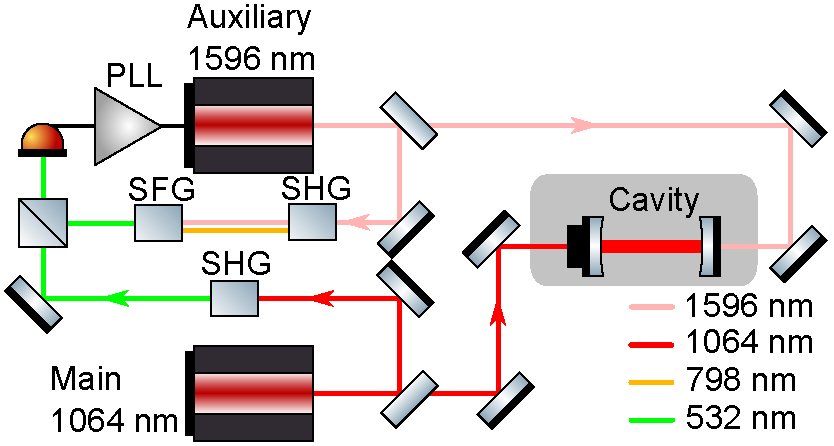
The experimental optical setup used to develop and test a novel cavity length stabilisation technique for future gravitational-wave detectors. Image credit: Dr Jian Liu / OzGrav.
A collaborative research project spanning OzGrav’s three instrumentation nodes has successfully demonstrated a new cavity length stabilisation technique, helping overcome a key technical challenge for the next generation of gravitational-wave observatories. Led entirely by early-career researchers (ECRs), the project was supported through OzGrav’s Special Initiative funding program and brought together expertise from the University of […]
A collaborative research project spanning OzGrav’s three instrumentation nodes has successfully demonstrated a new cavity length stabilisation technique, helping overcome a key technical challenge for the next generation of gravitational-wave observatories.
Led entirely by early-career researchers (ECRs), the project was supported through OzGrav’s Special Initiative funding program and brought together expertise from the University of Western Australia, Australian National University and University of Adelaide.
The research, published in Physical Review D, presents a novel multi-wavelength arm-length stabilisation (ALS) system designed for future upgrades to gravitational-wave detectors, including A#.
Tackling a challenge in gravitational-wave detection
Gravitational-wave detectors such as LIGO use highly sensitive laser interferometers to measure extraordinarily small changes in distance caused by passing gravitational waves.
For these detectors to operate, their mirrors must be precisely controlled so that laser light can resonate within the detector’s long optical cavities.
Current arm-length stabilisation systems use a green laser beam with a wavelength of 532 nanometres to help bring these cavities into their operating state.
However, future detector upgrades are expected to incorporate advanced aluminium gallium arsenide/gallium arsenide (AlGaAs/GaAs) mirror coatings, which absorb too much light at this wavelength.
To address this challenge, OzGrav researchers developed a new approach using an auxiliary laser operating at 1596 nanometres, a wavelength outside the coatings’ problematic absorption bands.
By combining frequency conversion and phase-locking techniques, the team demonstrated how the auxiliary laser and the detector’s main science laser can work together to achieve stable cavity control.
In laboratory experiments, the researchers successfully demonstrated stable cavity detuning and a robust transition between laser locking systems, validating the technique’s potential for future gravitational-wave detectors.
A milestone for ECR-led collaboration
Beyond its technical achievements, the project highlights the value of collaboration across OzGrav’s instrumentation research teams.
Bringing together specialised expertise and resources from three universities, the initiative enabled early-career researchers to lead a complex experimental development project from concept through to peer-reviewed publication.
“It has been a rewarding and fantastic learning experience to lead this project across three of OzGrav’s instrumentation nodes,” said Dr Jian Liu, an OzGrav postdoctoral researcher at the University of Western Australia (UWA).
“We are grateful to the OzGrav Centre for supporting ECRs to lead novel research that could help pave the way for the next generation of gravitational-wave detectors.”
The project demonstrates how OzGrav’s Special Initiative program can support innovative research, strengthen collaboration across institutions and provide valuable leadership opportunities for emerging researchers.
As the global gravitational-wave community prepares for increasingly sensitive observatories, advances in precision laser control and mirror technology will play an important role in expanding our ability to explore the Universe.
This research represents another step towards enabling those future discoveries.
Research publication
Title: Novel arm-length stabilization scheme for gravitational-wave detectors with AlGaAs/GaAs coated mirrors
Journal: Physical Review D, 114, 082002 (2026)
Authors: Jian Liu, Juntao Pan, Carl Blair, Chiara Di Fronzo, Li Ju, Chunnong Zhao, Sheon S. Y. Chua, Bram J. J. Slagmolen, Nutsinee Kijbunchoo and David Ottaway.=