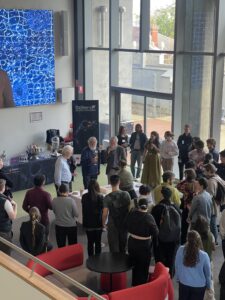
Last week, the Australian gravitational-wave community gathered at Swinburne University to celebrate a landmark moment in science, the 10-year anniversary of the first direct detection of gravitational waves (GW150914). This discovery, announced in 2016 from data recorded on 14 September 2015, confirmed Einstein’s prediction and opened an entirely new window on the Universe. The two-day […]
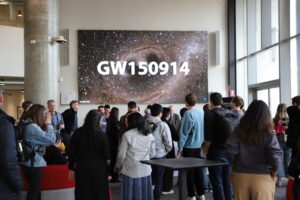
Last week, the Australian gravitational-wave community gathered at Swinburne University to celebrate a landmark moment in science, the 10-year anniversary of the first direct detection of gravitational waves (GW150914). This discovery, announced in 2016 from data recorded on 14 September 2015, confirmed Einstein’s prediction and opened an entirely new window on the Universe.
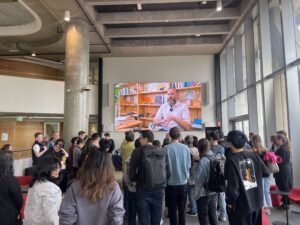
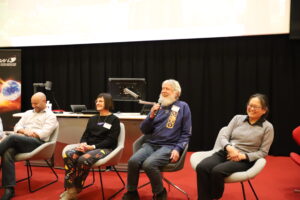
The two-day workshop, hosted by the Australian Research Council Centre of Excellence for Gravitational Wave Discovery (OzGrav), brought together more than 80 students, researchers, and leaders from across the country. The workshop was more than just a commemoration of GW150914, it was a chance to reflect on Australia’s pivotal role in that discovery, to celebrate the remarkable advances of the past decade, and to look forward to what the next decade of gravitational-wave science will bring.
OzGrav’s Director, Professor Matthew Bailes, reflected on the impact of that first signal: “When the first detection happened in 2015, it completely transformed the landscape. Suddenly, gravitational-wave astronomy was real, and Australia needed a Centre of Excellence dedicated to it and that’s how OzGrav was born in 2017.” He added, “Since then, we’ve captured neutron star mergers in both gravitational waves and light, pushed quantum noise limits, and pioneered squeezed-light technology.”
For many in the room, it was collaboration that defined the journey. As Distinguished Professor Susan Scott, from the Australian National University, reminded the audience, “The first detection was only possible through collaboration and that spirit continues to drive gravitational-wave science forward.”
The workshop program reflected that spirit, spanning technical advances, new discoveries, and emerging projects, while also acknowledging the teamwork and persistence that made it all possible.
The celebration was about the future as much as the past. Day two highlighted the next generation of detectors and discoveries with Professor Paul Lasky from Monash University summing up the mood with optimism, “The gravitational-wave future is loud, much louder than GW150914. Every increase in sensitivity lets us hear further into the universe.” He also issued a call to action: “If we want an observatory in Australia, we will need ambition and collaboration to make it happen.”
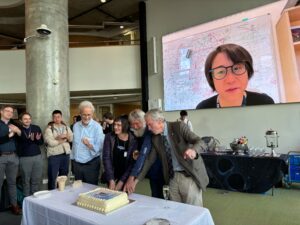
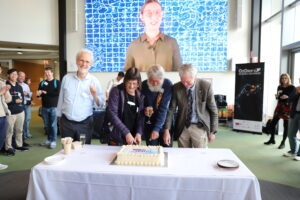
Over coffee breaks, panel discussions, and even a celebratory cake, there was a palpable sense of both gratitude and anticipation. The workshop marked not only ten years since a signal that changed the world but also the strength of a community that has grown around it, a community ready to take the next bold steps into the cosmos.
Thank you to the local organising committee:
-
Jade Powell, Diana Haikal, Kirsten Banks, Jackie Bondell, Carl Knox (Swinburne University of Technology)
-
Susan Scott (ANU)
-
Christine Lee (University of Melbourne)