
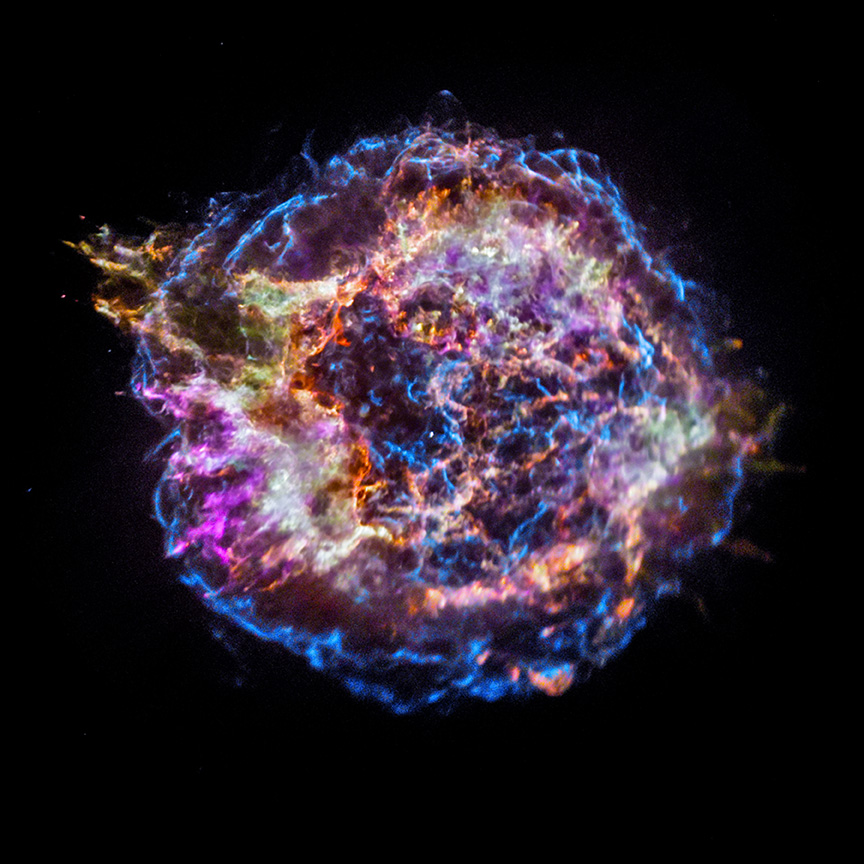
The supernova remnant Cassiopeia A, one the youngest and brightest known core-collapse supernova remnants in our Galaxy, as seen by the Chandra X-ray Observatory. The central white dot is a point-like X-ray source believed to be the neutron star left behind the supernova explosion and known as a ‘Central Compact Object’. Image credit: X-ray: NASA/CXC/Meiji Univ./T. Sato et al.; Image Processing: NASA/CXC/SAO/N. Wolk.
An international team of scientists from the LIGO, Virgo, and KAGRA collaborations, including researchers from the ARC Centre of Excellence for Gravitational Wave Discovery (OzGrav), has completed one of the most sensitive searches yet for continuous gravitational waves from young supernova remnants. Neutron stars (NSs) are among the most exotic objects in the Universe. They […]
An international team of scientists from the LIGO, Virgo, and KAGRA collaborations, including researchers from the ARC Centre of Excellence for Gravitational Wave Discovery (OzGrav), has completed one of the most sensitive searches yet for continuous gravitational waves from young supernova remnants.
Neutron stars (NSs) are among the most exotic objects in the Universe. They are born when massive stars die in energetic explosions called core-collapse supernovae. These explosions rip the star apart and leave behind a beautiful diffuse nebula called a supernova remnant.
“These objects are incredibly extreme environments,” said Dr Ornella Piccinni, from the University of the Balearic Islands and Associate Investigator at OzGrav, who led the study while at the Australian National University. “They give us a way to test physics in conditions we can’t reproduce on Earth.”
NSs are also the strongest magnets in the Universe and can rotate astonishingly fast, with some rotating hundreds of times per second. Astrophysical estimates suggest that millions of NS may have formed in our Galaxy. However, only a fraction of neutron stars are observed as pulsars (they emit pulses of light). This lack of observation may be either because their emission beams do not intersect the Earth or because they have become too weak to detect. As a result, most neutron stars remain electromagnetically silent, and their internal properties are largely inaccessible even to the most sensitive telescopes.
“Gravitational-wave signals from neutron stars are incredibly faint, which makes them difficult to detect,” said Dr Ling (Lilli) Sun. “But they carry unique information about the structure of neutron stars.”
Continuous gravitational waves (CWs) provide a new tool to discover previously missed pulsars and unobserved NSs and probe their exotic interiors.
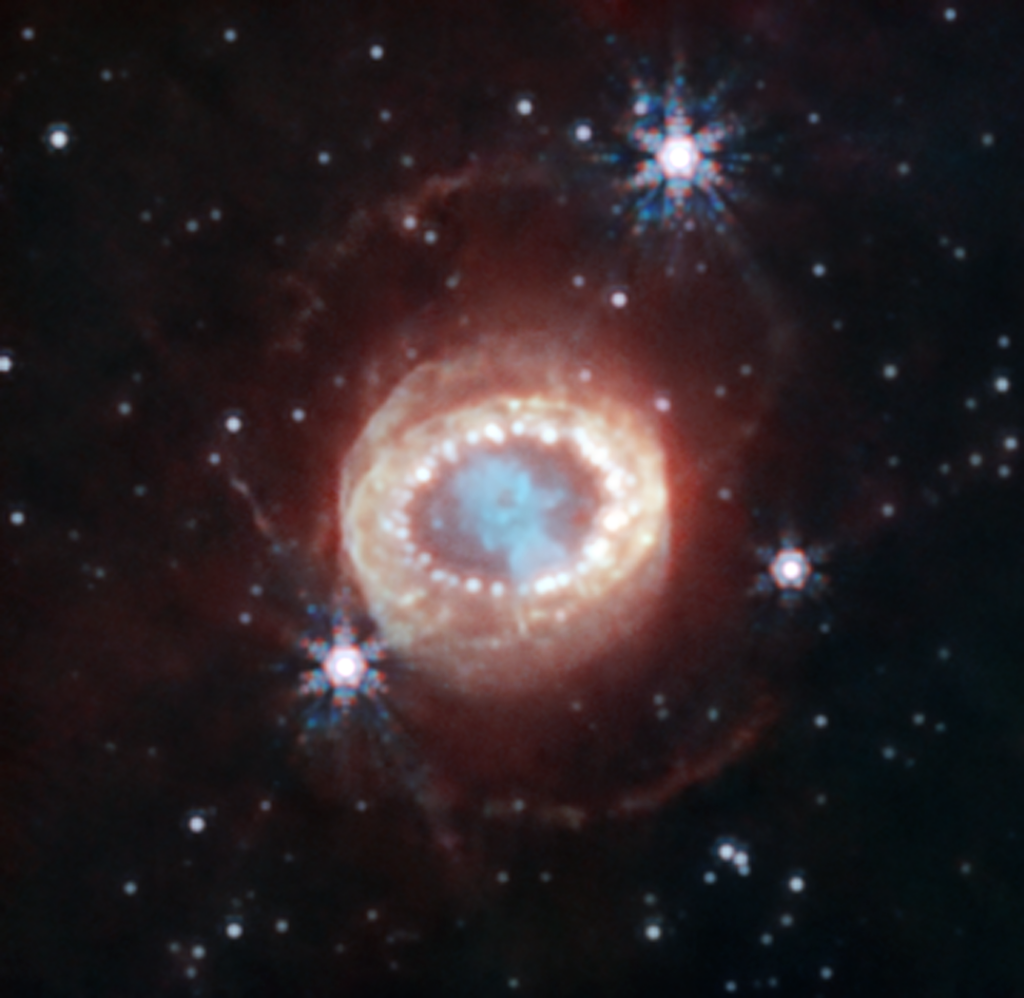
In a recent paper, the team searched for continuous gravitational waves from 15 young to middle-aged supernova remnants, ranging from approximately 40 years old (SN 1987A) to tens of thousands of years old, 14 of which are in our galaxy and one in our neighbouring galaxy, the Large Magellanic Cloud.
The search used eight months of data from May 2023 to Jan 2024 during the first phase of the detectors’ fourth observing run (O4a).
While transient bursts of gravitational waves are now regularly observed, CWs are much harder to detect because these signals are expected to be far weaker than the bursts seen from neutron star or black hole mergers, often weaker by several orders of magnitude.
But no detection does not mean there are no results.
By measuring how sensitive the search was, the team was able to place the strongest limits so far on how strong these signals could be, improving on previous observing runs. These limits help narrow what scientists think neutron stars can look like, including how “bumpy” they are and how matter behaves under the most extreme conditions in the Universe.
“Even when we don’t see a signal, we’re still learning,” said Yutong (Tracy) Bu from the University of Melbourne, who worked on the analysis. “We can place stronger constraints on what these neutron stars are doing.”
These systems may host young neutron stars where the rotation frequency is still unknown. Their relatively young age implies that the neutron star candidates are more likely to have non-uniform deformations than older ones and emit stronger continuous gravitational waves.
“We’re pushing the sensitivity of these searches further than ever before,” said Dr Piccinni. “Each step brings us closer to a detection.”
These results are the most sensitive broadband frequency searches so far for continuous gravitational waves from supernova remnants.
As data collection continues and sensitivity improves, researchers are closing in on the first detection of continuous gravitational waves — a breakthrough that would open an entirely new way of studying neutron stars.
Watch the explainer video below: