
- Vision and Values
- Messages from Director and Advisory Chairs
- Centre Snapshot
- Science Highlights
- Research Translation Highlights
- Equity, Diversity and Inclusion Highlights
- Professional Development Program
- Education and Outreach Highlights
- Awards and Honours
- Events and Community Highlights
- Key Research Programs
- Instrumentation Theme
- Discovery Theme
- Physics Theme
- People of OzGrav
- KPI Dashboard
- Linkages and Collaborations
- Finance
- Governance
- Publications
- FREQUENTLY USED ACRONYMS
Vision and Values
Our Vision
- To pursue exceptional research and scientific discovery.
- To provide world–class research training and leadership.
- To inspire young people to take up careers in science and technology.
Our Values
Co-Creating a Shared Vision for Our Future
In 2024, OzGrav embarked on a journey to define and articulate the values that represent our identity as a community. This collaborative process brought together members from across the Centre, reflecting the diverse perspectives and shared aspirations that drive us forward. Through pre-discovery questionnaires, an in-person co-design workshop, thematic analysis, and multiple rounds of feedback, we co-created a set of values that embody who we are and who we strive to be.
We are proud to share OzGrav’s values, which now serve as a foundation for our culture and a guiding framework for our future.




Messages from Director and Advisory Chairs
Message from the Director
Dear Colleagues,
At a time of global upheaval it is nice to be able to be distracted by science. I am currently working on a talk to be delivered at the launch of our amazing new Virtual Universe theatre, and have been researching some of the earliest breakthroughs in astronomy. These include the first measurement of the diameter of the Earth, the establishment of the distance to the Moon, and attempts to measure the distance to the Sun by ancient Greek scientists. Although they sometimes made some colossal blunders, they also achieved some amazing discoveries. Long after their civilisations faltered, we can still marvel at their insights and achievements. I’d like to think that the science OzGrav is pursuing is advancing knowledge and is on a plane that is distinct from politics and wars. Let’s hope that our discoveries will be cited and indeed celebrated long after current global events have settled, and we remember the joy we experienced in contributing to this nascent field of astrophysics via OzGrav.
This has been a year that underscores both the scale and the ambition of OzGrav as Australia’s leading gravitational-wave research centre. With more than 300 members spread across institutions nationwide, the Centre continues to operate as a genuinely distributed national collaboration, whose collective output reflects not just its size, but the depth of its scientific culture. Over 240 papers were published this year, the majority in top-tier journals, and a striking proportion of the highest-impact work was led by early career researchers, a testament to the pipeline of talent OzGrav has cultivated since its inception.
Scientifically, the year delivered results of global significance. OzGrav members contributed to landmark gravitational-wave discoveries, including record-breaking black hole merger detections that are pushing the boundaries of what we know about the most extreme objects in the universe. Alongside these, new tests of black hole physics and general relativity are sharpening our understanding of gravity itself. The Centre’s reach extended beyond gravitational waves, with radio astronomy breakthroughs, including discoveries of long-period radio transients and unexpected stellar systems, demonstrating the strength of OzGrav’s integrated approach across instrumentation, observation, and theory.
Looking to the future, OzGrav is actively building the technological foundations for the next generation of gravitational-wave detectors. Development of advanced cryogenic test facilities and other cutting-edge instrumentation is positioning Australia as a credible partner in ambitious international projects, including LIGO Voyager and the Einstein Telescope. This forward investment ensures that Australia will remain at the frontier of gravitational-wave science for decades to come. Bram Slagmolen led the largest infrastructure grant (LIEF) awarded in 2025.
The year also carried deep symbolic weight. The 10th anniversary of the first gravitational-wave detection was marked with a national workshop that brought together the community to reflect on a decade of discovery. Melbourne hosted the LIGO-Virgo-KAGRA Collaboration Meeting, welcoming more than 400 international attendees and affirming Australia’s standing at the heart of the global gravitational-wave effort.
Investment in people remained central to the Centre’s identity. The Winter School, Early Career Researcher Workshop, and a broad professional development program were all delivered with positive feedback, with participants highlighting the value of practical training and the connections forged across nodes. This commitment to training the next generation sits alongside a national outreach program that reached schools, teachers, and public audiences, with particular attention to underrepresented communities, through curriculum-aligned programs, immersive experiences, and direct researcher engagement.
Equity, diversity and inclusion are not peripheral to OzGrav; they are embedded in how the Centre operates. The Gold Pleiades Award, a national recognition of sustained EDI effort, reflects years of genuine commitment, as does the Indigenous Work Experience Program, which continues to open pathways into research for students who might not otherwise find them. Progress on ARTIC, the Centre’s cross-institutional research translation initiative, is likewise building structured connections between fundamental research and broader societal impact.
Finally, this has been a year rich in recognition. Awards and honours have been received across all career stages, and the Centre takes pride not in individual accolades alone, but in what they represent: a thriving, generous, and high-achieving scientific community.
The annual retreat focused on planning, and I’ve been buoyed by how many projects seem to have been spawned from it, as well as the genuine sense of community spirit, as highlighted by the raucous karaoke numbers belted out at the conference dinner.
As always, I’m grateful to be able to lead such a thriving community, and am especially grateful to our admin team led by Dr Yeshe Fenner and my Deputy Directors, Professors Tamara Davis and David McClelland.

Image Credit: Department of Industry, Science and Resources
Yours sincerely,
Prof Matthew Bailes
OzGrav Director
Swinburne University of Technology
Message from the Chair of the OzGrav Governance Advisory Board
I would like to congratulate OzGrav on a very productive year, with this report highlighting substantial activity across the Centre’s programs in research, training, translation and engagement.
It is very pleasing to see that the Centre met or exceeded almost all of its key performance indicators in 2025, despite setting ambitious targets. This is reflected in the breadth of initiatives and outcomes presented throughout the report.
OzGrav demonstrates the value of a nationally coordinated Centre of Excellence, bringing together a large and diverse community of researchers, students, and professional staff across its partner institutions. The scale of this collaboration, and the breadth of activity described in this report, reflects a strong commitment to both scientific progress and the development of its people.
OzGrav places a clear emphasis on supporting its members at all career stages. The report highlights a number of activities designed to build skills, strengthen networks, and create opportunities for early career researchers and students. For example, the Centre delivered its first Winter School under OzGrav 2.0, bringing together early career researchers for focused training and collaboration, alongside a program of workshops and professional development activities.
The Centre also continued to prioritise equity, diversity and inclusion in 2025. As described in the report, this includes the ongoing implementation of EDI initiatives across the Centre, as well as the achievement of Gold Pleiades accreditation (the highest level of recognition under the Astronomical Society of Australia’s framework). This work is reflected in practical measures such as the provision of primary carer support, Indigenous Work Experience programs, and the integration of inclusive practices across events and programs.
It is also encouraging to see momentum building in research translation, with the establishment of the Australian Research Translation and Innovation Consortium (ARTIC) and a series of initial workshops and working group activities. This is a considerable step towards strengthening connections between research, industry, and government.
As showcased in this report, OzGrav was very active in education and outreach. The Centre has engaged with schools, students, and the wider community through a range of initiatives, including programs that support participation from underrepresented groups. These activities contribute not only to public understanding of science, but also to longer-term development of the STEM pipeline.
I commend the OzGrav community on a productive year and look forward to what 2026 holds.

Chair: Prof. Stuart Wyithe
Director, Research School of Astronomy and Astrophysics,
Australian National University
Message from the Chair of the OzGrav Science Advisory Board
The Scientific Advisory Board (SAB) continues to be impressed by the breadth, quality, and ambition of OzGrav’s research program.
The Centre delivers impactful results in gravitational-wave discovery, pulsar astronomy, and fundamental physics, while also contributing to major international collaborations. Recent highlights include the detection of the most massive black hole merger observed to date, new insights into long-period radio transients, and advances in pulsar scintillation that are enabling detailed mapping of the interstellar medium. Precision studies of systems such as the Double Pulsar continue to provide some of the most stringent tests of general relativity in the strong-field regime. The quality of the Centre’s research is reflected in its strong publication record, including a high fraction of papers in leading journals with a significant number led by early career researchers.
The SAB also notes important progress in instrumentation and detector science. OzGrav continues to play a valued role in the development of gravitational-wave detector technologies, including advances in cryogenic test facilities that enable precision measurements of thermal noise in silicon optics. These efforts are essential to improving detector sensitivity and underpin the next generation of gravitational-wave observatories.
Through my engagement with OzGrav leadership, including attendance at the 2025 OzGrav retreat, I have seen a program that is responsive to evolving scientific conditions while remaining focused on delivering high-impact outcomes. The SAB particularly values the openness with which OzGrav has sought advice on potential shifts in emphasis, reflecting a mature and reflective approach to managing a large, multi-institutional research program.
An encouraging feature of the Centre’s scientific program is the central role played by early career researchers. Students and postdoctoral researchers are not only contributing to the research program, but are increasingly leading it in many areas. I note OzGrav’s model of empowering early career researchers to take on Project Scientist roles, working under the mentorship of more senior Program leads. This approach provides meaningful leadership opportunities while maintaining necessary scientific guidance, and it represents an effective and forward-looking model for developing the next generation of research leaders.
The SAB also recognises the Centre’s continued commitment to collaboration, both nationally and internationally. OzGrav remains deeply embedded within the global gravitational-wave community, including the LIGO-Virgo-KAGRA Collaboration, while also fostering strong partnerships among Australian institutions.
Beyond scientific outputs, the SAB commends the Centre’s ongoing investment in researcher development, training, and culture. Structured programs supporting students and early career researchers, combined with a clear emphasis on inclusivity and community, contribute to an environment in which researchers can thrive and do their best work.
Overall, the SAB considers OzGrav to be performing strongly against its scientific objectives and to be making significant contributions to both astrophysics and fundamental physics. The Centre is well positioned to continue delivering high-impact discoveries and to play a crucial role in the next phase of gravitational-wave science.
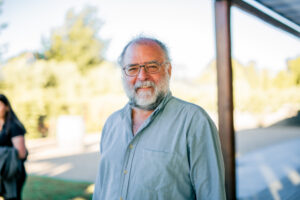
Chair: Prof. Stan Whitcomb
LIGO, American Physical Society (APS) and Optical Society (OSA)
Centre Snapshot
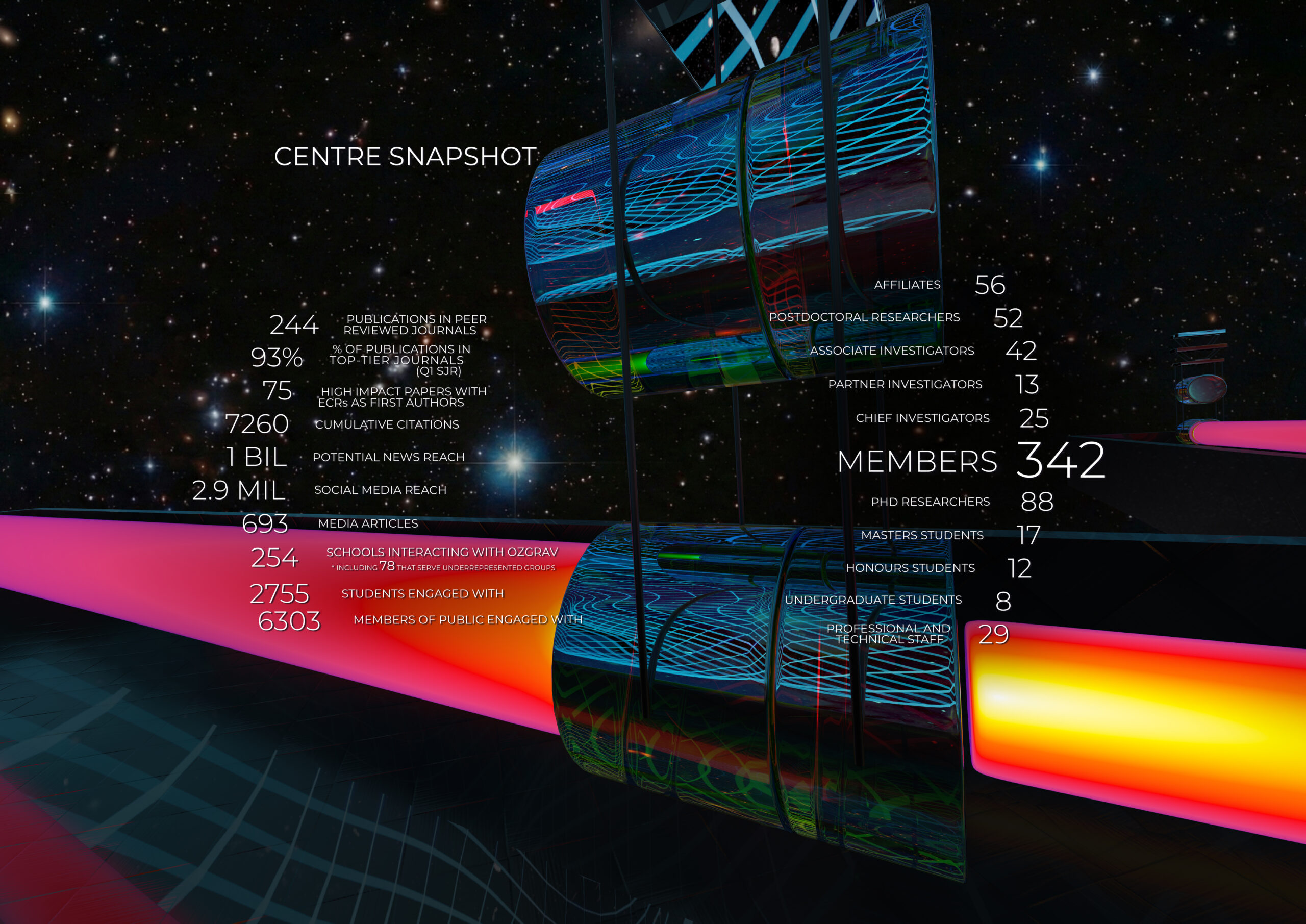
OzGrav Member Breakdown
OzGrav Centre Snapshot
Science Highlights
Blinking radio pulses from space hint at a cosmic object that ‘shouldn’t exist’

Research led by OzGrav PhD student Yu Wing Joshua Lee and supervisor Dr Manisha Caleb at the University of Sydney has uncovered the slowest cosmic lighthouse yet: a long-period radio transient, likely a neutron star, spinning once every 6.5 hours.
This discovery, made using CSIRO’s ASKAP radio telescope and published in Nature Astronomy, pushes the boundaries of what we thought possible for such objects, which typically rotate very quickly. It also reveals a rare phenomenon: the ability to see radio pulses from both of the star’s magnetic poles.
Find out more about the discovery in the paper published in Nature Astronomy: https://www.nature.com/articles/s41550-024-02452-z
You can also read about it in The Conversation: https://theconversation.com/blinking-radio-pulses-from-space-hint-at-a-cosmic-object-that-shouldnt-exist-246663
SHOCK INSIGHTS – WHY OBJECTS IN THE RADIO SKY TWINKLE
It’s one of the first things any of us learn about astronomy: stars twinkle while planets don’t. However, other point-like objects in the radio sky also twinkle, or “scintillate”, including spinning neutron stars known as pulsars. A team led by Australian scientists has used a scintillating pulsar to perform tomography of the interstellar medium in our galaxy, mapping previously unseen layers of plasma, including within a rare structure called a bow shock.
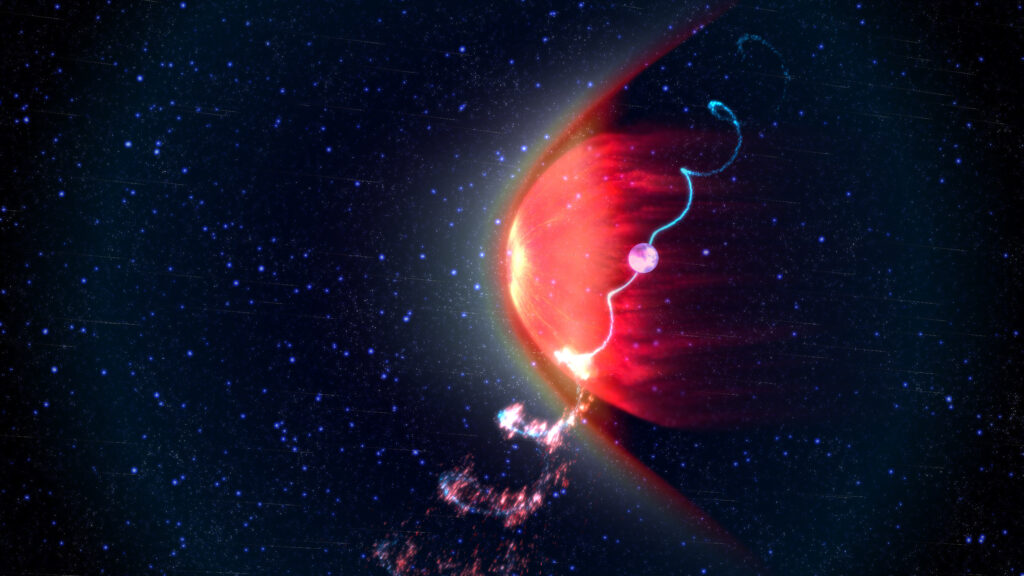
The discoveries, published in Nature Astronomy, challenge existing theories of our local interstellar medium and will lead to new models for pulsar bow shocks.
Read more here → SHOCK INSIGHTS – WHY OBJECTS IN THE RADIO SKY TWINKLE
Astronomers spot nanosecond ‘spark’ from a defunct NASA satellite while looking for Fast Radio Bursts

Astronomers have detected an ultra-bright burst of radio waves from Relay 2, a NASA communications satellite launched in 1964 and silent since 1967. OzGrav Chief Investigator Adam Deller, Professor of Astrophysics at Swinburne University of Technology, was one of the principal authors of the discovery, recently accepted for publication in the Astrophysical Journal Letters.
“This was a chance discovery made when looking for Fast Radio Bursts, which are millisecond-duration radio pulses that originate in distant galaxies. Despite FRBs being discovered almost 20 years ago, we still don’t know what can generate such short and bright radio emission, which is what is driving us to build better and better machines for finding them,” said Prof Deller.
Read more here → Astronomers spot nanosecond ‘spark’ from a defunct NASA satellite while looking for Fast Radio Bursts
LIGO Detects Most Massive Black Hole Merger to Date
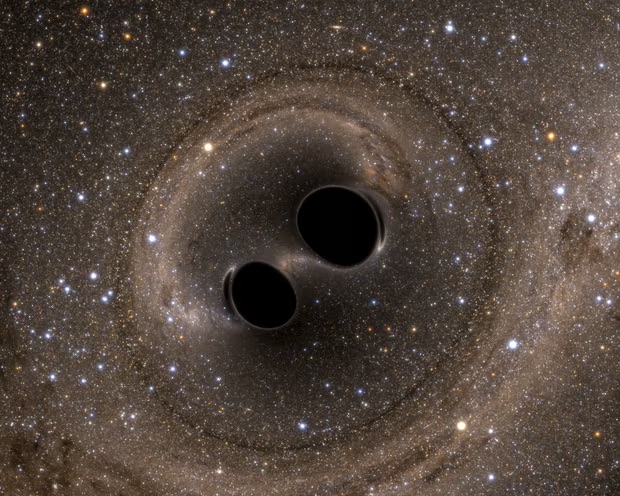
Gravitational waves from record-breaking black holes challenge current astrophysical models
The LIGO-Virgo-KAGRA (LVK) Collaboration has observed the heaviest black-hole merger ever detected, registering gravitational waves from two rapidly spinning giants that coalesced into a single black hole about 225 times the mass of our Sun. Designated GW231123, with “GW” standing for gravitational wave and “231123” for the detection date 23 November 2023, the signal was captured during the fourth LVK observing run and publicly released on Monday, 14 July 2025.
Read more here → LIGO Detects Most Massive Black Hole Merger to Date
Gravity Tests with the Double Pulsar Honoured
2025 Frontiers of Science Award for the international Double Pulsar research team
The research paper “Strong-Field Gravity Tests with the Double Pulsar”, led by OzGrav Partner Investigator Michael Kramer (Max Planck Institute for Radio Astronomy, MPIfR) and including OzGrav Chief Investigator Adam Deller (Swinburne University) along with an international research team, was published in the journal Physical Review X (Kramer et al. 041050, 13 December 2021). Their work received the Frontiers of Science Award in the category “Astrophysics and Cosmology – theory” from the International Congress for Basic Science (ICBS). The award ceremony took place at the China National Conference Center on 13 July 2025.
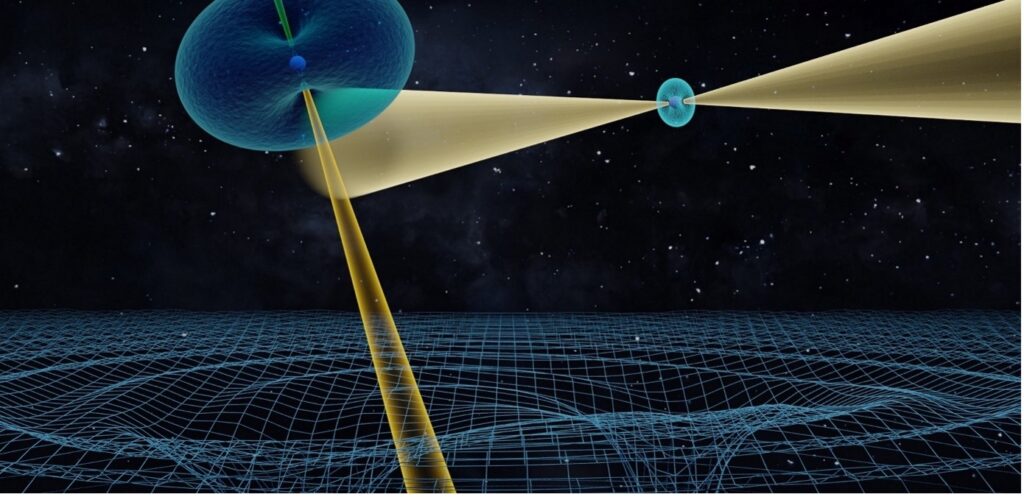
Read more here → Gravity Tests with the Double Pulsar Honoured
A Decade’s Worth Of Gravitational Wave Data Reveals New Black Hole Behaviour
In 1916, Albert Einstein published the paper that predicted gravitational waves – ripples in the fabric of space-time resulting from the most violent phenomena in our distant universe, such as supernova explosions or colliding black holes.
It took a century for Einstein’s theory to be proven when, in September 2015, the newly commissioned Advanced Laser Interferometer Gravitational-Wave Observatory (LIGO) detectors observed gravitational waves resulting from merging black holes approximately 1.3 billion light-years away. This watershed achievement earned three of LIGO’s founding members the 2017 Nobel Prize in Physics.
Today, more than 80 Australian researchers, among over 2,000 scientists globally, have published data on the whole catalogue of gravitational-wave observations accumulated since September 2015. In total, 218 events have been recorded, including three types of binary mergers: binary neutron star, neutron star–black hole, and binary black hole mergers.
Read more here → A Decade’s Worth Of Gravitational Wave Data Reveals New Black Hole Behaviour
Binary stars everywhere: Monash University scientists help rewrite cosmic origin story
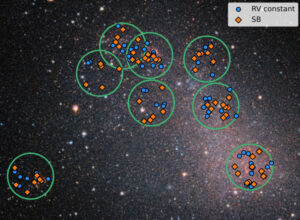
A new international study, published in Nature Astronomy, reveals that massive stars are about as likely to form in close binary systems in the low-metal environments of the early Universe as they are today, reshaping our understanding of stellar evolution and the origins of gravitational-wave events.
The research, led by a global team of astronomers and using the European Southern Observatory’s Very Large Telescope in Chile, studied 139 O-type stars in the Small Magellanic Cloud, a nearby dwarf galaxy with just one-fifth the metallicity of our Sun. The findings challenge previous observations that low-mass stars are more likely to be found in binaries in metal-poor environments than in our Galaxy.
Professor Ilya Mandel, from the Monash University School of Physics and Astronomy and the ARC Centre of Excellence for Gravitational Wave Discovery (OzGrav), co-authored the study, contributing to the statistical analysis testing whether the abundance of binary stars changes with metallicity, the chemical richness of the stars’ environment.
Read more here → Binary stars everywhere: Monash University scientists help rewrite cosmic origin story
Ten years after gravitational wave scientists proved Einstein’s theory, Stephen Hawking’s landmark prediction has also been proven to be true
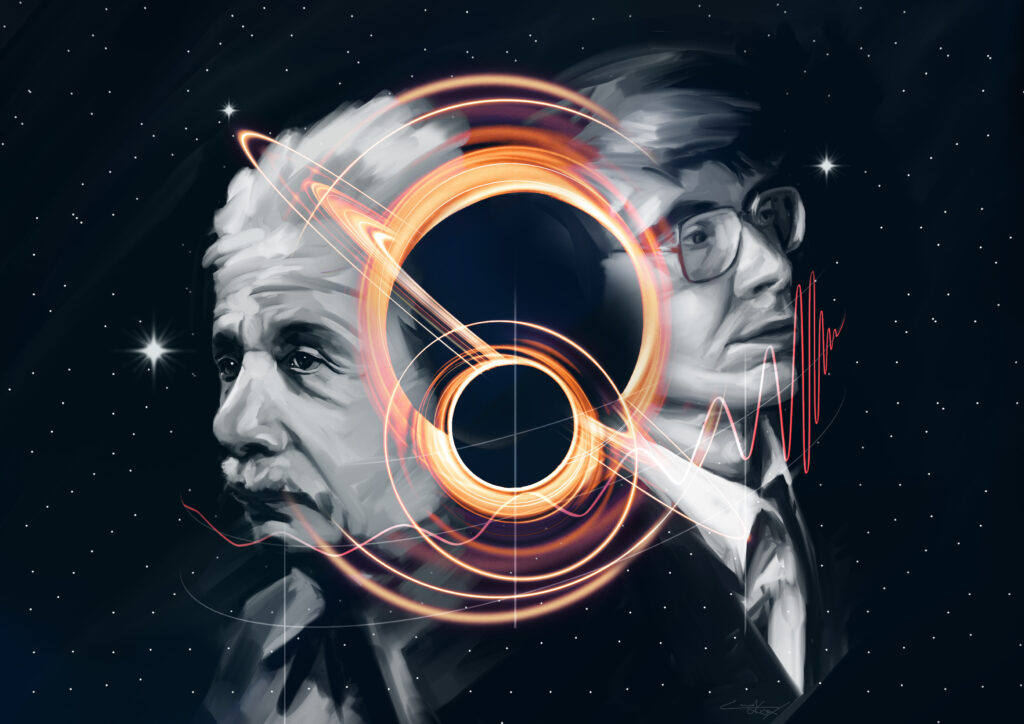
A global team of astrophysicists, including Australians, has witnessed a collision between two black holes that was so loud, they were able to use it to test — and prove — Stephen Hawking’s theory of black hole thermodynamics.
The event, observed by the LIGO, Virgo, and KAGRA collaborations, involved two black holes merging to form a single, larger one, strikingly reminiscent of the historic first detection in 2015. But this time, thanks to a decade of instrumental upgrades and data analysis advances, the signal was captured with three times more clarity, enabling scientists to test two fundamental predictions of black hole physics:
- Black holes obey the laws of thermodynamics — their surface areas always increase, never decrease.
- Disturbed black holes behave exactly as predicted by Einstein’s theory of general relativity.
“Excited black holes are known to ‘ring’ like cosmic bells at precise frequencies. This is the strongest and cleanest black hole ‘note’ we’ve ever heard,” said Neil Lu, a lead Australian author from the Australian National University and the ARC Centre of Excellence for Gravitational Wave Discovery (OzGrav).
Read more here → Ten years after gravitational wave scientists proved Einstein’s theory, Stephen Hawking’s landmark prediction has also been proven to be true
Twin Black Hole Mergers Reveal Secrets of Cosmic Evolution
An international team of scientists from the LIGO, Virgo, and KAGRA collaborations, including researchers from the ARC Centre of Excellence for Gravitational Wave Discovery (OzGrav), has detected two remarkable black hole collisions that are offering new insights into both the evolution of the cosmos and the nature of dark matter.

The pair of gravitational-wave events, named GW241011 and GW241110, were detected in late 2024, just one month apart, during the O4b observing run of the global detector network. Each signal was produced by the violent merger of two black holes, forming an even more massive remnant and sending ripples through space-time, each travelling for hundreds of millions to billions of years before reaching Earth.
Read more here → Twin Black Hole Mergers Reveal Secrets of Cosmic Evolution
A mysterious radio signal from space has been tracked down to an unexpected star
New research, led by OzGrav postdoctoral researcher Dr Iris de Ruiter at the University of Sydney, has uncovered the surprising origin of a mysterious repeating radio signal from space. Rather than coming from a neutron star, long thought to be the only objects capable of producing such pulses, the signal was traced to an unusual stellar pair: a white dwarf and a red dwarf locked in a tight orbit, circling each other every two hours.
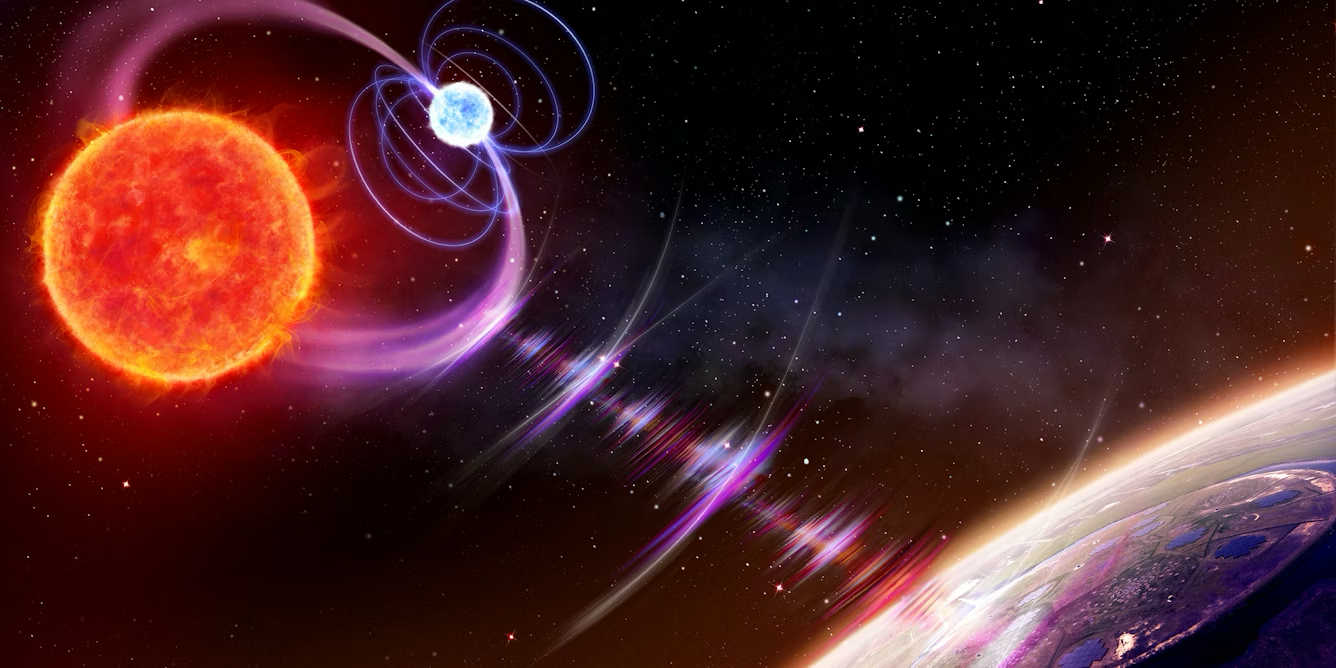
The discovery challenges decades-old assumptions about the kinds of objects that can generate coherent radio pulses and opens a new window on how compact stellar systems behave. By combining long-term observations with detailed analysis, the team was able to pinpoint the source of the signal and show that even relatively low-mass stars can produce powerful, highly structured radio emission under the right conditions.
Read more →
- Nature Astronomy: https://www.nature.com/articles/s41550-025-02491-0
- The Conversation: https://theconversation.com/a-mysterious-radio-signal-from-space-has-been-tracked-down-to-an-unexpected-star-250251
Kicking Neutron Stars from the Nest
Neutron stars don’t stick around for long after they’re born. Recent research has now uncovered just how fast they flee.
They Grow Up So Fast
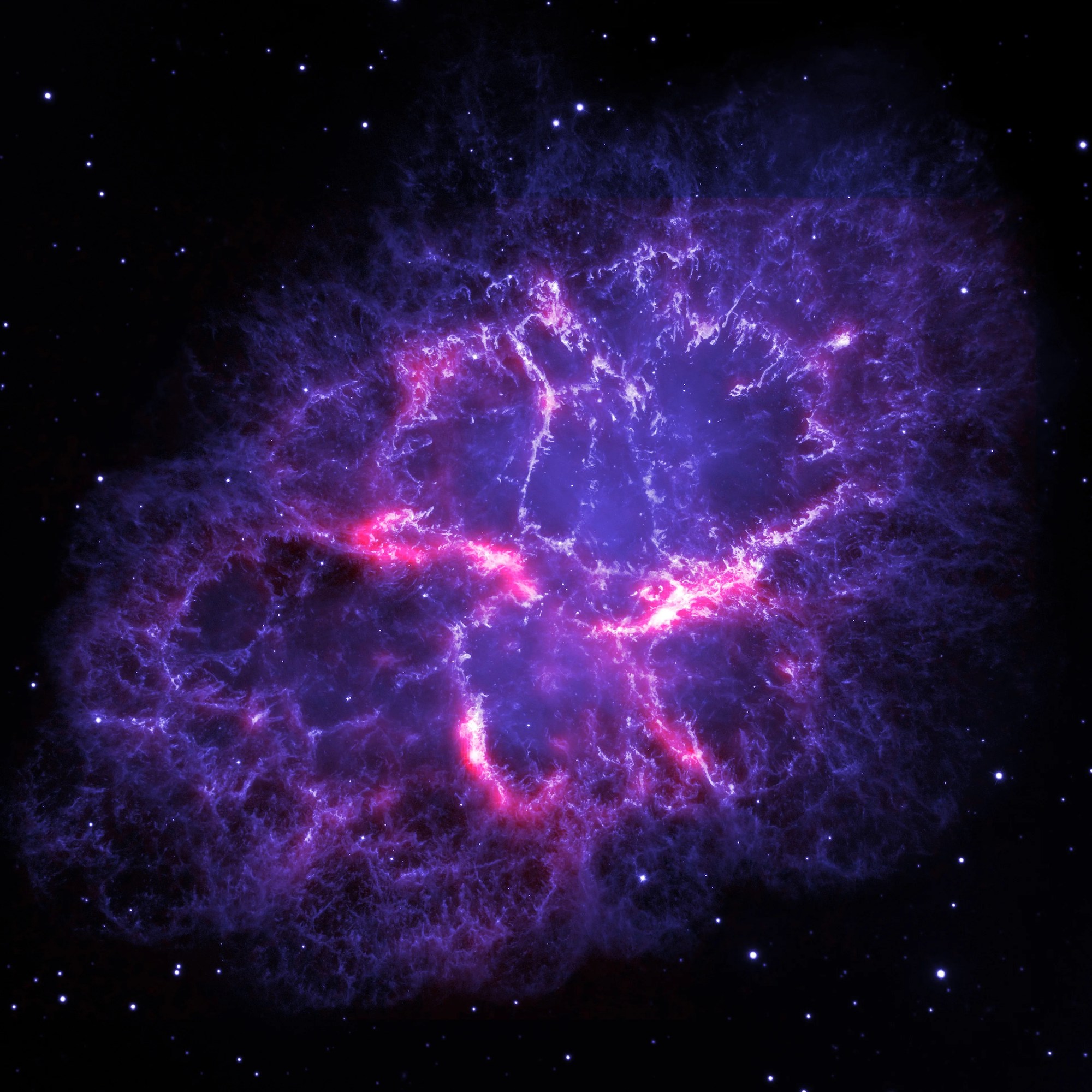
Credit: ESA/Herschel/PACS/MESS Key Programme Supernova Remnant Team; NASA, ESA and Allison Loll/Jeff Hester (Arizona State University)
Human beings require many years of care and support from their parents before they’re able to venture forth into the world. This is an embarrassingly long process compared with the standard for animals like deer and horses, whose offspring are ready to walk mere minutes after birth. However, baby neutron stars, some of the densest objects in the known universe, put all life on Earth to shame with their immediate self-reliance: after a fiery birth from a supernova explosion, these stars flee the site of their creation at hundreds of kilometres per second.
These “natal kicks”, as they’re called in research literature and in recent work by Paul Disberg and Ilya Mandel (Monash University and OzGrav), are a natural consequence of neutron star formation. When a massive star burns through the last of its fuel and surrenders to its own gravity, it collapses inward and compresses its core into a neutron star before rebounding in an explosion. This collapse is never perfectly symmetric, however, and the slight imbalance gives the resulting neutron star a shove.
Read more on the American Astronomical Society (AAS) website → https://aasnova.org/2025/09/24/kicking-neutron-stars-from-the-nest/
OzGrav scientists build low-vibration cryogenic test facility for next generation of ground-based gravitational-wave observatories
Scientists from the ARC Centre of Excellence for Gravitational Wave Discovery (OzGrav) have developed a state-of-the-art cryogenic test facility designed to push the sensitivity of future gravitational-wave detectors to new limits. Published in Review of Scientific Instruments, the team describes a low-vibration cryogenic infrastructure capable of cooling precision optical experiments to 123 Kelvin (–150°C) while maintaining extraordinary stability. Future observatories such as LIGO Voyager and the proposed Einstein Telescope aim to operate at cryogenic temperatures using crystalline silicon mirrors and suspensions to reduce thermal noise, tiny vibrations caused by heat that ultimately limit detector sensitivity.
The OzGrav team successfully radiatively cooled a suspended silicon test cavity to 123 K in approximately 41 hours and maintained temperature stability within ±1 millikelvin over months of operation. At this temperature, silicon’s thermal expansion crosses zero, significantly suppressing thermo-elastic noise. Crucially, the facility achieves a displacement noise floor of around 3 × 10⁻¹⁷ metres per square-root Hertz in the key audio frequency band used by gravitational-wave detectors, enabling direct measurement of broadband thermal noise in crystalline silicon.
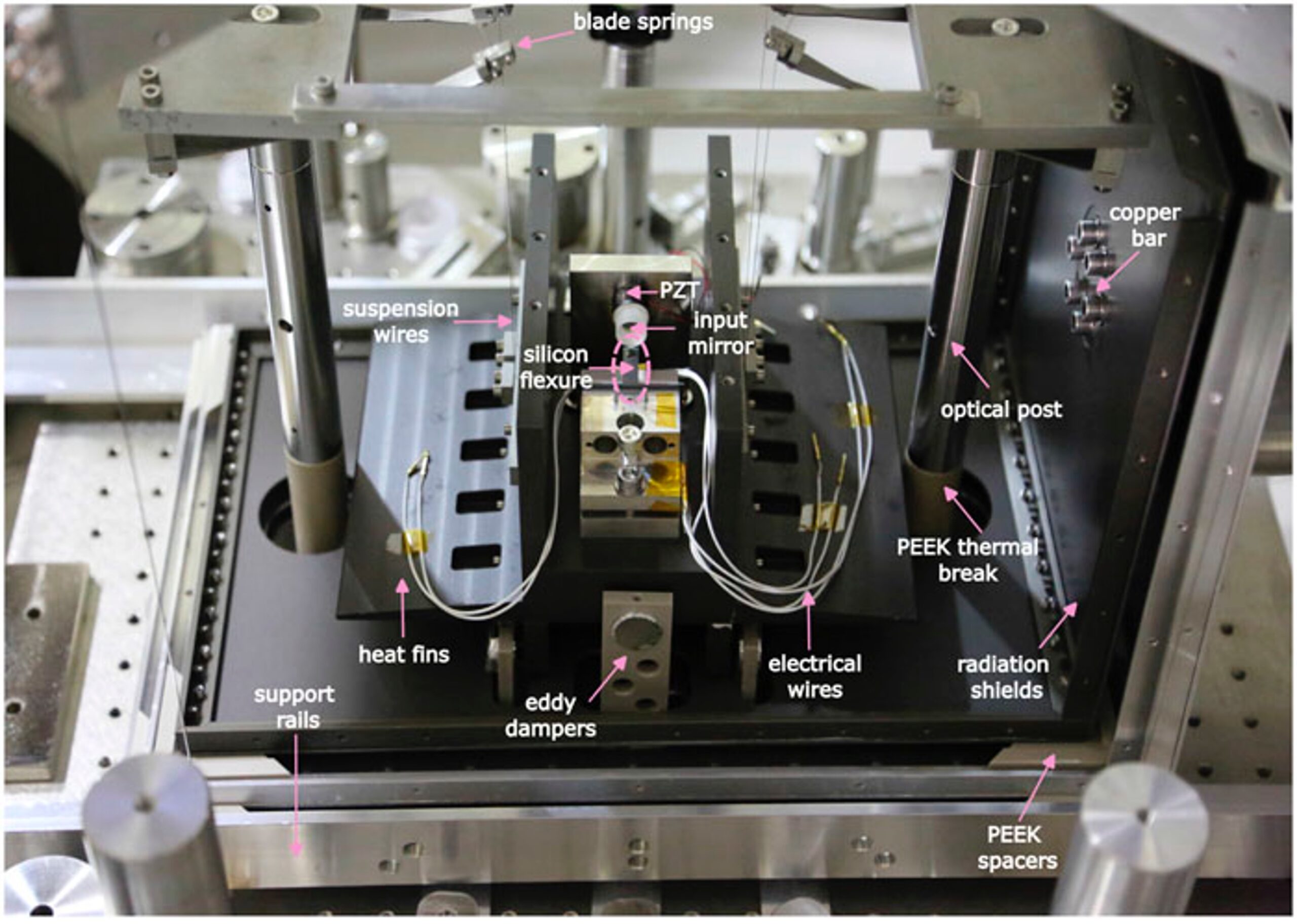
The new infrastructure also provides a platform for testing advanced mirror coatings at cryogenic temperatures, another major challenge for future detectors. By enabling ultra-precise measurements in a low-vibration cryogenic environment, this facility strengthens Australia’s role in developing the technologies that will power the next era of gravitational-wave astronomy, revealing more about black holes, neutron stars and the most extreme events in the Universe.
Read the full paper here: https://doi.org/10.1063/5.0236965
Random conversation leads to innovative dark matter detector design
A random conversation between physicists from different areas has led to a new ultrasensitive device to search for dark matter.
The device is inspired by an instrument designed for mitigating noise in gravitational wave detectors, and will be sensitive to extremely light dark matter particles, around 10-21 times the mass of an electron.
“It’s a very different idea from conventional dark matter detectors – it doesn’t require significant advances in technology to enhance the sensitivity in this mass range, but relies on things we can do already,” said Dr Lilli Sun, the lead author of the paper detailing the design in Physical Review D.
“For the type of tiny particles we aim to look for, our sensor can test an interaction strength about 1,000 times weaker than has already been tested.”
The possible mass of dark matter candidates spans 90 orders of magnitude, from huge black holes down to tiny particles far lighter than any currently known particle. At the light end of this range, the dark matter particles would behave as low-frequency waves.
The new device would be sensitive to this ultra-light, wave-like dark matter, and would explore a frequency range between 0.01 Hz and 10 Hz.
“It began with a random conversation, and then we did some brainstorming,” Dr Sun said.
“The novel design arose because of the interdisciplinary nature of the discussion – it’s a great way to create new ideas.”
Read full article here: https://physics.anu.edu.au/news_events/?NewsID=384
Research Translation Highlights
Building Momentum for Research Translation: ARTIC in 2025

The Australian Research Translation and Innovation Consortium (ARTIC) continued to take shape in 2025, moving from concept development into a focused phase of community building, co-design, and strategic alignment across Australia’s ARC Centres of Excellence (CoEs).
Following the foundational work undertaken in 2024, the emphasis in 2025 shifted towards testing the consortium’s value proposition, strengthening cross-Centre engagement, and ensuring ARTIC’s structure would be genuinely responsive to the needs of researchers, industry, and government partners.
Progress and Community Building in 2025
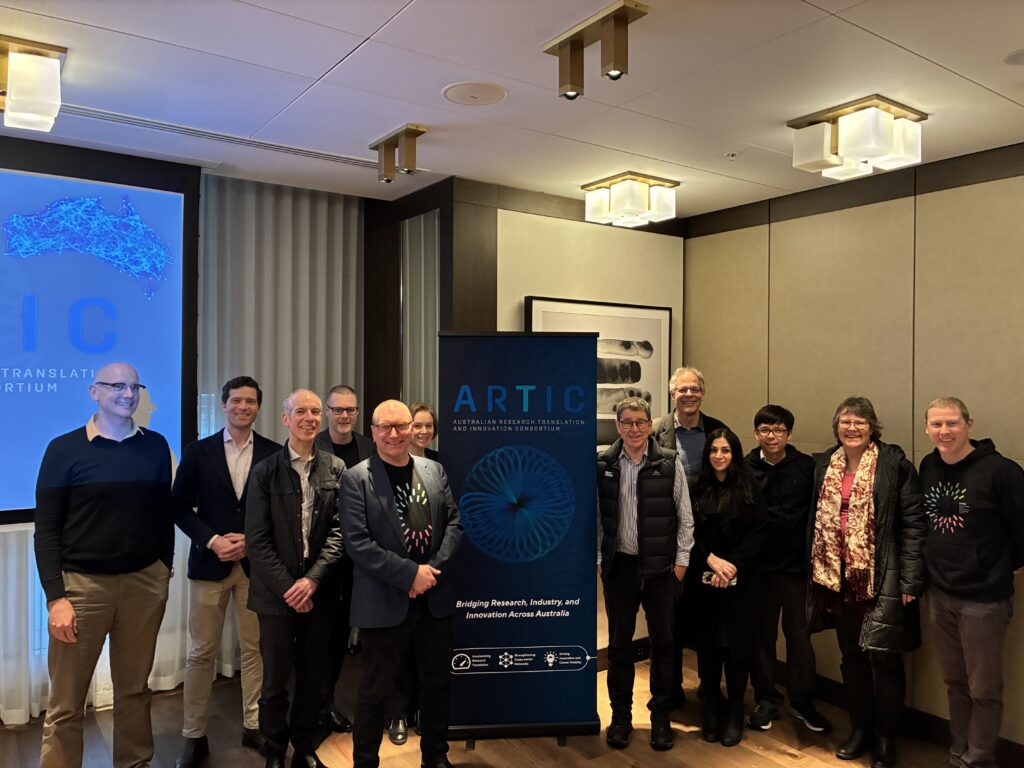
A major milestone in 2025 was the ARTIC workshop held in Melbourne at The Ritz Carlton, which brought together representatives from multiple ARC Centres of Excellence, alongside stakeholders with experience in research translation, commercialisation, and industry engagement.
The workshop provided a valuable forum to openly discuss shared challenges, opportunities, and gaps in Australia’s research translation ecosystem.
Discussions at the workshop reinforced a strong appetite for a cross-Centre consortium focused on:
- lowering barriers to industry engagement,
- sharing translation expertise and resources across Centres,
- and creating clearer pathways from research excellence to real-world impact.
Importantly, the workshop also highlighted the need to take a staged, co-designed approach to ARTIC’s development — prioritising trust, clarity of purpose, and practical value over rapid rollout.
Establishing the ARTIC Working Group
Building on this momentum, a formal ARTIC working group was established in 2025 to guide the consortium’s next phase of development. The working group brings together representatives from participating CoEs and provides a mechanism for collaborative decision-making on ARTIC’s governance, scope, and priority activities.
Throughout the year, the working group focused on refining ARTIC’s mission, identifying early-stage pilot activities, and clarifying how the consortium can complement, rather than duplicate, existing Centre-based translation efforts. This work has been critical in ensuring ARTIC develops as a shared national asset, shaped by its members and grounded in practical needs.
Looking Ahead: ARTIC in 2026
With strong foundations now in place, 2026 will mark a transition from planning to action for ARTIC. Key priorities for the coming year include:
- formalising ARTIC’s operating model and governance arrangements,
- piloting targeted translation activities and cross-Centre initiatives,
- expanding engagement with industry and government partners,
- and developing shared resources to support researchers across participating Centres.
Rather than a single “launch moment,” ARTIC is progressing as a deliberately staged initiative, designed to grow sustainably and deliver long-term value for Australia’s research translation ecosystem.
Through this measured approach, ARTIC is positioning itself to play a meaningful role in strengthening collaboration across ARC Centres of Excellence and accelerating the translation of world-leading research into societal, economic, and national benefit.
Future Plans
In 2026, the Australian Research Translation and Innovation Consortium (ARTIC) will officially launch, marking a new chapter in collaborative research translation and innovation. The consortium will bring together STEM-based Centres of Excellence to collaborate on shared challenges and opportunities, fostering a united effort to advance research impact. ARTIC will host its inaugural Research Translation and Innovation Conference, bringing together researchers, industry leaders, and government representatives to showcase cutting-edge research and foster meaningful partnerships.
The consortium will also expand its resource library, providing a centralised hub of training materials, industry insights, and commercialisation tools. Through regular events, workshops, and networking opportunities, ARTIC aims to strengthen research translation efforts and create impactful collaborations across the research, industry, and government sectors, contributing to OzGrav’s mission to deliver societal and economic impact.
Speed-of-Light Sensors: Australian Researchers Pioneer Global Earthquake and Tsunami Early Warning Technology
Australia may be far from the world’s seismic hotspots, but a team from the ARC Centre of Excellence for Gravitational Wave Discovery (OzGrav) at the Australian National University (ANU) is leading a breakthrough that could transform how earthquakes and tsunamis are detected worldwide. With $671,000 in new funding from the Australian Research Council’s (ARC) Discovery Projects (DP) scheme, Professor Bram Slagmolen and colleagues are developing technology capable of detecting earthquakes almost as soon as they happen at the speed of light.
When earthquakes strike, devastation can unfold in minutes or even seconds…
Read more here: Speed-of-Light Sensors: Australian Researchers Pioneer Global Earthquake and Tsunami Early Warning Technology
Seeing the Unseeable: Translating Gravitational-Wave Technology to Industry
2025 ARC Linkage Project – University of Western Australia
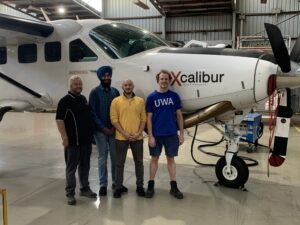
The UWA team with Xcalibur and a Cessna 208 aircraft. From left to right: Eric Steele (Xcalibur R&D engineer), Joogroop Singh (UWA MSc student), Aidan Loasby (UWA PhD student), Andrew Sunderland (UWA research fellow). Credit: Andrew Sunderland.
OzGrav Chief Investigators Professor Ju Li and Professor Chunnong Zhao, together with Associate Investigator Professor David Blair, were awarded a 2025 ARC Linkage Project in partnership with Industrial Pattern Xcalibur. This project builds on a long-standing collaboration between the University of Western Australia and the industry partner, focused on applying precision measurement technologies developed for gravitational-wave detection to real-world challenges in airborne geophysical surveying.
Gravitational-wave detectors are designed to measure extraordinarily small signals by isolating and removing environmental noise, from ground vibrations to distant seismic activity. These same techniques are now being adapted to improve airborne survey systems used in mineral and resource exploration, where sensor arrays are towed behind aircraft to detect subtle variations beneath the Earth’s surface.
Previous work in this collaboration has already demonstrated significant impact, reducing vibration in airborne instruments by a factor of ten and enabling more stable and sensitive measurements. These advances have the potential to allow mineral deposits to be detected at greater depths and with higher accuracy, improving exploration efficiency and reducing costs for industry.
The new ARC Linkage project addresses the next critical challenge: improving the positional accuracy of airborne receivers to further reduce uncertainty in survey data. By enhancing the precision of these systems, the project aims to deliver more reliable subsurface imaging and support better decision-making in resource exploration.
This work highlights the powerful translation of fundamental physics into industry applications, demonstrating how technologies developed to observe the most distant events in the Universe can be repurposed to better understand what lies beneath our own planet.
Read more here: OzGrav and Xcalibur multiphysics seeing the unseeable
Equity, Diversity and Inclusion Highlights
Fostering Indigenous Talent in STEM
Aboriginal and Torres Strait Islander knowledge of astronomy represents over 65,000 years of continuous connection to the skies and remains a vital part of Australia’s cultural heritage. However, Indigenous representation in astronomy remains low, with broader disparities in higher education participation.
This year, OzGrav was involved in two programs supporting Aboriginal and Torres Strait Islander high school students in STEM, each with a distinct focus. The MTC Future Aspirations Camp, co-resourced by OzGrav and led by Swinburne’s Moondani Toombadool Centre (MTC), offered a broad introduction to university life across five days. The Indigenous Work Experience Program (IWEX) is OzGrav and Swinburne’s own dedicated program, a full week of immersion specifically in astrophysics research.
Moondani Toombadool Centre (MTC) Future Aspirations Camp – January 2025
In January 2025, ten Aboriginal and Torres Strait Islander students were immersed in university life through the MTC Future Aspirations Camp, hosted by Swinburne’s Moondani Toombadool Centre and OzGrav HQ.
The camp, which provided a fully accommodated five-day university experience at no cost to families, aimed to demystify university by connecting students to STEM, culture and campus life, while exploring diverse post-school pathways.
The camp cultivated a strong connection to community and culture through its collaboration with the Wurundjeri Woi Wurrung Council and Swinburne Elder in Residence, Aunty Miranda Madgwick.
OzGrav was involved on the first and fourth days. Students explored the Universe through virtual tools and toured the Ngarrgu Tindebeek supercomputer. The fourth day included a session with Wiradjuri astrophysicist and science communicator Dr Kirsten Banks, who led an informal discussion about her career, field, and experiences.
The session successfully engaged students, sparking genuine curiosity and interest. Students connected strongly with the panellists’ varied career journeys and the value placed on diverse approaches to learning and problem-solving in research. A particular highlight was students being gifted copies of The First Scientists by OzGrav facilitators. Their excitement was a clear sign of a meaningful connection to astronomy and Indigenous science. Mentors and facilitators also responded positively to the session.
Indigenous Work Experience Program (IWEX) – July 2025
The IWEX program provides Aboriginal and Torres Strait Islander students with hands-on exposure to astrophysics while recognising the legacy of the world’s first astronomers. Originally established by the ARC Centre of Excellence for All Sky Astrophysics in 3D (ASTRO 3D), the program was delivered at Swinburne in partnership with ASTRO 3D and OzGrav, with OzGrav committed to supporting its continuation following ASTRO 3D’s conclusion.
In July 2025, seven students in Years 10–12 from across Australia participated in a week-long program at Swinburne University. Guided by Wiradjuri astrophysicist Dr Kirsten Banks and Gomeroi astrophysicist Krystal De Napoli, students undertook research activities, toured advanced facilities including the supercomputer and virtual reality labs, and explored connections between contemporary science and Indigenous oral traditions. The program also included engagement with the Moondani Toombadool Centre and Aboriginal and Torres Strait Islander academics, alongside cultural visits to the Melbourne Museum and Bunjilaka Aboriginal Cultural Centre.

A highlight of the week was the student-led research presentations, in which participants independently explored an area of astronomy and communicated their findings through storytelling, honouring the role narrative plays in encoding Aboriginal and Torres Strait Islander scientific knowledge. Topics included quasars, black holes, and the relationship between culture and the night sky.
Reflecting on the week, program lead Professor Emma Ryan-Weber noted that the final presentations were exceptional and that students had grown visibly over the course of the program.
The IWEX program aligns with OzGrav’s equity, diversity, and inclusion goals of supporting pathways for Indigenous students into STEM, fostering culturally inclusive research environments, and strengthening engagement with Aboriginal and Torres Strait Islander communities.
OzGrav Awarded Gold Pleiades Award

OzGrav was awarded a Gold Pleiades Award in 2025, recognising the Centre’s sustained leadership and commitment to equity, diversity, and inclusion (EDI) across all aspects of its operations. The award, conferred by the Astronomical Society of Australia’s Inclusion, Diversity and Equity in Astronomy (IDEA) Chapter, represents the highest level of accreditation under the Pleiades framework.
The assessment panel commended OzGrav for its comprehensive and transparent approach to embedding EDI principles throughout the Centre. The application was noted for its depth, clarity, and evidence-based reflection, demonstrating a mature and well-integrated EDI strategy aligned with OzGrav’s broader mission. In particular, the panel highlighted the strength of ongoing programs, including annual workshops and regular community engagement activities that contribute to a supportive and inclusive environment.
The panel also recognised OzGrav’s responsiveness to feedback, noting a strong culture of continuous improvement, with the Centre actively reflecting on its practices and taking meaningful action to advance inclusion. OzGrav’s EDI initiatives continue to play a central role in fostering a collaborative and respectful research community across its national network.
As part of the assessment, the panel identified opportunities for further enhancement, including increasing visible senior leadership participation in EDI governance structures. OzGrav will build on this feedback as part of its ongoing commitment to strengthening EDI practices and ensuring these values are embedded at all levels of the Centre.
The Gold Pleiades Award reflects OzGrav’s sustained investment in building an inclusive research culture and reinforces its leadership within the Australian astronomy community in advancing equity and inclusion in STEM.
Workshops and Training
Understanding Neurodiversity
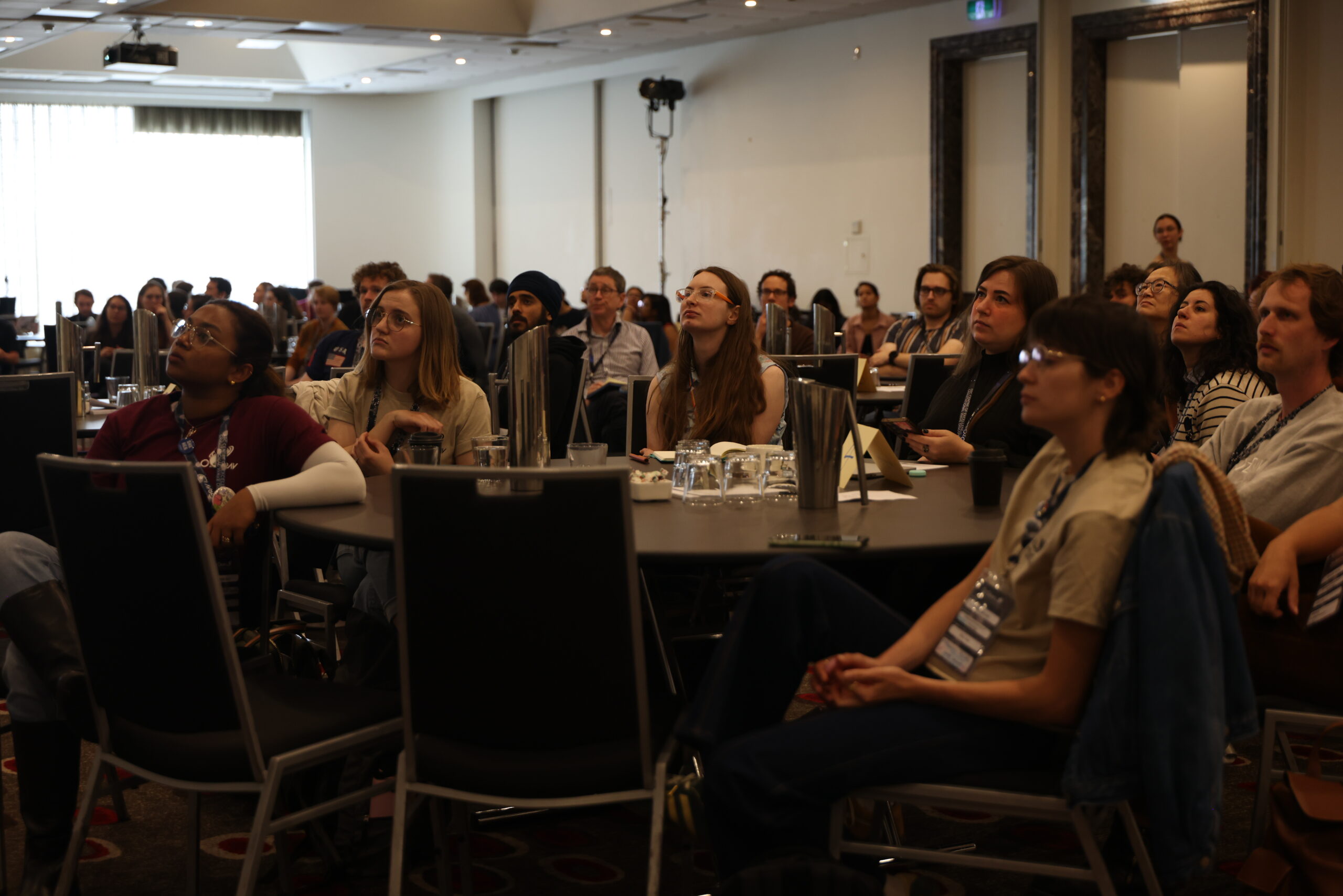
In 2025, OzGrav delivered its first neurodiversity workshop, Understanding Neurodiversity, at the annual retreat, open to all centre members. With at least 91 OzGrav members in attendance, the session was developed in direct response to OzGrav members’ requests, reflecting a genuine appetite for this kind of learning across the centre.
In a 90-minute session, the focus was intentionally on the foundations: how we think and talk about disability and neurodivergence, and where those ways of thinking come from. Building awareness and shifting how we approach neurodivergence matters as much as any practical strategy. When people have the language and frameworks to think differently about disability and neurodivergence, it changes how they show up in their teams, their supervision, and their everyday interactions, and that is where culture actually shifts.
With that in mind, the workshop traced the history of disability in Australia, including Indigenous perspectives on human diversity that predate and challenge colonial frameworks, and covered language and neuro-affirming communication, masking and why it matters for wellbeing and belonging, and the double empathy problem. It was designed as the first step in an ongoing journey, with the intention of building toward more contextual and hands-on learning in future years.
Mental Health and Wellbeing
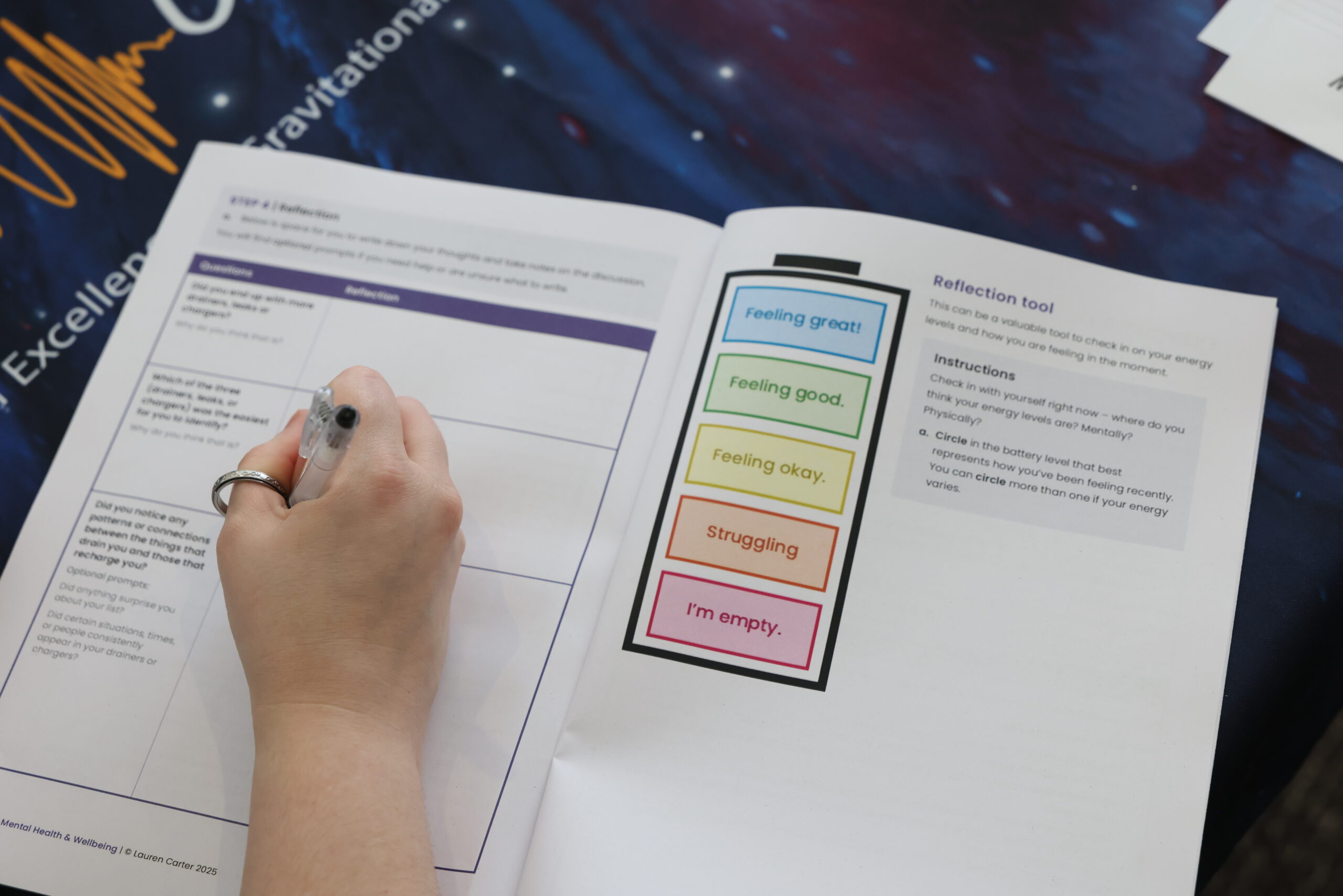
The Mental Health and Wellbeing workshop was facilitated as part of the 2025 ECR Workshop, with 94 participants attending. In a 90-minute session, Early Career Researchers were given space to actually pause and look at what they were carrying.
Through guided, facilitated exercises, participants reflected on how they were spending their time, what was driving their choices, and what they genuinely needed to feel steady and supported, rather than just what they felt they should be doing. The format of the workshop meant that participants were supported to identify the practical supports and structures that could work for them, captured in their own Support Pillars.
The workshop was designed with a neuro-affirming approach throughout, recognising that people engage with and process topics like this in different ways, with participants invited to come as they are and engage in whatever way felt right for them. A companion handout was developed alongside the session so participants could return to the exercises independently whenever they needed.
One learning from this session was that timing and setting shape how people can engage with topics like mental health and wellbeing. Holding this kind of session at the start of an intensive retreat week in a professional setting can make it harder to create the conditions people need to genuinely reflect and open up. Future sessions will look at different formats, timing, and settings to better support that.

2025 Progress
- Along with eight other Centres of Excellence, OzGrav were proud to co-organise the very successful inSTEM 2025 workshop for under-served groups in STEM and their allies, described in more detail in the Professional Development section.
- OzGrav was involved in two programs supporting Aboriginal and Torres Strait Islander high school students in STEM in 2025 (both described in more detail above):
- OzGrav partnered with Swinburne’s Moondani Toombadool Centre on the MTC Future Aspirations Camp, a fully accommodated five-day university experience connecting students with STEM, culture, and campus life at no cost to families, with two of the five days focused on astronomy and astrophysics.
- OzGrav and the Swinburne Centre for Astrophysics ran the 2025 Indigenous Work Experience Program (IWEX), which continues to grow in impact, with former IWEX students now returning as mentors for more junior Indigenous students.
- OzGrav was delighted to be awarded the Gold Pleiades Award by the Astronomical Society of Australia’s IDEA Chapter, as described above. This is the highest level of the Pleiades Award, and it recognises our sustained commitment to equity, diversity and inclusion, as well as the collective effort of the OzGrav community.
- OzGrav was honoured to partner with Wurundjeri artist Colin Hunter Jr Jr on his creation of “Infinite Pathways”, a striking artwork composed of many tiny dots - representing each of us on planet Earth – connected by pathways that can lead to infinite possibilities. The nature of the design echoes what astronomers see when they peer into the night sky, and draws on themes of journey and interconnected knowledge systems. This collaboration builds on OzGrav’s ongoing relationship with the Hunter family, following earlier work with Uncle Colin Hunter Jr on artwork accompanying the Centre’s Acknowledgement of Country at the entrance to OzGrav headquarters.
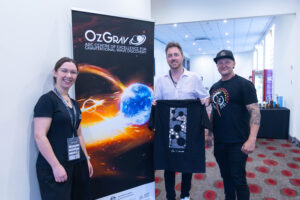
- Infinite Pathways was officially launched at the OzGrav 2025 Annual Retreat as a special commemorative t-shirt. The launch followed a Welcome to Country from Uncle Shane Clarke and a didgeridoo performance by Ganga Giri, creating a powerful and reflective setting. Colin Hunter Jr Jr then introduced the artwork, sharing the story behind its creation in a moving address that resonated strongly with attendees.
- OzGrav delivered neurodiversity and mental health and wellbeing workshops to centre members in 2025, with a combined attendance of over 185 participants. Both workshops were developed with a neuro-affirming, people-centred approach and are described in more detail above.
- OzGrav nodes held ECR social gatherings across the centre, supporting connection and community building among Early Career Researchers.
- OzGrav provided ongoing individual support to members navigating accessibility, wellbeing, and inclusion needs, offering practical guidance and connecting people with relevant resources and pathways across the centre and their home institutions.

Future Plans
- We will finalise and launch our EDI Action Plan, articulating strategic goals, metrics, and priorities to guide future efforts.
- We will continue to expand the Members Portal to provide members with more information and enhanced functionality.
- We will continue to run the annual Indigenous Work Experience Program (IWEX) and be involved in Indigenous STEM camps, with the aim of expanding our reach over time.
- We will rerun our culture survey, last completed in 2023, to track progress and guide our Equity, Diversity and Inclusion planning and broader centre culture.
- We will strengthen formal support pathways and embed support across nodes to promote wellbeing, raise awareness, and provide local points of contact.
- We will continue to develop and deliver training and workshops that are both responsive to member feedback and proactive in addressing emerging needs.
- We will broaden community-building initiatives to enhance member connection and inclusion, including informal gatherings, learning lunches, and journal clubs.
- We will explore new ways for members to actively engage with equity, diversity and inclusion across the centre.
Professional Development Program
OzGrav Winter School 2025
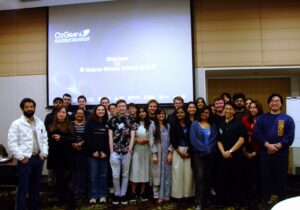
OzGrav 2.0 delivered its first Winter School in Kingscliff, NSW, on Bundjalung Country, bringing together nearly 40 participants from across Australia and New Zealand. The majority of attendees were early career researchers, alongside students and senior researchers, reflecting OzGrav’s strong focus on training, skills development, and community building. Despite overcast conditions at the outset, the event was characterised by high levels of enthusiasm and engagement, with participants eager to connect with new collaborators and peers.
The program opened with an Acknowledgement of Country, highlighting the importance of Indigenous perspectives in communicating astronomy. Sessions spanned OzGrav’s key research areas, including LIGO instrumentation and control systems, pulsar timing and the Shapiro delay, and cosmology, alongside recent results from DESI on dark energy. Hands-on activities, such as designing model interferometers to explore noise mitigation, and practical training in developing custom Python tools, supported participants to build technical capability in line with OzGrav’s training and research excellence goals.
The Winter School also placed strong emphasis on professional development and inclusive culture. Sessions led by postdoctoral researchers on work–life balance and mental health created space for open discussion, while interactive outreach and communication activities encouraged participants to think critically about engagement beyond academia. Informal and creative elements, including a “PowerPoint Bingo” session, helped foster a collaborative and supportive environment. As organisers reflected, the event provided “a welcoming and collaborative environment where participants could learn from each other, share ideas, and build lasting connections across the OzGrav network”.
Participant feedback was overwhelmingly positive, with strong interest in future Winter Schools. The event directly supports OzGrav’s goals in training the next generation of researchers, fostering cross-node collaboration, and strengthening an inclusive and connected research community.
inSTEM workshop 2025: building a more inclusive future in STEM
OzGrav was a lead organiser and co-sponsor of inSTEM 2025, a national conference led by the ARC Centres of Excellence to advance equity, diversity, and inclusion across the STEM sector. Held over two days in Melbourne, the conference brought together more than 130 members from Centres of Excellence across Australia, including more than 15 OzGrav members spanning students, Chief Investigators, and professional staff. OzGrav was one of nine Centres that collaboratively organised the event, reflecting a shared commitment to driving cultural change across the research community.
OzGrav members were deeply involved in all aspects of the event, contributing not only as attendees but also as organisers, program contributors, and session chairs. OzGrav staff played key roles in shaping the conference agenda and facilitating discussions, helping to ensure a strong focus on actionable outcomes and meaningful community engagement.
The program combined keynote talks, panels, and interactive workshops focused on topics such as inclusive leadership, allyship, mentoring, career development, and supporting underrepresented groups in STEM. The conference provided a safe and inclusive space for participants to share lived experiences, build professional networks, and develop strategies to support both individual career progression and broader cultural change.
Reflecting on the opening keynote, OzGrav’s Senior Communications and Engagement Advisor, Diana Haikal, noted: “Prof Emma Lee’s opening keynote was a real highlight of the conference. Her reflections on decades of work in Indigenous affairs, and her powerful framing of ‘love bombing’ as a strategy for change, deeply resonated with the audience. It was a compelling reminder that creating impact is not just about presenting evidence but about building relationships, trust, and a genuine sense of connection. Her talk was both empowering and energising, inspiring attendees to become active advocates for Indigenous rights, including within their own organisations, research practices, and communities.”
OzGrav’s leadership and active participation in inSTEM 2025 reflects our ongoing commitment to equity and inclusion, and our role in strengthening collaboration across Centres of Excellence to help build a more inclusive, connected, and sustainable STEM community.





2025 Progress
- Our students and postdoctoral researchers were lead authors on 75 high-impact peer-reviewed papers in 2025, out of a total of 244 peer-reviewed Centre publications. This is an outstanding achievement and reflects our proactive commitment to providing leadership opportunities for early career researchers and building Australian capacity in our discipline and related industries.
- We delivered training and professional development sessions on 30 topics throughout the year, including during the ECR Workshop and Winter School.
- The 2025 Early Career Researcher Workshop was held on 24–25 November. The program focused on interactive sessions, networking opportunities, and team-building activities, providing a space for early career researchers to connect, share experiences, and develop collaborations within the OzGrav community. Feedback from the 100+ attendees was overwhelmingly positive, with many commending the highly practical and hands-on training sessions, engaging workshop formats, and strong opportunities for networking and collaboration across nodes.
- Eight of our early career researchers received competitive external awards in 2025, in addition to OzGrav’s own awards. This is a testament to their exceptional talent, dedication, and hard work.
Future plans
- We will continue to grow the pool of mentors in our joint Centres of Excellence mentoring program and encourage all OzGrav members to sign up as a mentee, mentor, or both.
- We will further develop and implement a multi-year professional development plan that equips our members with skills in research translation, industry engagement, commercialisation, leadership, communication, and inclusive practice, ensuring they are well prepared for diverse and impactful careers.
- We will support our early career researchers to plan an innovative and constructive 2026 ECR Workshop and Winter School.
- We will continue to promote students and postdoctoral researchers into leadership roles on publications, Centre programs and committees, and international working groups.
- We will raise awareness of, and encourage uptake of, the grant opportunities available within the Centre, including the Research & Innovation Grant and the Professional Development Grant.
- We will develop a structured cross-nodal collaboration program that connects students with research projects at other nodes. The program will support short-term collaborations that enable students to gain new technical and research skills, strengthen networks across the Centre, and foster new joint publications and research outcomes. By creating more systematic opportunities for cross-node engagement, the initiative will further integrate the Centre’s national research capability.
Education and Outreach Highlights
Education and Outreach Program Overview
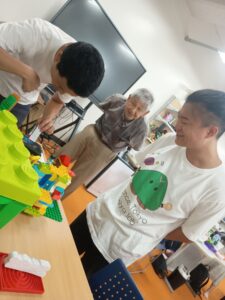
In 2025, OzGrav delivered a comprehensive national education and outreach program, connecting cutting-edge gravitational-wave research with students, educators, and the broader community. The program combined curriculum-aligned learning, public engagement, and science communication training to reach diverse audiences across Australia.
This work was delivered through a collaborative model involving both dedicated education staff and OzGrav Outreach Ambassadors, ensuring that activities were pedagogically robust while remaining closely connected to current research.
School students remained a central focus of the program, particularly at the secondary level where there is strong demand for curriculum-aligned physics engagement. At the same time, OzGrav engaged teachers through professional learning initiatives designed to support long-term classroom impact, while public audiences and families were reached through interactive and immersive experiences.
A key strength of the program is its ability to deliver both immediate impact and sustained influence. By supporting educators and building communication capacity within the research community, OzGrav ensures that its outreach extends well beyond individual events.
National Reach and Accessibility
In 2025, OzGrav’s outreach activities were delivered across metropolitan, regional, and remote locations, as well as through online platforms. This blended delivery model enabled broad national reach and ensured accessibility for communities with varying levels of access to STEM opportunities.
Regional and remote engagement remained a priority, with school visits and partnerships extending the program beyond major cities and into communities where opportunities to interact directly with research scientists are often limited.
Equity and Inclusion
Equity and inclusion continued to underpin OzGrav’s outreach strategy in 2025. Across the Centre, approximately 31% of school engagements involved institutions serving traditionally underrepresented communities, including regional and remote schools, low socioeconomic communities, schools supporting Indigenous students, and girls’ schools.
Within programs led by OzGrav headquarters, this proportion was significantly higher, with approximately 88% of engagements reaching underserved communities. This reflects a targeted approach within flagship programs, complementing broader Centre-wide outreach activities.
Together, these efforts demonstrate OzGrav’s commitment to broadening participation in physics and ensuring that students from diverse backgrounds have access to high-quality science engagement and pathways into STEM.
Education Research and Program Development
In 2025, OzGrav also undertook scoping work for a new education research initiative in collaboration with Nobel Laureate Professor Brian Schmidt. This work focused on exploring how best to evaluate and strengthen the impact of outreach programs, with an emphasis on evidence-based approaches to science education and long-term engagement outcomes.
This initiative represents an important step towards embedding research-informed practice within OzGrav’s outreach strategy and strengthening the Centre’s contribution to national education outcomes.
A Research-Connected Delivery Model
OzGrav’s outreach model integrates the expertise of professional education staff with the knowledge and enthusiasm of researchers and Outreach Ambassadors. This approach enables scalable delivery across Australia while maintaining strong connections to current research.
It also provides valuable professional development opportunities for early career researchers, supporting the development of communication skills and fostering a culture in which outreach is embedded within the research community.




Public Lectures
Dr Katie Mack – Tiny Beginnings. Catastrophic Endings. One Unforgettable Night.
A highlight of the year was a special public lecture featuring internationally renowned astrophysicist Dr Katie Mack, who presented The End of Everything (Astrophysically Speaking). The event drew strong public interest, offering audiences a compelling exploration of the ultimate fate of the Universe and showcasing complex cosmology through engaging and accessible storytelling.
For those who missed the event, a recording of the session is available online: Tiny beginnings. Catastrophic endings. One unforgettable night – Public Lecture featuring Dr Katie Mack
National Science Week – Decoding the Universe
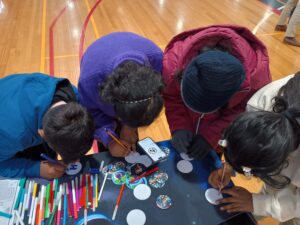
As part of National Science Week 2025, OzGrav hosted Decoding the Universe at Swinburne University, combining hands-on outreach activities with a dynamic panel discussion. The event featured interactive science stations for families alongside a panel exploring how scientists interpret the cosmos through gravitational waves, radio astronomy, and cultural star knowledge.
The event highlighted OzGrav’s commitment to inclusive and engaging science communication, with participation from researchers, students, and Outreach Ambassadors.

Science Communication Panel: Telling the Stories of the Universe
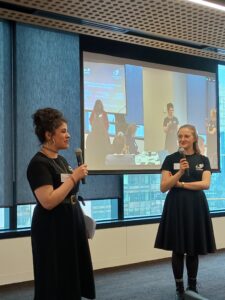
OzGrav delivered a dedicated science communication panel bringing together leading voices in astrophysics outreach. The session explored how complex scientific ideas can be translated into compelling narratives, emphasising the importance of storytelling, audience engagement, and the evolving role of researchers as communicators.
For those who missed the event, a recording of the session is available online: Science Communication Panel: Telling the Stories of the Universe
The Role of Serendipity in Scientific Discovery
OzGrav also hosted a public lecture exploring the role of unexpected discoveries in advancing science. The event highlighted how chance observations and creative thinking have led to some of the most significant breakthroughs in astrophysics, reinforcing the importance of curiosity-driven research.
For those who missed the event, a recording of the session is available online: The Role of Serendipity in Scientific Discovery
OzGrav Outreach Ambassador Program
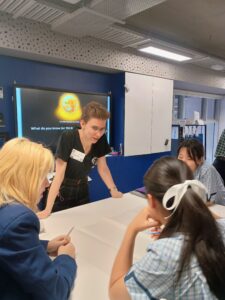
The OzGrav Outreach Ambassador Program continued to grow in 2025, empowering early-career researchers to actively participate in science communication and public engagement. Ambassadors delivered outreach activities across multiple institutions, supported public events, and contributed to school programs.
The inaugural cohort of Outreach Ambassadors has already made a strong impact, visiting schools, participating in conferences, and engaging communities across Australia. From guiding virtual reality experiences to presenting their research to students, ambassadors are helping make OzGrav’s science more accessible and inspiring.
📸 Meet the ambassadors who are taking science beyond the lab and into the community.

Future Plans
As OzGrav continues to grow, the Education and Outreach program remains committed to expanding its impact and engaging diverse audiences across Australia. In 2026, key priorities include:
- OzGrav Outreach Ambassador Program: Expanding the program to empower more early career researchers to lead outreach initiatives, supported by training, resources, and leadership opportunities.
- New Outreach Activities and Partnerships: Developing co-designed programs with partners such as the Gravity Discovery Centre, integrating curriculum-aligned STEM content with Indigenous knowledge systems.
- Digital Experience Room: Continuing development of a permanent immersive outreach space at Swinburne University to deliver virtual experiences and interactive learning.
- Enhanced Training Opportunities: Delivering targeted workshops in communication, public speaking, and outreach to build researcher capability.
- Long-term School Partnerships: Strengthening relationships with schools, particularly those in underserved communities, to support sustained engagement and measure long-term impact.
Through these initiatives, OzGrav continues to foster a culture of collaboration, accessibility, and innovation in science communication, ensuring that its discoveries have a lasting impact on society.
Awards and Honours
Matt Dodds awarded the 2025 Prime Minister’s Prize for Excellence in Science Teaching in Secondary Schools

Image Credit: Department of Industry, Science and Resources
4 Nov 2025: OzGrav Associate Investigator Matt Dodds was awarded the 2025 Prime Minister’s Prize for Excellence in Science Teaching in Secondary Schools.
This prestigious national award recognises Matt’s outstanding contribution to science education, inspiring the next generation of students through innovative teaching and a deep passion for physics.
His work continues to strengthen the connection between cutting-edge research and classroom learning.
Read more → OzGrav Associate Investigator Matt Dodds awarded the 2025 Prime Minister’s Prize
Prof Tamara Davis AM FAA elected as a 2025 Fellow of the Australian Academy of Science
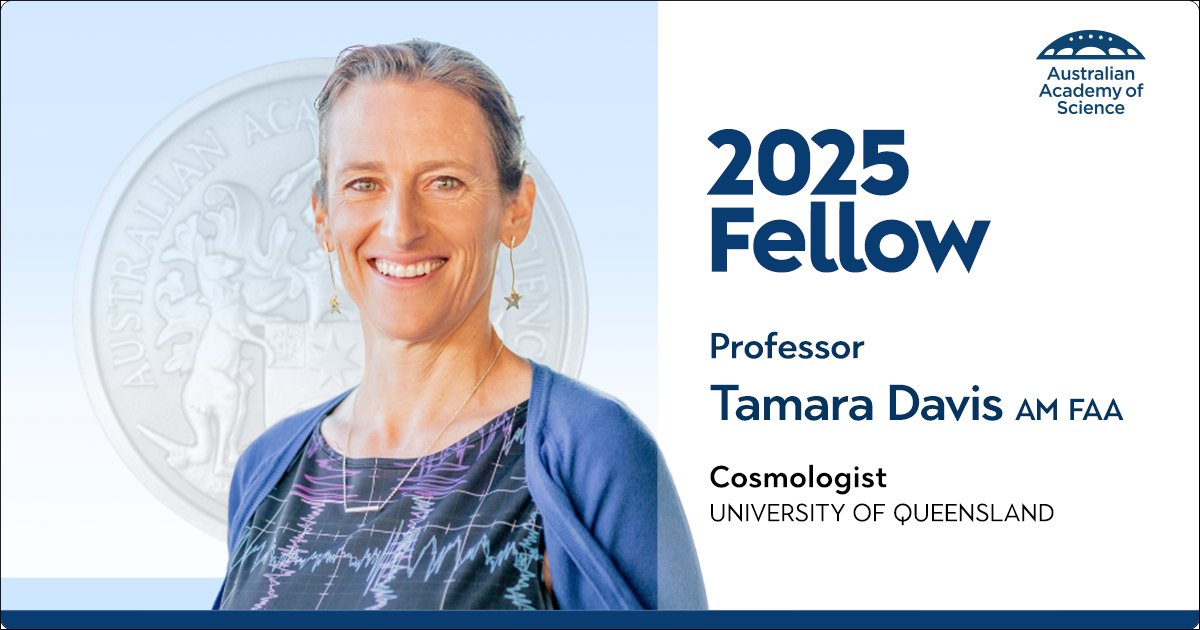
May 2025: OzGrav Deputy Director Professor Tamara Davis AM FAA was elected as a Fellow of the Australian Academy of Science.
Election as a Fellow recognises outstanding contributions to scientific research. A leading theoretical cosmologist at the University of Queensland, Tamara’s work on dark energy and precision measurements of the Universe has significantly advanced our understanding of cosmic expansion.
Her election places her among Australia’s most distinguished scientists and reflects both her research excellence and her leadership within OzGrav.
Ilya Mandel named a Clarivate Highly Cited Researcher
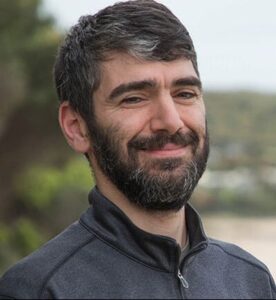
Jan 2025: Ilya Mandel achieved the distinction of being a “1 in 1000” highly cited researcher by Clarivate.
This global recognition highlights the exceptional influence of his research, placing him among the most impactful scientists worldwide based on citation metrics.
Michael Kramer and Adam Deller’s team awarded the 2025 Frontiers of Science Award
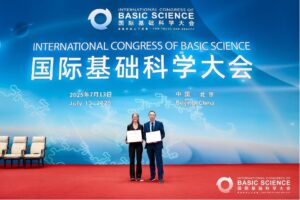
Aug 2025: OzGrav Partner Investigator Dr Michael Kramer and Chief Investigator Prof Adam Deller, together with their international collaborators, were awarded the 2025 Frontiers of Science Award.
The award recognises their groundbreaking research on the Double Pulsar, one of the most precise laboratories for testing Einstein’s theory of general relativity.
Professor Tamara Davis AM awarded the 2025 Moyal Medal
Sep 2025: Professor Tamara Davis AM was awarded the 2025 Moyal Medal by Macquarie University.
The Moyal Medal honours outstanding contributions to mathematics and physics, recognising Tamara’s influential work in cosmology and her continued leadership in advancing our understanding of dark energy and the expanding Universe.
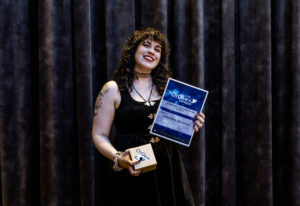
Anais Möller awarded the Swinburne Vice-Chancellor Research Excellence Award

Dec 2025: Anais Möller was awarded the Swinburne Vice-Chancellor Research Excellence Award.
This award acknowledges outstanding research achievement and impact, recognising her leadership in large-scale astronomical surveys and data-driven astrophysics.
Aswathi Pampurayath Subhash awarded the John Carver Award

Sep 2025: Aswathi Pampurayath Subhash was awarded the John Carver Award from The Australian National University.
This competitive award recognises excellence in postgraduate research presentation, reflecting her strong communication skills and research impact.
Natasha Van Bemmel awarded an MNRAS Student Prize

July 2025: OzGrav PhD student Natasha Van Bemmel was awarded an MNRAS Student Prize.
Her first-author paper, An Optically Led Search for Kilonovae to z~0.3 with KNTraP, was selected as one of the six best student-led publications of the year.
Jassimar Singh awarded the ANZOS-Vescent Prize
Dec 2025: Jassimar Singh was awarded the ANZOS-Vescent Prize at the ANZCOP conference for outstanding student poster.
This award recognises excellence in scientific communication and research presentation.
Kirsten Banks received the New Social Media Talent Award

Dec 2025: Kirsten Banks received the New Social Media Talent Award from Swinburne University.
Recognised for her dynamic science communication and strong public engagement, Kirsten continues to inspire diverse audiences and expand the reach of astronomy.
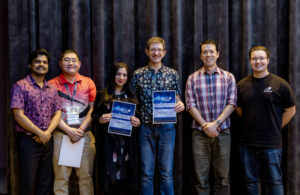
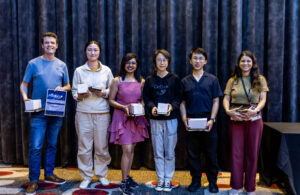
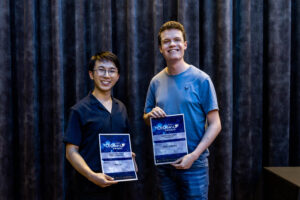
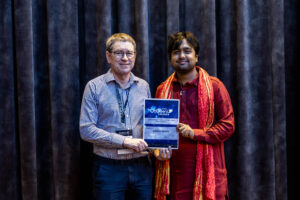
OzGrav Annual Achievement Awards
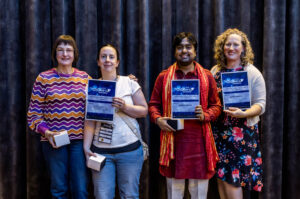
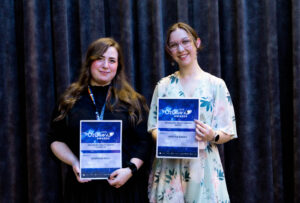
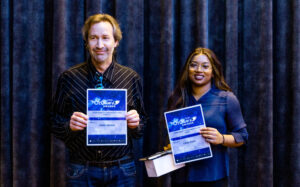
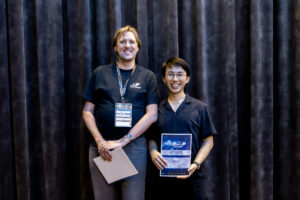
Our Annual Awards celebrate the people and teams who embody OzGrav’s values—excellence in research, collaboration, service, equity, and community. From scientific leadership to mentoring and outreach, these awards recognise the many ways our members strengthen both our science and our culture.
See the full list of winners → OzGrav Annual Awards

Events and Community Highlights
LIGO-Virgo-KAGRA (LVK) Collaboration Meeting in Melbourne
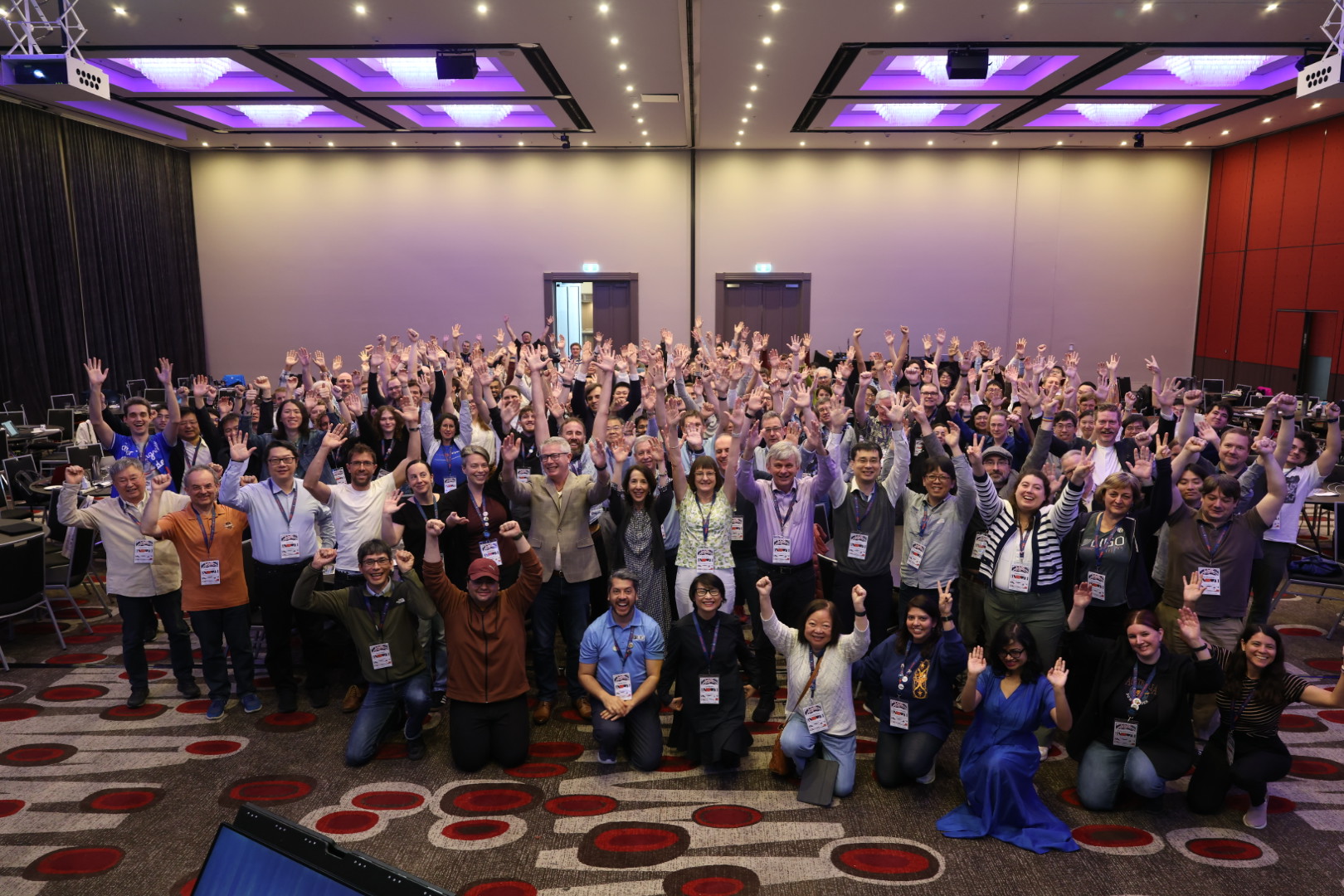
The March 2025 LVK Collaboration Meeting took place from 24–27 March 2025 at the Pullman Melbourne Albert Park, bringing together more than 400 scientists from across the global gravitational-wave community.
Hosted by OzGrav, the four-day meeting featured a dynamic program of plenary sessions, parallel working group meetings, workshops and a large poster session. Researchers shared the latest results in gravitational-wave astronomy, explored new detector technologies, and discussed future observing runs and scientific priorities.
Beyond the science, the meeting provided a valuable opportunity to strengthen international collaboration across the LIGO, Virgo and KAGRA partnerships. Early career researchers played a central role throughout the program, contributing talks, leading discussions and participating in dedicated networking and professional development activities.
The Melbourne meeting highlighted Australia’s growing leadership in gravitational-wave science and showcased OzGrav’s capability to deliver large-scale international events that bring together the world’s leading researchers in the field.
A Decade of Discovery: Celebrating 10 Years of Gravitational Waves
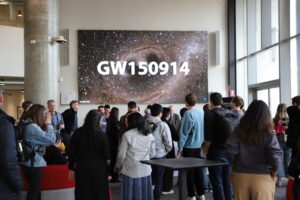
In September, the Australian gravitational-wave community gathered at Swinburne University to celebrate a landmark moment in science—the 10-year anniversary of the first direct detection of gravitational waves (GW150914). This discovery, announced in 2016 from data recorded on 14 September 2015, confirmed Einstein’s prediction and opened an entirely new window on the Universe.
The two-day workshop, hosted by the Australian Research Council Centre of Excellence for Gravitational Wave Discovery (OzGrav), brought together more than 80 students, researchers, and leaders from across the country. The workshop was more than just a commemoration—it was a chance to reflect on Australia’s pivotal role in that discovery, celebrate the remarkable advances of the past decade, and look ahead to the future of gravitational-wave science.
Read more → A Decade of Discovery
Dynamic Radio Sky 2025
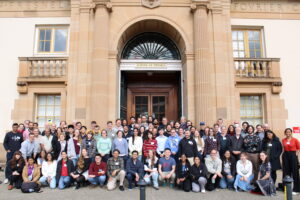
Dynamic Radio Sky 2025 (DRS2025), held from 28 July to 1 August 2025 at the University of Sydney, brought together more than 90 radio astronomers from Australia and around the world.
The five-day workshop focused on the rapidly evolving field of time-domain radio astronomy, with sessions covering fast radio bursts, galactic and extragalactic transients, stellar radio emission, active galactic nuclei, and scintillation. The program also explored current and future survey capabilities, software and data analysis methods, and the growing importance of multi-wavelength approaches.
Participants shared new discoveries and emerging techniques that are transforming our ability to observe the dynamic Universe, from short-timescale transient events to long-term variability across cosmic sources.
The meeting highlighted Australia’s leadership in radio astronomy and its central role in shaping the future of dynamic sky surveys, particularly in the lead-up to next-generation facilities such as the Square Kilometre Array. OzGrav researchers contributed to both the scientific program and organisation of the event, strengthening national and international collaboration.


ARC Centre of Excellence Summit
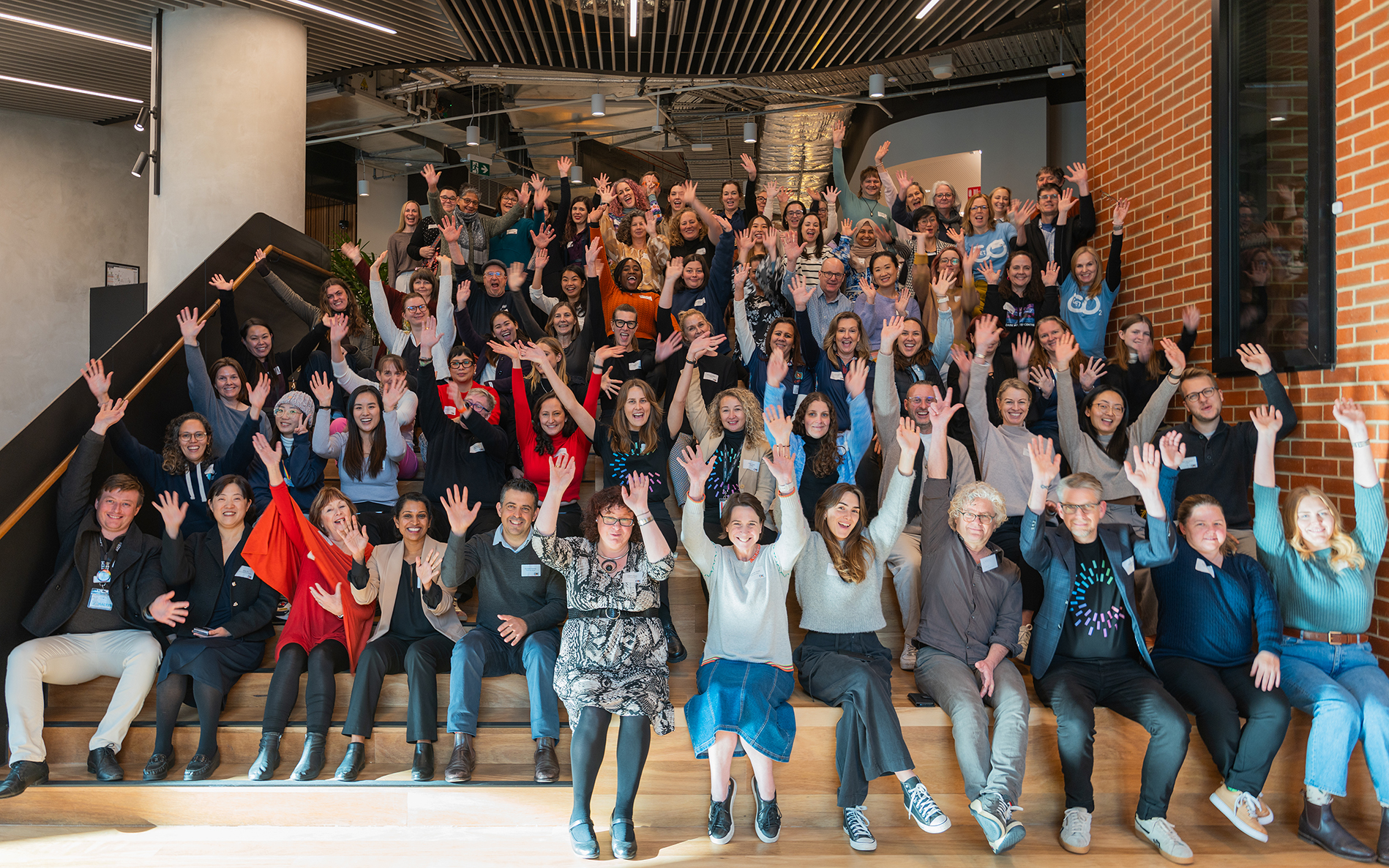
OzGrav collaborated with other Victorian-based Centres of Excellence to co-organise and co-sponsor the ARC Centre of Excellence Summit, an annual event that brings together Centre leaders and professional staff for professional development and networking.
The 2025 Summit was held in Melbourne and featured a Director and COO Day, a Professional Staff Day, and several community of practice sessions.
OzGrav professional staff were closely involved in the planning and delivery of the program, including leading and contributing to a number of sessions. The Summit provided opportunities for cross-Centre exchange on governance, research impact, succession planning, operational management, and career development for professional staff, while also strengthening national connections across the Centres of Excellence network.
Key Research Programs
Our research program is divided into three themes – Instrumentation, Discovery, and Physics. Within these themes, we run key programs that are the core science of OzGrav. Each of these key programs is led by one or two of our Chief Investigators, supported in specific projects by more junior members who are given the title “Project Scientist”. Here we summarise the foci of the Key Programs of OzGrav as planned for 2026.
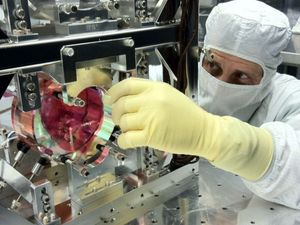
Instrumentation
Developing advanced technology for LIGO and next-gen gravitational wave detectors.
Discovery
Detection algorithms and follow-ups to uncover gravitational waves and cosmic events.
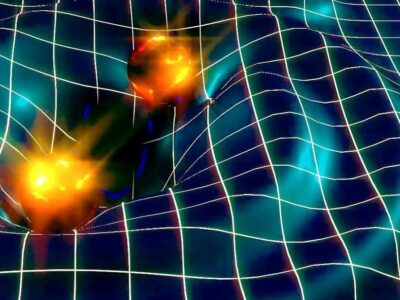
Physics
Theory, simulation, and data analysis to understand gravity and extreme matter.
Programs and Projects Overview
Instrumentation Theme
Key Program: Optimisation
Leaders: Bram Slagmolen + Ju Li
Overall aim: Prepare for the post fourth observing run (O4) break to help install and commission LIGO for its fifth observing run (O5)
2025: Planned contributions to LIGO commissioning break from November 2025 to July 2026. There are various projects and subsystems OzGrav members are contributing to (Central HEater for Transient Attenuation (CHETA), Squeezed Light Source management, Large Optic Coatings, Suspension Platform Interferometer, defect detection, qOSEMs. In addition, a significant upgrade to the Gingin High Optical Power Facility has been undertaken.
In 2026, we will be actively engaging with commissioning activities for the next observing run IR1, planned to commence in November 2026.
Project: CHETA Gingin Demonstration
Project Scientist: Carl Blair
Aim: Reduce the impact of thermal transients in the LIGO detectors.
To bring the LIGO detectors to their operating point, the optical power in the arm cavities is slowly increased from low power, to medium and very high circulating power up to 300 kW. A very small amount of power is absorbed by the optical test masses, which slowly heat up the optic. This heat creates thermal transients that deform the shape of the optics. Thermal transients in the LIGO detectors reduce sensitivity and create calibration uncertainty in the first few hours of each data taking segment. In addition, thermal transients make commissioning the detectors difficult and result in transient parametric instability that sometimes disrupt data acquisition.
The Central HEater for Transient Attenuation (CHETA) system aims to direct light from secondary lasers onto the central part of the optical test masses, creating a similar thermal deformation as when full optical power is circulating in the arm cavities.
In this project, we provide critical demonstrations and the human capital to enable the successful completion of the Central HEater for Transient Attenuation (CHETA) project.
We also plan to demonstrate a complete LIGO CHETA system at Gingin with the lasers and stabilisation as proposed for the LIGO detectors. With LIEF support, we supply CHETA systems, technicians for installation and commissioning in LIGO for a demonstration of a partial CHETA system where only the Input Test Masses (ITMs) are preheated.
2025 Progress:
We participated in testing two potential lasers for use in CHETA: quantum cascade lasers (QCL) and CO2 lasers. The CO2 lasers have been set up and tested at Gingin (while a QCL laser is being tested at LIGO). We have achieved the desired CHETA thermal compensation as measured by Hartmann wavefront sensors. The suspended 80m cavity, used to test the CHETA system, can now be controlled and all the sensing is in place to run the experiment. Initial test results are being used to confirm simulations by the team members at the University of Adelaide. We have succeeded in our goal to demonstrate the full CHETA (on both input Test mass and End Test Mass) concept at the Gingin facility. We are still validating the finite element modelling and optical modelling.
We are now working on a CHETA system suitable for LIGO to aid with design and planned commissioning at the LIGO sites. One early career researcher (ECR) is currently at LIGO Hanford and another will visit LIGO Livingston in July 2026, delivering our hardware and expertise.
2026 Plans: Publish a paper on Gingin CHETA demonstration; send personnel to the LIGO sites to help install and commission the CHETA system.
Project: Understanding the aLIGO Squeezer Crystal Degradation
Project Leader in Charge: Bram Slagmolen | Project Scientist: Nutsinee Kijbunchoo
Periodically poled potassium titanyl phosphate (PPKTP) crystals are used in the LIGO squeezed light source and are the key element that generates squeezed quantum states of light — light with noise in one property below the standard quantum limit. The manipulation and control of these quantum states has been instrumental in optimising the performance and detection rates of the LIGO detectors over the past five years.
Kar Meng and other scientists at the LIGO Hanford site putting the finishing touches on their clean room garb. These suits are required when any work is done inside the LIGO high vacuum system, which must remain ultra clean.
From the end of 2025 and beginning of 2026, OzGrav ANU PhD student Kar Meng Kwan was at the LIGO Hanford observatory participating in the commissioning and upgrade of the LIGO detector. After several years of steady operation, the ANU-designed quantum squeezers are being refreshed with new non-linear crystals. Kar Meng is an expert in squeezed light operations and contributes to the delicate maintenance work for the quantum squeezer installed in the LIGO Hanford detector.
Even though the squeezed light source is carefully maintained and operated, one ongoing challenge is that all squeezers degrade over time due to a phenomenon known as “grey tracking”. OzGrav researchers are undertaking a study to better understand and reduce this effect.
Aim: To understand the conditions under which “grey tracking” emerges in the optical elements of LIGO’s squeezed light source, enabling strategies to mitigate its impact.
The squeezed light sources, or squeezers, suffer from “grey tracking” when exposed to high-intensity green light. Our aim is to characterise the amount of green optical power required for grey tracking in PPKTP crystals to occur, and quantify the reversible and irreversible damage thresholds.
Outcome:
To date, the experiment has been calibrated and meets the minimum sensitivity required. The basic experimental setup for absorption measurements of both infrared and green wavelengths has been established. A test beam has been directed through a crystal relative to a reference beam, allowing preliminary qualitative measurements for green light. The next steps are to control the crystal temperature using a crystal oven, record calibrated measurements, and observe corresponding effects on the infrared light.
Once we have quantified green and infrared absorption versus intensity across a range of crystals from different suppliers, we will be able to assess whether they meet the increasingly demanding standards of the LIGO observatory quantum noise budget.
2025 Progress: Progress has been made in measuring induced grey tracking, with preliminary results presented. Due to personnel constraints, this work has not yet been finalised.
2026 Plans: Due to personnel constraints, this project is currently on hold.
Project: Coating large LIGO ‘beamsplitter’ optics
Project Scientist: Johannes Eichholz
Aim: To coat the LIGO beamsplitter to the stringent specifications required for next-generation detector performance.

The A+ LIGO beamsplitter (450mm diameter), after coating and in the annealing oven.
The ANFF-Optofab at the ANU Research School of Physics, in partnership with the OzGrav ANU node and the ANU Centre for Gravitational Astrophysics, is providing the mirror coatings for the new, larger beamsplitters for the “A+” upgrades to the Advanced LIGO gravitational-wave detectors. These beamsplitters sit at the very heart of the giant Michelson interferometers.
The first beamsplitter coated at ANU was delivered to LIGO at the end of 2025 and will be installed in the first half of 2026. This milestone reflects years of work by a highly skilled and dedicated team to develop the capability to coat large optics with exceptional precision and uniformity across a wide surface area.
Project: Developing the Arm Length Stabilization (ALS) for A#
Project Scientist: Jian Liu
Aim: To develop a novel Arm Length Stabilization (ALS) system for LIGO A#.
With the potential use of new optical coating for the test masses in future upgrades, a new Arm Length Stabilisation (ALS) system to bring the detectors to their operating point is required. The potential new crystalline AlGaAs coatings have lower thermal noise, they are opaque for light at shorter wavelengths, in particular 532 nm which is used in the current ALS system. Our novel ALS system for A# will include an auxiliary laser operating at 1596 nm, incorporating a second harmonic generator (SHG) and a sum frequency generator (SFG).
Outcomes:
We have already completed a detailed experimental design and implemented the 1064 nm second-harmonic generation with 500 mW output at 532nm. We now have ordered and received the components required to complete the system, including the non-linear second harmonic generation and Sum Frequency Generation crystals from Laserfabriken; the low noise 1W 1596 nm laser from Precilaser; and the science cavity mirrors from Layertec.
Thanks to intensive activities and node visits we soon expect experimental demonstration of the proposed novel ALS system in a table-top cavity, and test it in the Gingin 80 suspended east arm cavity. This work will result in multiple publications and technology demonstration for future gravitational wave detector upgrades.
2025 Progress:
All long lead-time items were received in early April. The setup for third-harmonic generation from 1596 nm to 532 nm was completed in May, producing a 532 nm beam of about 400 nW. Subsequently, the 532 nm beam from second-harmonic generation of the 1064 nm science laser was mode-matched and combined with the third-harmonic 532 nm beam to search for an optical beating signal. On 20th August, the beating signal was observed for the first time and was further optimised in the following days. Phase locking between the 1596 nm and 1064 nm lasers commenced in October and obtained initial results in November. Meanwhile, the science cavity mirror holder and PZT actuation unit were assembled, the 1596 nm laser was mode-matched to the science cavity, and cavity locking is currently in progress. A paper summarising this novel ALS experiment design is being prepared.
2026 Plans:
An inter-node visit is planned to work together on optimising the phase locking loops and demonstrating the science cavity locking transition from 1596 nm to 1064 nm; We also aim to publish the experimental paper this year.
Project: Getting to the Point: AI Hunts for Microscopic Defects in Gravitational Wave Detectors
Aim: As gravitational-wave detectors like LIGO increase their laser power to detect fainter signals from across the universe, they face a heated challenge: microscopic imperfections on their primary mirrors. Known as ” point absorbers”, these tiny defects absorb high-power laser light, creating localised hotspots that deform the mirror’s surface and scatter light, ultimately reducing detector sensitivity.
Traditionally, identifying these absorbers required expert commissioners to manually analyse complex thermal maps from Hartmann wavefront sensors—a time-consuming process prone to subjectivity. To address this, OzGrav researchers developed a machine-learning algorithm adapted from the “You Only Look Once” (YOLO) object detection framework, which is commonly used in computer vision.
By applying transfer learning to synthetic datasets of thermal deformations, the team trained the model to recognise the specific signatures of point absorbers. The algorithm proved highly effective, achieving a true-positive detection rate of over 99%. When tested against archival data from LIGO’s observing runs, the model successfully identified all human-confirmed point absorbers and uncovered new candidates that experts had previously missed.
This automated system can now monitor test masses in situ during operation, allowing for faster diagnosis of optical defects. As next-generation observatories prepare to operate at megawatt-scale laser powers, this AI-driven approach will be critical for protecting instrumentation and maximising scientific reach.”
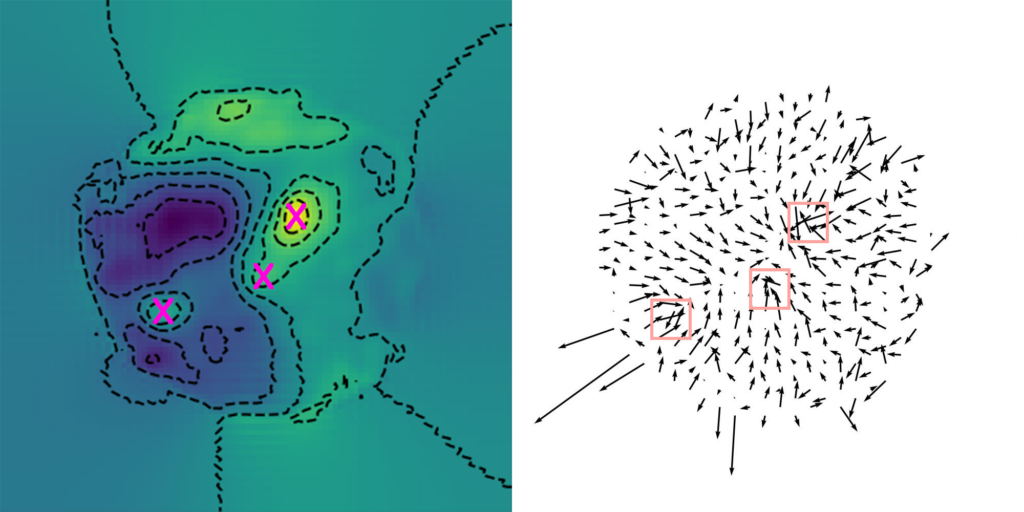
AI-Detects-Point-Absorbers” – Credit: Created by Simon Goode with data from the LLO
Project: QOSEM displacement sensors
Project Scientists: Tom Roocke and the AU/LIGO team
Aim: To improve the displacement sensors used on the vibration-isolation suspension systems that shield the LIGO detector mirrors from seismic motion.

Fig: Tom Roocke at LHO, assembling a QOSEM for installation in the new large-beamsplitter suspensions scheduled for use in observing run IR1.
Gravitational waves (GWs) are detected by measuring minute time-varying changes in the distance between mirrors separated by 4 km. Unfortunately, ambient ground vibrations can produce orders of magnitude larger motions, which would swamp the effect of a passing GW. Cascaded suspension systems are therefore used to isolate the mirrors from the ground motion, providing a quiet background from which to observe GWs.
The final layer of the isolation systems employ pendular suspensions, and displacement sensors and actuators, known as OSEMs, are used to damp residual low-frequency motion. Unfortunately, the current OSEMs are limiting the performance of the suspensions, due to a lack of sensitivity in the displacement sensor, and the residual motion of the mirrors is beginning to limit the detector sensitivity.
The AU group has developed a new compact, high sensitivity, optical beam-deflection sensor, in which a short-focal-length lens and a quadrant photodiode are used to detect motion. Importantly, it can be retrofitted into the existing OSEM bodies, to yield a QOSEM. The beam-deflection sensor has a sensitivity of 4 pm/√Hz above 1 Hz and a dynamic range of 1 mm, providing a factor of 10 improvement in sensitivity over the current sensors. Additionally, it features a 2D readout, which will further improve the readout of residual angular motion. These QOSEMs will be installed onto key mirror suspensions in the upcoming commissioning break.
Project: Parametric Instability Control
Project Scientist: Carl Blair, Jian Liu
Aim: To develop techniques for parametric instability (PI) control including optical feedback for A+ and new AMDs for A#.
As the power inside the GW detector cavity increases, it is apparent that we need multiple mitigation methods to control PI. This project is to test and develop the optical feedback control scheme at the Gingin High Optical Power Facility (HOPF) and implement it at LIGO.
Outcomes:
We have successfully demonstrated the suppression of PI in Gingin HOPF. A trial has been conducted at LIGO during a commissioning break.
2025 Progress:
The LIGO trial data was extensively analysed. A simulation model was built to better understand the system behaviour. A paper was submitted to PnP and is under review.
2026 Plan
Current feedback schemes modulate the input light to generate feedback sidebands which destructively interfere with the light causing PI. Since the feedback signal will go through several input optics such as mode cleaner, this makes the system complicated and relies on a fortuitous coupling to the high order mode which is not well understood. We plan to demonstrate a scheme that uses the transmitted light from the end mirrors, which directly contains the cavity higher order modes information, to generate the feedback light. This new scheme is simpler and will be demonstrated in the High Optical Power Facility East Arm.
Project: Gingin High Optical Power Facility (HOPF) Upgrade
Project Scientist: Chiara Di Fronzo
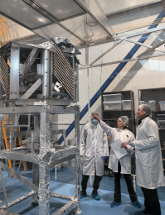
Figure caption: Felix Wojcik, Chiara Di Fronzo and John Winterflood at Gingin lab, installing new parts on the facility.
During 2025, the laboratory space has had a major upgrade to the HVAC system, which has stabilized the temperature within the main laboratory. This contributes to more stable experimental results and also makes it a more comfortable place to work. Work will also be commencing soon on placing a shelter over the entire length of both vacuum tubes to stabilize the temperature of the vacuum tubes over the course of the day. These upgrades are happening in conjunction with upgrades in experimental apparatus. Suspensions (see figure) are being built so the south arm will have fully suspended test masses. Active isolation tables have been installed. And low noise 2um lasers are actively being developed. The current state of the south arm is that a 2um laser can be locked to a 7m single suspension cavity with finesse 300.
Project: Mode Matching Error Signals
Project Scientist: Carl Blair, Jian Liu
Aim: To develop techniques to generate mode matching error signals. These will allow the shapes of beams in each cavity to be matched, minimising optical losses
Outcomes:
The result of improved mode matching will be reduced optical losses. Reduced optical losses will result in more optical power in the interferometer and more importantly less degradation to the squeezed vacuum entering the interferometer dark port. This will result in a reduction in quantum noise. We have demonstrated that the error signals can be produced and measured for the mode matching between the power recycling cavity and the arm cavity at LIGO in 2024.
2025 Progress:
- Completed paper on tabletop demonstration of simple mode matching error signal scheme (Oscar Zhu)
- Obtained funding from the UWA “Research Collaboration Award” to implement AI assisted cavity mode matching.
- Design of tabletop coupled cavity experiment.
2026 Plans:
- Completed paper on tabletop demonstration of coupled cavity error signal scheme (Oscar Zhu)
- Design of Gingin coupled cavity error signal scheme
- LIGO demonstration of mode matching error signals using modulation locked to the high order mode frequency using a phase locked loop.
Project: Suspended Platform Interferometer, LIGO Prototype
Project Scientist: Sheon Chua, Bram Slagmolen
Aim: Stabilising the motion between two large isolation platforms within the LIGO detectors to improve the low frequency detector performance.
Outcomes:

LIGO uses many large suspended optical tables onto which many mirror suspensions are mounted. These tables are referred to as Internal Seismic Isolation (ISI) systems. These tables are very quiet on their own. However, even small motions and tilt between two of these tables can introduce more motion of the mirror which sits on top of these tables. By linking the tables (up to 10 m apart) using additional optical interferometry, we will further stabilise their relative motion and tilt. This will reduce the additional mirror motion, further improving the low frequency detector performance.
2025 Progress: We designed the receiver unit, which consists of a partial reflective mirror, a lens and a quadrant photodiode. We designed the Laser Prep Chassis, vacuum compatible fibre spool and additional vacuum hardware.
2026 Plan: Assemble the remaining vacuum compatible components at the LIGO Hanford Observatory, and help with the actual installation and integration of the system into the detector. After commissioning, the plan is to operate the SPI during the ISR1 observing run.
Key Program: Future Tech
Leaders: Kirk McKenzie + David Ottaway
Overall aim: Develop enabling technology for future ground and space-based detectors. We pursue quantum enhanced detection schemes, advanced materials, laser technologies, and space-based laser interferometer schemes.
Project: Space Interferometers
Project Scientist: Andrew Wade, Emily Rees
Aim: Advance space-based GW detector missions by studying interferometer architectures and advancing key technologies with the goal of seeing Australian research applied to large scale space missions like LISA and other technology platforms like GRACE.
Outcomes:
Overall, we will investigate different architecture options for future space-based laser interferometers and propose new types of missions that could be realised with simpler and more compact designs.
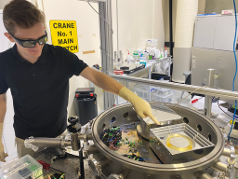
PhD Student Jake Wilson in the ANU high bay lab preparing a thermal isolation chamber for a laser stabilization system with optical fibre core.
Laser stability is a key limiting factor of gravitational wave detectors. In this project, we will investigate the laser frequency stabilisation limits in new technologies, such as optical fibre interferometers instead of ULE cavities, and understand the limits imposed by features such as thermal noise.
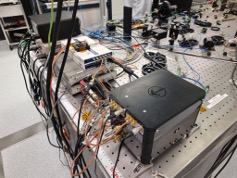
Optical test suite developed by Callum Sambridge for a low-power phasemeter tracking test with the GRACE Follow-On laser at NASA-JPL. Results were published in Physical Review Applied.
The LISA detector is based around phasemeter tracking instruments. In this project, we will test phasemeters in extreme limits to open design options for future space-based detectors. Exploration of rugged communications class lasers operating at 1550nm for space-based sensing is an opportunity. Could these lasers be appropriate for precision tracking in space?
2025 Progress: Probing laser stabilisation limits and demonstrating phase-tracking in space interferometer conditions
- First measurement of thermo-optic noise in a LIGO relevant coating, a collaboration with MIT [Chabbra et al, Phys Rev D 2025]
- Characterizing the phase-tracking limits of the GRACE follow-on flight laser [Sambridge et al, Phys Rev Applied 2025]
- Design of a Dual-quadrature phasemeter for space-based interferometry [Sambridge et al, Phys Rev Applied 2025]
- Investigation of hollow-core fibre as a low thermal coefficient replacement for single-mode fibre in laser stabilisation systems
- Hosted Yuri Levin at ANU: discussions of Brownian thermal noise in optical fiber laser stabilisation systems
Paper highlights
- N Chabbra, et al., Physical Review D 112 (8), 082003 (2025)
- CS Sambridge, et al. Physical Review Applied 24 (1), 014015 (2025)
- CS Sambridge, K McKenzie,. Physical Review Applied 24 (1), 014009 (2025)
2026 Plans: Validation of new space interferometer configurations and laser stabilisation technologies
- Testing/validation of a Dual-quadrature phasemeter for space-based interferometry
- Characterisation of 1550nm lasers against space-based sensing metrics of frequency and intensity stability
- Long term measurement of absolute laser frequency with a dual RF modulation scheme
- Development and characterisation of thermal isolation chamber for an optical fibre based laser stabilization system
- Explore fiber optic intrinsic loss angle theory
Project: Future Australian Detector Design
Project Scientist: Bram Slagmolen, Carl Blair
Aim: Develop the detector design for a future Australian Gravitational Wave Detector in the global third generation (3G) detector network.
A study into the broad case for siting a ‘third generation’ Gravitational Wave Observatory in Australia has been funded by Astronomy Australia Limited with OzGrav and ANU support. In parallel with this we have set up an activity to investigate potential designs for such an observatory for deployment in the 3G era when the proposed European Detector, Einstein Telescope (ET) and the proposed US Detector, Cosmic Explorer(CE) are online. A 3G detector in Australia will enable the 3G GW network to have the resolution required to do three dimensional tomography of the universe. In addition we are also studying the design of detectors with enhanced kilohertz frequency sensitivity that will likely enable the detection of the post merger GW signature of binary neutron stars which contains information on the hot equation of state of neutron stars. Knowledge of this reveals information about nuclear matter that cannot be obtained in any other way.
2025 Progress:
- We have had active discussions with the Cosmic Explorer senior management about taking on the task of designing the CE 20 km design. This is a proposed 20km arm length detector that will have slightly less peak sensitivity compared to a 40km detector but will have greater sensitivity in the kilohertz frequency range.
- We have formed a working group that conducts bi-weekly detector design meetings and have developed 2 planning documents and have decided to answer the following key question in the next 6 months: What are the key features that will make a future Australian detector contribute most to a future third generation detector network?
- We will then focus on the detailed design and noise performance of the detector. Engaged with the CE consortium and have taken an active role in developing the CE20 concept.
2026 Plans:
- Progress with plan, with 3 remaining months developing concepts. Then proceed to focus on the detailed design and noise performance of the detector.
Project: Quantum Techniques
Project Scientist: Terry McRae
Aim: This project examines and tests technologies to enhance the gravitational wave detector sensitivity, primarily with the manipulation of quantum noise. Ultimately, we would like to see these Australian developed technologies adopted in the next generation gravitational wave observatories.
Outcomes:
Currently, squeezed light is injected into a gravitational wave detector to mitigate quantum noise entering the interferometer. This technology was developed within OzGrav and is often referred to as “external squeezing”. A new technique has been proposed that could achieve a further sensitivity enhancement from the manipulation of quantum noise within the interferometer, referred to as “internal squeezing”. A major step towards the demonstration of internal squeezing has been achieved in our lab with the first demonstration of squeezed light generated within a complex coupled cavity system at the normal mode splitting frequency [Junker PRL 2025].
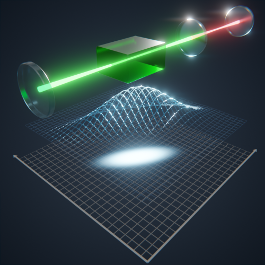
This image is an artistic 3D render of a coupled cavity system that is a precursor to demonstrating internal squeezing in a gravitational wave detector [Junker et. al. PRL 134, 243603 (2025)]. The main image features coupled optical cavities for quantum squeezing enhancement and a nonlinear crystal for quantum squeezing generation. Below the coupled cavity system is an artistic Wigner function representation to illustrate the quantum noise of the amplitude and phase [Image credit: Spark Shen].
Proposals for future gravitational wave observatories include operation with light at a longer wavelength. These observatories will also require squeezed light at the longer wavelength. OzGrav achieved the first measurement of -4 dB of squeezed light at the 2 micron wavelength that was compatible with gravitational wave observatories. This year we completed an enhanced phase sensitive amplification technique to measure more than -8 dB of squeezed light at 2 um overcoming key technological limitations [Kwan PRL 2026, Editor’s highlight].
Optimising the quantum noise reduction across the full observatory bandwidth is currently done with an optical filter cavity that requires hundreds of meters of vacuum infrastructure. Proposals at the table top level have been tested in OzGrav that use entangled light to avoid this infrastructure. Currently we are generalising this to a quantum teleportation technique that may be suitable for future observatories that would otherwise require multiple filter cavities. This experiment has enabled a significant collaboration with our Japanese colleagues.
The ability to manipulate the optical spring effect by integrating an optical parametric amplifier into an optical cavity has been demonstrated [Liu Opt. Lett. 2025]. The method can be applied to gravitational wave detectors to enhance peak sensitivity within a narrow frequency band. The optical spring frequency can be dynamically adjusted to track the GW signal from merging compact binaries or tuned to search for the post merger signal of a known binary coalescence.
2025 Progress:
- Many diagnostics and upgrades enabled the first demonstration of coupled cavity squeezed light at the normal mode splitting frequency [Junker Rev. Lett. 134, 243603 (2025)].
- Measurement upgrades of our system allowed the first observation of more than -8 dB of squeezed light at a wavelength of 2 micrometers [Kwan Rev. Lett. Editors highlight (2026)].
- The optical system for the quantum teleportation experiment is near completion.
- The ability to manipulate the optical spring effect by integrating an optical parametric amplifier into an optical cavity has been demonstrated [Liu Opt. Lett. 2025].
2026 Plans:
- The coupled cavity system enables a wide range of quantum noise reduction techniques to be explored. We would like to start with signal injection and an analysis of the signal to noise ratio. This will require significant levels of coupled cavity squeezing to achieve a robust analysis. Beyond 2026 there are possibilities for testing control and filtering systems compatible with gravitational wave observatories.
- Measurement of 2 um squeezed light to lower frequencies.
- Develop the control system for the quantum teleportation system and take the first quantum noise measurements.
- Observation of an enhanced optical spring with the optical parametric amplifier operated at the de-amplification regime.
Project: Laser Development
Project Scientist: Ori Henderson-Sapir
Aim: This project aims to develop new laser sources that are required for a range of near and longer term gravitational wave instrumentation projects. These include new laser sources for the main laser interferometer and lasers for the auxiliary systems such as displacement noise free wavefront shaping in the interferometers.
Outcomes:
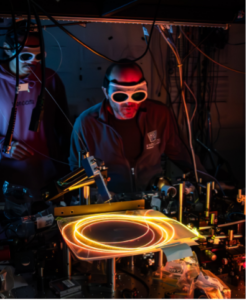
Future gravitational wave detectors that plan to use silicon as the test mass materials, including the proposed ET LF. This is done to reduce thermal noise and thermal aberrations but require the main laser to have wavelengths longer than 1.4 um because the currently used 1.064 um wavelength lasers are too heavily absorbed in silicon. We are currently pursuing the development of a number of light source technologies for this use. This includes low power master lasers that use monolithic fibre bragg grating in thulium or holmium doped silica fibre to generate single frequency lasers that operate around 2um. These sources are then amplified using single mode optical pre-amplifiers and amplifiers to achieve power to the 10 watt level. We have generally been focused on understanding the frequency and intensity noise limitation of these lasers.
The other piece of main laser development that we have been focusing on is how we can achieve significant power enhancements in a single optical amplifier needed for next generation detectors without being limited by non-linear effects that fundamentally limit the output of narrow linewidth single mode fibre laser architectures. Our aim is to use highly multimode fibres combined with input wavefront shaping to create a diffraction limit output.
The other area of laser development that we are undertaking is the use of mid-infrared fibre lasers for the replacement of the CO2 lasers used in the thermal compensation systems of advanced LIGO and Virgo. Fibre lasers operating around 3.6 um have the advantage of cleaner beams, better potential for beam shaping and improved intensity stabilization.
2025 Progress:
- Completed a new high sensitivity frequency diagnostic set-up for 2 um lasers. This enabled greater understanding of the frequency noise of thulium and holmium DFB fiber lasers.
- Working with collaborators from Yale University, a new detailed numerical model of multi-mode fibre transmission was developed. This was facilitated by a 6 month stay at Yale University by OzGrav PhD student Darcy Smith Funded by a significant grant from the American Australian Association.
- Explored the use of flat-top beam shaping optics for creating new profiles for thermal compensation systems.
Paper highlights
- Darcy L Smith, Kabish Wisal, Baichuan Huang, Stephen C Warren-Smith, Ori Henderson-Sapir, Hui Cao, David J. Ottaway, A Douglas Stone. Modeling Light Propagation and Amplification Efficiency in Highly Multimode, Yb-doped Fiber Amplifiers submitted to Optics Express, arXiv preprint arXiv:2603.11514
- Theodosiou, Antreas, Ori Henderson‐Sapir, Yauhen Baravets, Oliver T. Cobcroft, Samuel M. Sentschuk, Jack A. Stone, David J. Ottaway, and Pavel Peterka. “Understanding the temperature conditions for controlled splicing between silica and fluoride fibers.” Advanced Photonics Research 6, no. 5 (2025): 2400150.
2026 Plans:
- Demonstrate record near diffraction limited, narrow linewidth power levels from highly multi-mode fibers.
- Demonstrate robust 2 um lasers with near 10 Watt output that meet the Advanced Ligo specifications.
- Obtain a complete understanding of the sources of noise that limit the performance of the frequency and intensity noise of these laser systems.
- Continue to explore the use of mid-infrared lasers sources for use in thermal compensation of the second generation detectors.
Project: Future Materials
Project Scientist: Carl Blair
Aim: This project examines and tests future materials that will enhance GW detector sensitivity. OzGrav’s focus has been on silicon substrates and AlGaAs/GaAs coatings for the critical test masses of the detector. These materials promise lower thermal noise and the ability to handle more optical power. However, there are many material investigations across the whole detector.
Outcomes:
Silicon and sapphire have high thermal conductivity and low optical absorption. This means that more laser power can be absorbed in the coating and substrate with less thermo-optic and thermo-elastic distortions. These distortions are currently what limit the optical power in fused silica detectors like LIGO and VIRGO. Silicon and sapphire are crystalline materials so potentially suffer from more birefringence with respect to existing amorphous fused silica optics. Therefore much of the current work focuses on the investigation of birefringence. AlGaAs/GaAs coatings have about 5 times lower thermal noise compared to the best amorphous coatings that are currently being used in LIGO and VIRGO. However the coatings need to be grown on a lattice matched substrate and transferred to the test mass. This is a technical challenge. OzGrav have some of the largest AlGaAs coatings grown on a lattice matched substrate that are intended to be used in a 70m 2um coupled cavity at the Gingin high optical power facility. Before use a detailed characterisation of the coatings is required. Some of which are detailed below.
2025 Progress:
- Completed paper on spatial dispersion induced birefringence in silicon beam splitters. Paper is in pnp review (Alexandra Adam)
- Completed experimental work on thermally induced birefringence in silicon, sapphire and fused silica. Paper writing is progress. Aim to be complete mid year.
- AlGaAs/GaAs coating birefringence measurement in progress (Rem Madlener).
- Complete experiments measuring the change in quality factor from applied AlGaAs coatings. The results are still under investigation.
- A new technique, referred to as phase shifting polarimetry, for measuring birefringence in substrates and coatings has been developed by the AU team. It can produce a 2D map of the magnitude and orientation of the birefringence without requiring rotation of waveplates or translation of the sample, as required in traditional polarimetry.
2026 Plans:
- Birefringence compensation in silicon beam splitter (Aspire collaboration Carl Blair and Mark Eisenman)
- AlGaAs/GaAs coating birefringence paper
- Scatter measurement of AlGaAs coating
- Absorption measurement of AlGaAs coating
- Measurement of birefringence in Si using phase-shifting polarimetry.
Discovery Theme
Key Program: Detection
Leaders: Tara Murphy + Eric Thrane
The overall aim of the discovery theme is to discover interesting astronomical events that can teach us about fundamental physics and astrophysics. This includes discovering new sources of gravitational waves along with their electromagnetic counterparts, and discovering high-energy electromagnetic transients such as fast radio bursts and supernovae.
Project: Gravitational-Wave Astrophysics
Program Leader in charge: Eric Thrane | Project Scientist: Sharan Banagiri
Aim: To study compact binary properties – either exceptional individual events or the population – to learn about their formation mechanisms, environments, and stellar astrophysics.
Outcomes:
This project will use gravitational-wave signals to study the astrophysics of stars, binary stellar systems, and more. This will be done in collaboration with the LIGO-Virgo-KAGRA (LVK) collaboration, with OzGrav researchers making significant contributions to collaboration papers and leading special-event papers where appropriate.
We will develop new methods and algorithms to interpret gravitational-wave signals both from interferometers and from pulsar timing arrays.
We will work with the MeerTime pulsar timing array team to confirm the first detections of the gravitational wave background (where we detect many gravitational wave signals statistically, rather than individual events), applying our new analysis techniques to data from the 2nd data release, and preparing for the 3rd release near the end of 2026. We will also interpret any significant signals in the MeerKAT data, either from the stochastic background or from individual sources.
2025 Progress:
Contributions to LVK papers:
- GWTC-4.0 astrophysical distributions paper, submitted to ApJL
- Contributions: Christian Adamcewicz (Analyst and paper writing team member), Sharan Banagiri (Analyst)
- GW250114: Testing Hawking’s area law, published in PRL
- Contributions: Teagan Clarke (Analyst and paper writing team member)
- Black Hole Spectroscopy and Tests of General Relativity with GW250114
- Contributions: Neil Lu, Lilli Sun, Ornella Piccinni
- GWTC-5.0 astrophysical distributions paper (Paper in prep)
- Contributions: Sharan Banagiri (Analyst and paper writing team co-chair), Hui Tong (Analyst and paper writing team member), Lachlan Passenger (Analyst)
Short-author paper highlights:
- Banagiri et al, Astrophys.J. 990 (2025), Number 2, 144
- Tong et al, J. 985 (2025) 2, 220
- Tong et al, 2509.04151 (accepted in Nature)
- Adamcewicz et al, J. 994 (2025) 2, 261
- Guttman et al, J. 996 (2026) 2, 144
- Banagiri et al, 2509.15646 (submitted to PRL)
- Tong et al, 2511.05316 (submitted to PRL)
- Passenger et al, 2510.14363 (accepted at ApJ)
- Lu et al, 2510.01001 (submitted to Nature)
2026 Plans:
- GWTC-5 astrophysical distributions paper
- GWTC-5 Testing GR paper
- GWTC-5 Boson searches
- New analyses on GW subpopulations
- New PBH searches
- Boson Constraint systematics
Project: Electromagnetic detection and follow-up
Program Leader in charge: Tara Murphy | Project Scientist: Liana Rauf
Aim: Detect electromagnetic counterparts to gravitational-wave events that have a neutron star component, and then monitor and study their evolution.
Outcomes:
We will develop criteria upon which to trigger follow-up on the various telescopes we have available, perform follow-up observations to discover and/or characterise the electromagnetic afterglow of bright sirens and make predictions about the likely population of binary neutron star (BNS) and neutron star-black hole (NSBH) mergers, and their detectability with different instruments. Finally, we will collaborate with international colleagues to build up a more complete picture of the physical mechanisms that drive these events.
We will continue monitoring for EM counterparts from the LIGO O4 observing run, which will end in November 2025. We will also discuss follow-up strategies for poorly localised events and implement them for O5. Finally, we will update and circulate our planning documents with steps to follow in the case that a good follow-up candidate appears.
2025 Progress:
Proposals: Bright Siren Program (PI Liana Rauf)
- 2025A: 30hrs awarded. 2 ToO requests made.
- 2025B: 20 hrs awarded. 4 ToO requests made (SSM event). Some time was used for follow-up of Deeper-Wider-Faster (DWF) transients (PI Jeff Cooke).
Papers:
- Van Bemmel et al. 2025 https://arxiv.org/abs/2411.16136 – won the 2025 MNRAS student award
- Paek et al. 2025 (including Seo-Won Chang) https://arxiv.org/abs/2501.17506 https://ui.adsabs.harvard.edu/abs/2025GCN.39241….1P/abstract https://ui.adsabs.harvard.edu/abs/2025GCN.39297….1P/abstract
- Dongjin et al. 2025 (including Seo-Won Chang) https://arxiv.org/abs/2510.17053
2026 Plans: Specific to O4d/4.5.
- *SkyMapper follow-up program complementary to other telescopes and with a loose trigger criteria. (PI James Freeburn)
- ANU 2.3m 2026B bright siren follow-up during O4d proposal. (PI Liana Rauf)
- Multi-messenger follow-up for the O4d/IR1 run using the KMTNet + 7DT facilities and complementary Gemini follow-up of Kilonovae-like candidates (co-I Seo-Won Chang)
Proposals:
- ASKAP Follow-up of Gravitational Wave Events in LIGO O4 (30h on ASKAP, PI Dobie)
- Radio follow-up of LIGO gravitational wave events (1017h on ATCA, PI Dobie)
- Characterizing Neutron Star Mergers with VLBI Afterglow Observations (72h on LBA, PI Deller)
2026 plans:
Above proposals apply to IR1 as well, but we also have the following proposals which have been submitted this year:
- Jansky VLA mapping of Gravitational Waves as Afterglows in Radio (54h on VLA, PI Corsi)
- Characterizing Neutron Star Mergers with HSA Afterglow Observations ( 65h on HSA, PI Deller)
Project: Fast Radio Bursts Discovery
Program Leader In charge: Eric Thrane | Project Scientist: Dougal Dobie
Aim: Deliver a large sample of Fast Radio Bursts (FRBs) and FRB host galaxies, to be used to study the cosmology of the Universe and understand the nature of fast radio burst emission.
Outcomes:
We will search for and find fast radio bursts with the Australian SKA Pathfinder (ASKAP). This will enable us to associate fast radio bursts with host galaxies using multi-wavelength follow up, and determine host-galaxy properties, including their redshifts. We will conduct follow up observations of repeating FRB sources with Murriyang and other facilities. Looking to the future, we will plan for an all-sky all the time radio transient detection telescope for the Southern Hemisphere in collaboration with the CSIRO, and for FRB searches with the SKA.
We will soon complete scientific commissioning of the CRACO FRB detection system on ASKAP and submit observing proposals for follow up of Southern Hemisphere FRBs with the Very Large Telescope (VLT). We will also develop the science case for a southern hemisphere all-sky radio transient detection facility and refine the science case for FRB searches with the SKA.
2025 Progress:
With the CRAFT collaboration, we published the first large sample of localised FRBs using the “Incoherent Sum” FRB detector on ASKAP. OzGrav has continued to contribute to the scientific commissioning of the CRACO FRB detection system on ASKAP.
We submitted successful observing proposals for follow up of Southern Hemisphere FRBs with the VLT. The observations will be used to identify host galaxies and measure redshifts for FRBs found with ASKAP and MeerKAT radio telescopes.
We refined the science case for FRB searches with the SKA. OzGrav members contributed to chapters for the SKA science book and gave plenary presentations at the SKA science meeting in June 2025.
2026 Plans:
We will continue our searches with FRBs as part of the CRAFT collaboration with ASKAP and the MeerTrap collaboration with MeerKAT. We will follow up discovered bursts with optical facilities of appropriate aperture/sensitivity, depending upon their dispersion measures.
As future radio astronomical instrumentation evolves, we will develop science cases for wide field (all sky) interferometers that complement FRB searches that can be undertaken with the SKA.
We will continue to monitor hyperactive repeating FRB sources with Murriyang and other broad band instruments to better characterise the nature of FRB emission
Project: Rare Radio Transients
Program Leader in charge: Tara Murphy | Project Scientist: Dougal Dobie
Aim: Reveal the hidden population of radio transients, on timescales of seconds to minutes.
Outcomes:
We will develop novel approaches to search the massive imaging archives from ASKAP, MeerKAT, and other radio telescopes for radio transients including the extremely rapid ones. We will also tap into the OzGrav membership to run a “data challenge” to identify and classify sources. Our work will characterise the population of fast transients that can be used to model their physical properties. To gain traction we will run an international meeting on the Dynamic Radio Sky at the University of Sydney in August 2025.
Phase 1 of the project will commence in 2025. Experts from the CSIRO will help us resolve image quality issues that hinder detections and lead to false positives. We will formally scope out the storage and compute requirements for the full survey data reduction pipelines.
2025 Progress:
We ran a highly successful conference at the University of Sydney, Dynamic Radio Sky 2025, which was attended by over 100 participants from across the world. Several attendees extended their stays in Australia to participate in workshops at CSIRO and visit other OzGrav nodes.
Phase 1 of the project has been successful – we have worked closely with Tim Galvin (CSIRO) to develop improved processing parameters for imaging the Galactic plane and to implement a robust “fast imaging” pipeline running at 10 s time resolution. We have demonstrated that this new pipeline is capable of recovering known variable sources and have run a preliminary search for new variables. The storage and compute requirements for this project have been scoped and are achievable – large-scale processing has only been hindered by a variety of unresolved issues in deploying the pipeline on OzSTAR.
OzGrav affiliate Yuanming Wang has led the deployment of the “real-time VASTER” pipeline on ASKAP, enabling near-real-time searches for rare radio transients as part of regular ASKAP observing. Despite the relatively low time resolution (15 m), this has already proven highly fruitful, with two new Long Period Transients discovered in the first few weeks of operation (publication submitted) and a variety of sources discovered in the subsequent months.
Papers:
OzGrav researchers have led and contributed to a variety of Long Period Transient publications that are directly related to this project.
- The emission of interpulses by a 6.45-h-period coherent radio transient
- The Discovery of a 41 s Radio Pulsar PSR J0311+1402 with ASKAP
- Detection of X-ray emission from a bright long-period radio transient
- A new long-period radio transient: discovery of pulses repeating every 1.16 h from ASKAP J175534.9-252749.1
- ASKAP J144834−685644: a newly discovered long period radio transient detected from radio to X-rays
- Searching for long-period radio transients in ASKAP EMU data with 10-s imaging
Observing Proposals:
- Unravelling the physics of long-period coherent transients – ATCA – 355h (PI: Zic)
- Rapid follow-up of newly discovered long-period transient candidates – ATCA – 80h (PI: Zic)
- The Magellanic Clouds and Baades Window as Keyholes to Exotic Transients – ASKAP – 216h (PI: Caleb)
- Follow-up of transients from the ASKAP Variables and Slow Transients survey – Parkes – 40h (PI: Y. Wang)
- A High Resolution View of Southern Bright Coherent Transients – LBA – 180h (PI: Gourdji)
- Constraining the Period Derivative and Monitoring for Pulse Profile Variations of a 6.45-hour Radio Transient – ATCA – 79.5h (PI: Lee)
- ATCA Observations of Magnetic White Dwarf Binaries: Shedding light on a subset of long-period radio transients – ATCA – 80h (PI: de Ruiter)
- Monitoring Long Period Radio Transients with MeerKAT – 85.5h (PI: de Ruiter)
2026 Plans:
- We have recently submitted a grant to obtain support from the Sydney Informatics Hub to assist in deploying the FLINT search architecture on OzSTAR – this grant has been scoped and we should have an outcome by late March 2026. In the meantime, Tim Galvin is processing data for this project on the petrichor supercomputer. If the grant is not funded, we will explore other avenues for acquiring the necessary support – e.g. ADACS, AusSRC or an OzGrav strategic grant to hire a contractor.
- Yuanming Wang is leading an ADACS project to improve the existing source classification web-app so that it can be used at-scale. This should be completed in Q2 2026.
- The volume of data produced by our 10 s resolution pipeline is unprecedented for image domain searches for radio transients. We are currently exploring the optimal way to store and analyse these datasets and should have a solution finalised in Q2 2026
- In Q3 2026 we plan to run an open “data challenge” within OzGrav, leveraging the variety of statistics and data science expertise within the centre to aid in transient detection and artefact removal.
- There are currently ~300 deep ASKAP observations taken at low Galactic latitude (where we expect the bulk of rare radio transients to reside) that are publicly available. We plan to begin large-scale processing of these as soon as we achieve a stable pipeline deployment on OzSTAR. We are planning a paper describing the initial search to be circulated prior to the 2026 OzGrav Retreat
- We are working with MeerKAT and OzStar staff to transfer a large Galactic survey to OzStar so we can search it with this software.
Project: Extreme Transients and their Progenitors
Program Leader in charge: Tara Murphy | Project Scientist: Liana Rauf
Aim: Understand the progenitors (e.g., supernova explosions/GRBs) of neutron stars and black holes that eventually become sources of GWs/FRBs.
Outcomes:
We will classify and monitor the population of extreme transients using multiwavelength facilities (i.e., space-based and ground-based). We will focus on the most interesting extreme transients where we are able to constrain the properties and nature of these sources (and their environments/hosts) most easily using the resources we have access to and our expertise. We will model these transient phenomena (and their hosts/environments) to understand their physical properties and collaborate with both OzGrav and international colleagues to better understand the complete picture of the physical mechanisms that drive these events.
Over the next few years we will establish a sample of well characterised extreme transients and build on collaborations within OzGrav for either multiwavelength follow-up and/or for modelling of these transient phenomena. Finally, we will connect with other KPs to understand how these observations can be efficiently and effectively used to understand a coherent picture of the GW progenitor population (e.g., massive stellar and binary evolution or GW signatures).
2025 Progress:
Rubin changes observing strategy for Kilonova science
In an effort led by OzGrav members, the transient and GW community wrote a recommendation letter for Rubin Science Verification Observing strategy changes.
To enable the ToO program while the LVK network remained operational in 2025, we proposed a prioritization strategy during the Science Verification (SV) phase mid 2025. The strategy targeted regions with higher expected detection efficiency based on the LVK network’s sensitivity, which varies across the sky and changes over time. This allows the acquisition of templates for rapid identification of a candidate source which requires image differencing analysis (a comparison between a new and an old image).
The recommendation letter was a success and the Rubin SV was modified to observe these regions.
Survey Results: https://survey-strategy.lsst.io/progress/sv_status/index.html
Papers:
- Freeburn et al. 2025 https://arxiv.org/abs/2411.14749
- Pillas et al. 2025 (including Seo-Won Chang) https://arxiv.org/abs/2503.15422
- Möller et al. 2025 https://arxiv.org/abs/2502.19555
- Llamas et al. 2025 (including A Möller) https://arxiv.org/abs/2507.17499
- Stevenson et al. 2025 https://arxiv.org/abs/2510.12932v1
- Quintin et al. 2025 (including A Möller) https://arxiv.org/abs/2511.19016
- Goode et al. 2025 https://arxiv.org/abs/2509.07592
- Freeburn et al. 2025 https://arxiv.org/abs/2601.10902
Proposals:
Submitted Extreme transient proposal for the ANU 2.3m and were awarded 30 hours (PI Liana Rauf). The project has two goals:
- Identify and characterise kilonovae-like transients and their host galaxies.
- Quantify the contaminant rate in the Southern Hemisphere.
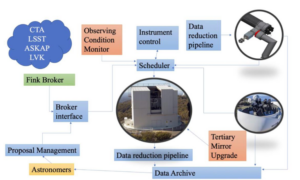
With the expected high contaminant rate, we aim to build a sample of well characterised extreme, rapidly evolving transients, to model transient phenomena and understand their progenitors. The candidates will be observed by Rubin and processed by Fink, which is designed to process large-scale time-domain alerts. Candidates that fit the ANU 2.3m criteria will be automatically observed using the SSO Alert System. Forecasts for this proposal are based on the OzGrav paper Stevenson et al. (2025).
Emma Carli is co-investigator for a proposal on the MeerKAT telescope, which was awarded 30 hours to search for new transients, pulsars and long-period transients in a radio survey of the Small Magellanic Cloud, unlocking the power of the lower frequencies of the MeerKAT telescope’s radio band, which is subject to very little interference. The neutron star population of the SMC will serve as a nearby template for high-redshift, low-metallicity, star-forming dwarf galaxies that are producing hyperactive fast radio bursts, exotic supernovae, gamma-ray bursts, and large high-mass X-ray binary populations.
2026 Plans:
- Coordinate with other users of the 2.3m (Chris Lidman, Katie Auchettl and Brian Schmidt have their own SNe programs) and decide what the extreme transient program will observe versus other programs. Will organise routine check ins with the co-I’s of the project.
- Continue monitoring LSST candidates on Fink. Once we have a better idea of what to target we will design a Fink filter specific to the extreme transient program in consultation with Anais Möller.
- SSO Alert System is up and running – will trial with Fink candidates.
- ATCA Follow-up of Neutron Star Mergers (400h ATCA, PI Dobie) (2025 and 2026)
- Revealing the Nature of Orphan Afterglows in the Rubin-era (120h ATCA, PI Freeburn) (2026)
- LBA classification of radio sources associated with Rubin transients (36h LBA, PI Deller) (2026)
- Understanding the diversity in short GRBs through late-time observations (200h ATCA PI Dobie, 30h VLA PI Leung)
- We have been awarded 495h of ASKAP time to carry out 1 year of ~10 day cadence monitoring of the five Rubin deep drilling fields. These observations will provide deep radio coverage of every discovery in these fields for the first year of operations while they are observed at a higher cadence. This program will be a flagship OzGrav project and a major contribution to the wider time domain astronomy community.
Physics Theme
Key Program: Gravity
Leaders: Lilli Sun
The overall aim of the Gravity Key Program is to perform stringent tests of fundamental physics using both the strongest gravitational fields in the universe and relativistic binary radio pulsars.
Project: Probing Dark Matter/New Particles
Program Leader in Charge: Lilli Sun | Project Scientist: Rowina Nathan
Aim: Use gravitational wave observations and/or gravitational wave detectors to probe dark matter and/or ultralight new particles
Outcomes:
We have an opportunity to test fundamental physics and probe new particles in an innovative way by looking for their impact on gravitational waves. The phenomenon of superradiance suggests that we should expect to find ultralight bosons around astrophysical black holes, if these new particles exist in a particular mass range; their effects may be visible in gravitational-wave data. To achieve this, our first step will be to develop robust analysis methods across various avenues, and then we will directly search for such gravitational wave signals or look for indirect evidence in new gravitational wave data.
Meanwhile, we will use techniques developed for gravitational wave detection to search for dark matter. Again, in an innovative way, we are exploring new experimental approaches that look for dark matter fields coupled to normal matter. We will adapt advanced precision measurement technologies, which are already widely used in GW detection, to this novel task.
2025 Progress:
OzGrav members advanced the use of gravitational-wave observations as an astrophysical probe of new particles through studies of black hole superradiance. Using high-spin binary black hole merger events from the third and fourth observing run, OzGrav researchers performed inference on the properties of ultralight bosons (a dark matter candidate), placing constraints on their allowed mass ranges. This work demonstrated the growing sensitivity of gravitational-wave observations to beyond-standard-model physics through black holes.
In parallel, OzGrav members developed new analysis methodologies for constraining ultralight vector bosons in searches targeting remnant black holes. This framework improved the robustness and interpretability of superradiance-based searches and has been incorporated into LIGO-Virgo-KAGRA collaboration analyses of O4 data. Together, these efforts strengthen the role of gravitational-wave observations as a complementary probe of dark matter and new particle physics.
OzGrav members also made significant contributions to LIGO-Virgo-KAGRA collaboration analyses probing new particles and fundamental physics with gravitational waves. This included leading contributions to the first collaboration search for ultralight vector bosons targeting remnant and Galactic black holes, as well as to studies of fundamental physics using gravitational-wave “twin” events. In addition, OzGrav members led work on the direct detection of ultralight dark matter using gravitational-wave technologies, demonstrating how precision measurement techniques developed for gravitational-wave detectors can be repurposed to search for dark matter.
Contributions to LVK papers:
- Directed searches for gravitational waves from ultralight vector boson clouds around merger remnant and galactic black holes during the first part of the fourth LIGO-Virgo-KAGRA observing run, Submitted to PRD
- Contributions Dana Jones , Lilli Sun, Ornella Piccinni, Karl Wette
- GW241011 and GW241110: Exploring Binary Formation and Fundamental Physics with Asymmetric, High-Spin Black Hole Coalescence, Published in Astrophys. J. Lett.
- Contributions Aswathi PS and Lilli Sun
Short-author paper highlights:
- Jones et al, Phys. Rev. D 111, 063028 (2025)
- Aswathi et al, Rev. D 112, 123048 (2025)
- Sun et al, Phys. Rev. D 111, 063064 (2025)
2026 Plans:
- Continue contributing to gravitational-wave searches for dark matter and new particles within the LIGO-Virgo-KAGRA Collaboration including the O4 b and O4 c boson papers.
- Further develop and apply gravitational-wave–based approaches to probing ultralight bosons and related beyond-standard-model physics.
- Broaden astrophysical constraints on new particles using an expanding set of gravitational-wave observations.
- Strengthen collaborations within OzGrav and with external partners across theory, data analysis, and particle physics.
- Explore complementary dark matter searches, including the use of gravitational-wave instrumentation and other observational probes such as pulsar timing arrays.
- Search for pulsars in the FAST telescope’s drift scan surveys.
Project: Testing General Relativity with GWs
Program Leader in charge: Lilli Sun | Project Scientist: Rowina Nathan
Aim: Test general relativity with gravitational wave events.
Outcomes:
Precision tests of general relativity are enabled by detailed analyses of gravitational-wave signals across all phases of compact binary coalescence. Black hole ringdown, the signal observed after two black holes merge, provides particularly stringent tests due to the precise predictions GR makes for the remnant’s quasi-normal mode spectrum.
Beyond ringdown, we perform complementary tests across the inspiral and merger regimes. These include searches for alternative gravitational-wave polarisations, constraints on deviations from GR during gravitational wave events, and targeted searches for gravitational-wave memory. Together, these analyses probe distinct aspects of the theory and significantly broaden our sensitivity to potential departures from Einstein’s predictions.
We are advancing tests of general relativity by incorporating state-of-the-art theoretical waveform modelling and developing more robust methods to extract weak signals from noisy detector data. Extensive injection campaigns and simulations are used to validate these methods before applying them to O4 events. These efforts contribute directly to LIGO–Virgo–KAGRA collaboration results on strong-field tests of general relativity.
In parallel, we analyse MeerKAT Pulsar Timing Array data to search for non-Einsteinian gravitational-wave signals at nanohertz frequencies, providing an independent and complementary avenue to detect physics beyond the standard model.
2025 Progress:
Using the loudest (highest signal-to-noise ratio) binary black hole merger detected to date, GW250114, we conducted precision tests of Hawking’s area law and tests of general relativity through Einstein’s no-hair theorem. This event provided strong evidence for an increase in the total black hole horizon area consistent with Hawking’s area law, and its measured ringdown modes exhibited frequencies and damping times in agreement with the predictions of general relativity. This work was carried out as part of a collaborative effort within the LIGO-Virgo-KAGRA (LVK) Collaboration and was significantly contributed to by OzGrav members.
In addition, GW250114 was used to directly probe the properties of the remnant black hole horizon through the detection of direct waves. This analysis marked the first experimental measurement of a direct wave in gravitational-wave data.
Two new methods for testing general relativity were developed by OzGrav members and applied to the third Gravitational-Wave Transient Catalog (GWTC-3). No significant deviations from general relativity were found. In addition, OzGrav members developed a new analysis framework for black hole ringdown studies, providing an independent probe of general relativity. This methodology has since been adopted in multiple LIGO-Virgo-KAGRA collaboration analyses of data from the fourth observing run.
OzGrav members also systematically studied how detector calibration impacts black hole ringdown analysis , quantifying their effect on parameter estimation and tests of general relativity. We contributed to the analysis of GW230814, exploring whether such a loud single-detector event could yield robust constraints on fundamental physics. OzGrav members also played a key role in LIGO-Virgo-KAGRA collaboration tests of general relativity during the fourth observing run.
Contributions to LVK papers:
- GW250114: Testing Hawking’s area law, published in PRL
- Contributions: Teagan Clarke (Analyst and paper writing team member)
- Black Hole Spectroscopy and Tests of General Relativity with GW250114, published in PRL
- Contributions (analysts): Neil Lu, Lilli Sun, Ornella Piccinni
- GW230814: investigation of a loud gravitational-wave signal observed with a single detector, published in Astrophys. J. Lett.
- Contributions: Neil Lu, Lilli Sun, Ornella Piccinni
Short-author paper highlights:
- Passenger et al, Astrophys.J. 994.2 (2025): 202.
- Cheung et al, 2507.02335 (Submitted to ApJ)
- Lu et al, Phys. Rev. D 112, 064047 (2025)
- Sinha et al, Phys. Rev. D 1 112, 084038 (2025)
2026 Plans:
- Continue contributions to LIGO-Virgo-KAGRA tests of general relativity using ongoing observing-run data.
- Further explore new and improved tests of general relativity using gravitational-wave observations.
- Extend studies of black hole ringdown and horizon physics to a wider range of events.
- Improve the robustness of tests of general relativity by addressing calibration, modelling, and systematic effects.
- Explore complementary tests of gravity using pulsar timing array data.
- O4b TGR paper
Key Program: Extreme Matter
Leaders: Ryan Shannon
Overall aim: Constrain neutron star and nuclear equations of state
Project: Neutron star masses, densities, & radii
Program Leader in Charge: Ryan Shannon | Project Scientist: Andres F. Vargas
Aim: Measure neutron star masses and study spin irregularities to better understand the structure of neutron stars and properties of nuclear matter.
Outcomes:
In this project we will learn about the quantum physics of nuclear material by studying the densest type of star – a neutron star. Our aim is to understand things such as the neutron star equation of state, which gives the relationship between the density and the pressure.
We can reveal the nature of the neutron star interiors by using high-quality pulsar timing data sets, combined with measurements of the radii of neutron stars from projects such as NICER. We will work with MeerKAT, Murriyang, and eventually SKA to generate these high-quality pulsar timing data sets. We will also develop sophisticated inference tools and apply them to the data (e.g. timing noise) to infer neutron star densities.
The first analysis will concentrate on delivering a robust measurement of the mass of PSR J1902-5105, potentially the most massive neutron star known. We will measure timing noise in J0437-4715 and other pulsars with independent mass measurements, and develop methods to combine mass, radius, and density measurements.
PSR J0437-4715 remains a primary target for NICER, where future analyses rely on OzGrav projects to deliver precise measurements of the pulsar mass derived from Parkes Pulsar Timing Array data sets.
2025 Progress:
- Deployed a Bayesian framework to infer braking torque parameters and timing noise amplitudes for 68 pulsars observed by Murriyang, in collaboration with Swinburne, CSIRO, and Jodrell Bank (Vargas et al. 2025).
- Completed first test run to measure the crust-superfluid coupling timescale using data of 105 pulsars from the UTMOST dataset (Dong et al. 2025).
- Finalised PSR J1902-5105 data set: This millisecond pulsar is of particular interest, and has been the subject of a half decade of monitoring as part of the MeerTime Relativistic binary program. Through the measure of the Shapiro delay of the companion star it is possible to determine the mass of a neutron star. Preliminary evidence suggests the neutron star is one of the most massive ever measured. The data set is finalised, and detailed analysis will be undertaken to determine a robust neutron mass measurement.
- Hosted pulsar data analysis workshop at University of Melbourne: We brought the pulsar community together for a three day workshop, where we shared techniques in pulsar data analysis, with discussions and tutorials led by experts from across OzGrav nodes.
- Organised fortnightly Australasia “ Orange[1]” pulsar seminar series: This fortnightly (online) seminar series brings together pulsar and pulsar adjacent researchers from OzGrav, Australia, and time-zone-aligned countries (notably New Zealand and India) for presentations on neutron stars and related astrophysics.
Paper highlights:
- Lower et al. (2025), MNRAS, 538, 3104
- Dunn et al. (2025), MNRAS, 541, 1792
- Vargas et al. (2025), arXiv:2511.18744
- Dong et al. (2025), arXiv:2511.15134
2026 Plans:
- Infer braking torque parameters and timing noise amplitudes for populations of neutron stars using data from Murriyang and MeerKAT. This includes applying this inference to millisecond pulsars for which the mass is known independently.
- Infer internal parameters, such as the crust-superfluid coupling time-scale, for populations of neutron stars using data from Murriyang.
- Use a neutron star two-component model to analyse J1902-5105, possibly the most massive neutron star known, and J0437-4715, the brightest millisecond pulsar known.
- Develop and apply algorithms that correctly disentangle timing noise from glitches to probe neutron star’s interior parameters.
- Further explore neutron stars’ braking by combining information from electromagnetic data and gravitational-wave searches.
- Using X-ray timing data to infer the time-dependent physics of the disk-magnetosphere interaction in X-ray binaries.
- Finalise mass measurement of PSR J1902-5105: We will undertake robust mass measurements of the MeerKAT pulsar timing measurements to infer the system mass. This will involve incorporating parameter estimation into the GPU accelerated discovery software package.
- Encourage and support collaborations within OzGrav and with external partners across theory and data analysis. This includes co-hosting a KP3/KP4 planning workshop at Melbourne University in April.
- We commenced a collaboration with Vivek Venkatraman Krishnan (MPiFR) to search for ultra-relativistic binaries in the cores of Southern globular clusters by shipping 3 PB of disks to the MeerKAT radio telescope, recording baseband data, then shipping it back to Australia for analysis on the OzSTAR supercomputer.
Project: Pulsar Timing Arrays
Program Leader in Charge: Ryan Shannon | Project Scientist: Daniel Reardon
Aim: Search for nanohertz-frequency gravitational waves and make maps of the nanohertz-frequency gravitational-wave sky.
Outcomes:
With this project we will deliver high quality pulsar timing data sets, particularly with MeerKAT, Murriyang, and eventually the SKA. To analyse this data we will develop sophisticated inference tools, and apply them to our world-leading data sets.
Work in progress is to produce the MeerKAT Pulsar Timing Array (MPTA) 6-year data release and the Parkes Pulsar Timing Array (PPTA) DR4 to search and map gravitational waves. We will then combine our data with that of the International Pulsar Timing Array (IPTA). Finally, we will play a role in developing the science case for the Square Kilometre Array and organise a pulsar inference workshop.
2025 Progress:
- The year started with publication of the first MPTA gravitational wave searches. The searches, discussed in detail in last year’s report, realised the potential for the SKA precursor MeerKAT as an gravitational-wave detector comparable in sensitivity of other experiments despite a much shorter timing baseline. The paper describing the search (Miles et al. 2025) has already been cited more than 100 times.
- The Commencement of the MPTA XLP: The MPTA entered its post MeerTime era as an independent extra large project (XLP) that commenced in March. The MPTA is the highest ranked and largest project XLP. This will ensure continuity in pulsar timing in the southern hemisphere and sensitive GW searches in the coming years..
- MPTA scintillation arc study: In addition to being essential for gravitational wave detections, MSPs can also be used to study the structure of the Milky Way. We used observations of the bright millisecond pulsar J0437-4715 to make a tomographic map of the interstellar medium in the solar neighbourhood (Reardon et al. 2025, Nature Astronomy), showing that region (within a few hundred light years of the sun) contained a series of over 25 discrete filaments, three of which were associated with the wake caused by the pulsar crashing into nearby gas. The Conversation article written to popularise the paper has been read by more than 280,000.
- Completion of the third MPTA and fourth PPTA data releases: we are excited to have completed our latest data releases which extends the timing baselines for both projects. The PPTA fourth data release spans from 2004 to January 2025 and the MPTA data set spans from 2019 to June 2025. The PPTA data release includes new wide-band timing methods (Curylo et al. 2025) that use full polarimetric properties of the pulsars in the analysis: a first for a timing array experiment. These releases set the stage for upcoming gravitational wave searches, which increase in sensitivity with longer timing baselines.
- Array optimisation and verification: With timing array experiments requiring significant observing time on the most powerful radio telescopes, it is important that the observations are most efficiently undertaken. We developed and assessed the best practices for dealing with frequency dependent “chromatic” noise processes in our pulsar timing data sets (di Marco et al. 2025. Kulkarni et al. 2025), show how and when low-frequency observations can be included. We also developed strategies to optimise observing with the MeerKAT Pulsar Timing Array and SKA (Middleton et al. 2025, Gitika et al. 2025), and demonstrated that the current strategy was close to optimal.
- SKA PTA science case: The SKA telescope, currently under construction, will provide the next leap in sensitivity in pulsar timing array experiments, with the SKA-mid telescope having a sensitivity a factor of three to four greater than MeerKAT. We led the effort to update the SKA PTA science case. We developed a realistic and feasible timing array experiment for the SKA, and forecast the science that such an experiment would achieve (Shannon et al. 2025). The SKA PTA will be able to use the sub-arraying capability of SKA to efficiently monitor hundreds of millisecond pulsars. We also presented this work at the SKA science meeting in Goerlitz. The SKA complements future pulsar timing facilities in the northern hemisphere such as the Deep Synoptic Array.
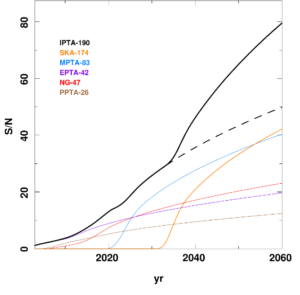
Paper highlights:
- Curtylo et al. (2025), arXiv:2512:09220
- Di Marco et al. (2025), ApJ, 990, 85
- Kimpson et al. (2025), arXiv:2510:11077
- Middleton et al. (2025), MNRAS, 540, 603
- Miles et al. (2025), MNRAS, 536, 1489
- Reardon et al. (2025), Nature Astronomy, 9, 1053
- Shannon et al. (2025), Open Journal of Astrophysics, 8
2026 Plans:
- 2026 is posing to be a transformational year for the PTA outputs for OzGrav. We will search our latest MPTA and PPTA data sets for gravitational wave backgrounds, and use our map making techniques to chart the nanohertz-frequency gravitational wave sky. To do this will require development of detailed models of the astrophysical signals present in the data that are foreground the gravitational waves.
- We will complete work on the Pulsar data portal (Pulsars.org.au), the state of the art data access portal where collaboration members and the public can access carefully manicured data sets from the MPTA and other MeerTime projects. The portal is acting as a prototype for best practices for accessing pulsar data with the SKA, and development work is continuing in collaboration with the Australia SKA Regional Centre.
- Given the increasing importance of our projects and the complexity fo the data analysis it is essential we broaden expertise in pulsar timing data analysis within OzGrav and more broadly in Australasia. To this end, we will host a pulsar timing busy week in April to train OzGrav members in the latest pulsar timing data analysis techniques, benefitting from data analysis. This follows on from a successful workshop we ran in 2022 in advance of our previous PPTA gravitational wave searches and the pulsar data workshop in April 2025.
- We will develop new methods for searching for gravitational waves and hierarchical models that best characterise noise in pulsar timing data sets. These developments will benefit through international collaboration as part of the International Pulsar Timing Array and access to Graphical Process Unit acceleration available on the Nggargu-Tindebeek supercomputer.
- Pulsar timing observations are affected by variations in plasma in the solar system caused by the dynamic and variable Sun. We will develop new methods to assess the impact of this space weather on pulsar timing data sets. In particular we will use for the first time models of the solar wind developed from interplanetary scintillation observations.
Case Study – Utmost-2D PROJECT
Pulsars are formed after massive stars have consumed their nuclear fuel, exploded as supernovae, and collapsed into extremely dense, rapidly spinning neutron stars. Over 3000 are known throughout the Milky Way and nearby galaxies, primarily because of the highly regular pulses of radio waves that they emit as they spin.
Pulsars allow an amazing range of fundamental physics to be studied, from the densest forms of matter, testing Einstein’s special and general relativity, gravitational waves, stellar evolution, and creation of accurate timing standards.
Observing a set of pulsars every day allows us to characterise their properties as a whole in unique ways. This has been the goal of the UTMOST-2D project, which operated on the Molonglo Radio Telescope from 2021 to 2023, collecting data on up to 50 pulsars every day for a total of 170 pulsars.
Molonglo Observatory Synthesis Telescope.
Liam Dunn, then a PhD student at the University of Melbourne, made it a key focus of his thesis to search for “glitches”. These are sudden changes in a pulsar’s rotation — the highly regular train of pulses abruptly shifts in frequency, sometimes between two pulses. Glitches provide insight into the internal structure of neutron stars, driven by the release of stresses as pulsars gradually slow over time.
There are several possible explanations for these events, and the underlying physical mechanisms remain an open question.
Liam’s program of very high frequent and high quality observations of the pulsars results in 17 glitches being detected in just over 2 years of monitoring, an outstanding result. He wrote codes that could give us real-time glitch alerts, so that particular pulsars could be targeted with intense monitoring over the following days and weeks, as well as sophisticated analysis of the entire dataset after the timing program had completed.
Key Program: Cosmos
Leaders: Chris Blake + Ilya Mandel
Overall aim: Study cosmology and astrophysics with gravitational wave sources.
Project: Standard Sirens
Program Leader in charge: Chris Blake | Project Scientist: Maddy Cross-Parkin (previously Simon Goode)
Aim: Improve cosmological measurements and methodologies involving standard sirens.
Outcomes:
We plan to improve cosmological measurements, such as the expansion rate of the Universe, using standard sirens. To do this we will improve the bright siren methodology by constructing velocity maps of the local Universe, propagating peculiar velocity errors into H0 analysis, and refining bright siren inclinations through high-resolution VLBI studies. Simultaneously, we will improve dark siren methodology by curating more complete galaxy redshift catalogues, using simulation studies to link GW mergers to host galaxies and optimise weights, and creating forecasts to optimise follow-up.
In addition, we will further develop other methods such as peak sirens, spectral sirens and joint analyses of the neutron star equation of state, for which we will contribute new modelling and pipelines.
We will build new galaxy catalogues and peculiar velocity maps that can be used in standard siren analyses such as those by LVK, as well as improve the inference methods by including details such as peculiar velocity errors in H0 analyses. We will also assess the value of AAT follow-up of standard sirens and work with the Discovery theme to efficiently follow-up the most interesting events.
2025 Progress:
OzGrav members investigated several areas of standard siren analyses, with a particular focus on events without electromagnetic counterparts—dark sirens. In particular, using data from the LIGO-Virgo-KAGRA third observing run, we showed how binary black hole spins can be used to identify robust mass scales for spectral siren cosmology (https://arxiv.org/abs/2502.10780).
OzGrav members also advanced galaxy catalogue–based methodologies by examining how uncertainties and biases affect Hubble constant measurements. We studied the impact of redshift precision, including trade-offs between spectroscopic and photometric catalogues (https://arxiv.org/abs/2502.17747), and developed a framework describing how peculiar velocity uncertainties propagate into H0 posteriors (https://arxiv.org/abs/2509.03101).
Short-author paper highlights:
- Tong et al, Astrophys.J. 985 (2025) 2, 220
- Cross-Parkin et al, PASA 42 ( 2025) e149
- Blake, Turner et al, Open Journal of Astrophysics 8 (2025)
2026 Plans:
- Publish a new measurement of the Hubble constant based on improved constraints on the inclination angle of GW170817 (Gourdji, Deller et al. 2026).
- Complete our pipeline and analysis using the peak siren method, which uses cross-correlations between gravitational wave sources and large-scale structure as an alternative to traditional dark siren techniques (Cross-Parkin et al. 2026).
- Perform a pilot study using the AAT for standard siren follow-up (Rauf, Lidman et al. 2026).
- Publish our analysis of how peculiar velocities affect measurements of the Hubble constant using current dark siren cosmology pipelines (Goode et al. 2026).
- Continue our involvement in the GWCats Collaboration.
Mapping the local Universe for standard sirens
The Dark Energy Spectroscopic Instrument (DESI) Peculiar Velocity Program is a dedicated component of the DESI survey that leverages direct measurements of galaxy distances and motions to probe the growth of cosmic structure and the nature of dark energy. Peculiar velocities—galaxy motions deviating from pure cosmic expansion—encode information about gravitational clustering and the underlying cosmological model, offering a powerful complement to traditional clustering and redshift-space distortion analyses. OzGrav member Khaled Said led the paper describing the DESI peculiar velocity program (Said et al. 2025, MNRAS, 539, 3627).
Distribution of the DESI Data Release 1 Fundamental Plane sample (blue) compared to the Cosmic Flows 4 catalogue (Tully et al., 2023, black) and the DESI early data release sample (Said et al., 2024, orange).
In late 2025, the DESI collaboration released a coordinated set of DESI DR1 Peculiar Velocity (PV) results, marking the first comprehensive exploitation of peculiar velocity data from the survey’s Bright Galaxy Survey (BGS) at low redshift (z < 0.1). Central among these is the Fundamental Plane Catalogue, led by OzGrav student Caitlin Ross and her supervisors Cullan Howlett and Khaled Said (arXiv:2512.03226), which provides the largest single sample to date of direct peculiar velocity measurements for early-type galaxies, with ~98,000 Fundamental Plane-based distances and velocities. This dataset doubles the historical sample of such measurements and sets the stage for precision local-universe cosmology.
In the future, OzGrav members will use this data to improve gravitational-wave standard siren measurements of the expansion rate of the Universe. Peculiar velocities can contaminate these measurements, and the DESI maps allow us to remove this source of error.
Project: GW Astrophysics
Program Leader in charge: Ilya Mandel | Project Scientist: Alexey Bobrick
Aim: Use gravitational waves and electromagnetic observations to develop and test a coherent story of stellar and binary evolution, including dynamical interactions.
Outcomes:
This project focuses on understanding the progenitors of gravitational waves. It uses state-of-the-art stellar evolution simulations to model the LIGO and LISA gravitational-wave signals from populations of gravitational-wave sources. Specifically, we model how many double compact objects form and merge, how often they do so, how massive they are, how far apart they are, and where in the Milky Way or in other galaxies they are found. We compare these predictions with the observed gravitational-wave and electromagnetic populations
We focus on reducing uncertainties in key evolutionary stages of binary stars, such as the common-envelope phase and supernovae, through detailed simulations and the development of computationally efficient recipes. We incorporate these recipes into the COMPAS population synthesis code, which predicts gravitational-wave population properties, allowing us to compare COMPAS predictions with gravitational-wave and EM observations for a variety of sources, including X-ray binaries, supernovae, GRBs, and double white dwarf binaries, to identify areas for improvement in the models. Alongside this effort, we explore and constrain other formation channels for merging compact objects (cluster environments, AGN disks, 3-body dynamics) and high-energy physics (nuclear star clusters, tidal disruption events, luminous red novae and other electromagnetic transients).
2025 Progress:
- We have extended the COMPAS code to include more realistic models of stellar response to accretion and mass loss, an improved treatment of tides, common envelope evolution, stellar winds, and chemically homogeneous evolution, thereby improving the modelling of gravitational-wave sources.
- We modelled low-mass X-ray binaries, millisecond pulsars, spider pulsars, and gamma-ray bursts, constraining the models of stellar ablation and neutron star kicks.
- We synthesised the Galactic populations of double white dwarf binaries for LISA, and modelled the populations of stellar progenitors, including sdB binaries and stripped horizontal branch stars.
- We published on supernovae, AGN discs, tidal disruption events and LIGO detections.
- With our collaborators in the US we used the JWST to detect the planetary-mass companion to a binary millisecond pulsar. This revealed Carbon lines in the spectrum and enabled us to measure the radial velocity and mass ratio of the system. It was mentioned in the New York Times.
Paper highlights:
- Mandel et al. 2025 (.280…43T; including Mandel, Riley, Brček, Hirai, Song, Stevenson)
- Disberg & Mandel 2025 (..989L…8D)
- Disberg et al. 2025 (2025A%26A…703A.288D; including Mandel)
- Gulati et al. 2025 (538.2676G; including Murphy, Dobie, Deller, Mandel)
- Lau et al 2025 (2025A%26A…699A.274L; including Hirai, Mandel)
- Shikauchi et al. 2025 (..984..149S; including Hirai, Mandel)
- Gilbaum et al. 2025 (..982L..13G; including Grishin, Mandel)
- Hu et al 2025 (..988L..24H; including Mandel)
- Bobrick et al. 2025 (544.3601B)
- Hirai et al. 2025 (..995…55H)
- Benitez-Palacios et al. 2025 (2025A%26A…697A..98B; including Bobrick)
- Vigna-Gómez et al. 2025 (2025A%26A…699A.272V; including Grishin, Bobrick)
- Zhang et al. 2025 (..995L..64Z; including Bailes, Reardon, Carli, Shannon)
2026 Plans:
- Further improving COMPAS models by calibrating them using detailed stellar / binary evolution codes.
- Improving the physics modelling in COMPAS, including the physics of ablation.
- Identifying synergies between LIGO, LISA, LSST and upcoming detectors.
Project: Physics with Fast Radio Bursts (FRBs)
Program Leader in charge: Ilya Mandel | Project Scientist: Manisha Caleb
Aim: Leverage OzGrav’s expertise in population synthesis modelling and inference to maximise the utility of FRBs as probes of cosmology.
Outcomes:
Fast-radio bursts have the potential to be strong probes of cosmology, because they offer unique backlights against which to measure the intervening matter – and use that to infer properties of the expansion of the universe.
We will perform cross-correlations between FRBs and large-scale structure to refine models of the baryon distribution and improve constraints on missing baryons. Meanwhile, we will extend the inference framework to improve the precision of our measurements of the expansion rate of the Universe, H0.
To get observational data we will collaborate with the detection theme to search for prompt FRBs from merger events, and sub-threshold GW searches. The extreme matter group can also use these FRBs to study merger remnants and the neutron star equation of state.
Finally, we will perform population synthesis modelling of potential progenitors to predict redshift distributions that can be compared against observations.
2025 Progress:
We have defined the scope of FRBs within Ozgrav to be FRB cosmology with a focus on simulations and population modelling.
- Cross-correlate publicly available FRBs with the large-scale structure (Publication in progress: Andy Nguyen)
- Crossmatch FRB positions with GWs (Publication in progress: Eric Howell)
Paper highlights:
- Roxburgh et al. 2025 (..42..164R; including Caleb, Deller and Shannon)
- Glowacki et al. 2025 (..42..157G; including Deller and Shannon)
- Huang et al. 2025 (.277…64H; including Deller and Shannon)
- Hoffmann et al. 2025 (..42…17H; including Deller and Shannon)
- Hsu et al. 2025 (2025A&A…698A.163H; including Ho)
- Hammer et al. 2025 (538.1800H; including Caleb and Driessen)
- Jaini et al. 2025 (..42…60J; including Deller)
- Gordon et al. 2025 (..993..119G; including Deller, Gourdji and Shannon)
- Jahns-Schindler & Spitler 2025 (112j3541J)
2026 Plans:
- Forecast the FRB detection rates at upcoming radio facilities (Tsu-Yin Hsu).
- Develop a unified framework for H0 constraints using FRBs, SNe and GWs (Nandita).
- Potential project involving a MeerTRAP/MeerKAT + CRAFT/ASKAP collaboration on modelling the joint population and obtaining cosmological constraints.
- Gravitational milli-lensing (Eric Thrane, Adam Deller, Manisha Caleb).
[1] The name follows the tradition of the Texas Symposia in Relativistic Astrophysics. The first “Orange” meeting was held in person in the town of Orange, NSW, and the name has been shared with subsequent in person and online meetings.
People of OzGrav

At the heart of OzGrav is a diverse and passionate community of researchers, students, professional staff, and collaborators. United by a shared curiosity about the Universe and a drive to push the boundaries of discovery, our people are what make OzGrav truly exceptional.
KPI Dashboard
Linkages and Collaborations
OzGrav students and researchers are involved in many collaborations, both international and Australia-wide.
International Partners and Collaborators
- Advanced Virgo
- Adopting Sustainable Partnerships for Innovative Research Ecosystem (ASPIRE) – Gravitational Waves
- Agnes Scott College
- California Institute of Technology (Caltech)
- Centre for Collaborative Education
- Chinese Academy of Sciences Institute of Theoretical Physics
- European Space Agency (ESA)
- Harvard University
- Istituto Nazionale di Fisica Nucleare (INFN)
- KAGRA
- Kavli Institute for Theoretical Physics China
- Keck Observatory
- Laser Interferometer Gravitational-Wave Observatory (LIGO)
- Massachusetts Institute of Technology (MIT)
- Max Planck Institute for Gravitational Physics (Hannover) – Albert Einstein Institute
- Max Planck Institute for Radio Astronomy
- MeerTime Collaboration
- NASA Goddard Space Flight Centre
- NASA Jet Propulsion Laboratory
- Northwestern University
- Quaisr
- University of Auckland
- University of Chicago
- University of Florida
- University of Glasgow
- University of California, Santa Cruz
- University of South Florida, St. Petersburg
- University of Tokyo
- University of Warwick
- University of Wisconsin–Milwaukee
- Utah State University
National Partners and Collaborators
- Advanced Navigation
- Anglo Gold Ashanti
- Astronomical Society of Australia
- Astronomy Australia Ltd
- Australian Research Translation and Innovation Consortium (ARTIC)
- Casey Tech School
- Charles Sturt University
- Cruxes Innovation
- CSIRO Australia Telescope National Facility (ATNF)
- DST (Defence Science and Technology)
- Forge Photonics
- Gravity Discovery Centre
- International Centre for Radio Astronomy Research (ICRAR)
- Knox Innovation Opportunity and Sustainability Centre
- Liquid Instruments Pty Ltd
- Pentalym
- Science With Mat
- Xcalibur Multiphysics
LIGO-Virgo-KAGRA Scientific Collaboration (LVK)
LIGO (Laser Interferometer Gravitational-Wave Observatory) is the world’s largest gravitational wave observatory and a cutting-edge physics experiment, comprising two enormous laser interferometers located thousands of kilometres apart in Hanford (Washington) and Livingston (Louisiana), USA. LIGO exploits the physical properties of light and of space itself to detect and understand the origins of gravitational waves. LIGO is funded by the NSF and operated by Caltech and MIT, which conceived of LIGO and led the Initial and Advanced LIGO projects.
Financial support for the Advanced LIGO project was led by the NSF with Germany (Max Planck Society), the U.K. (Science and Technology Facilities Council), and Australia (Australian Research Council) making significant commitments and contributions to the project. More than 1,500 scientists and over 100 institutions from around the world participate in the effort through the LIGO Scientific Collaboration, which includes the GEO Collaboration and the Australian collaboration OzGrav. Additional partners are listed at http://ligo.org/partners.php.
The Virgo Collaboration is currently composed of approximately 850 members from 143 institutions in 15 different (mainly European) countries. The European Gravitational Observatory (EGO) hosts the Virgo detector near Pisa in Italy and is funded by Centre national de la recherche scientifique (CNRS) in France, the Istituto Nazionale di Fisica Nucleare (INFN) in Italy, and the National Institute for Subatomic Physics (Nikhef) in the Netherlands. A list of the Virgo Collaboration groups can be found at public.virgo-gw.eu.
KAGRA is a laser interferometer in Kamioka, Gifu, Japan. The host institute is the Institute for Cosmic Ray Research (ICRR) at the University of Tokyo, and the project is co-hosted by the National Astronomical Observatory of Japan (NAOJ) and the High Energy Accelerator Research Organization (KEK). The KAGRA collaboration is composed of more than 480 members from 115 institutes in 17 countries/regions.
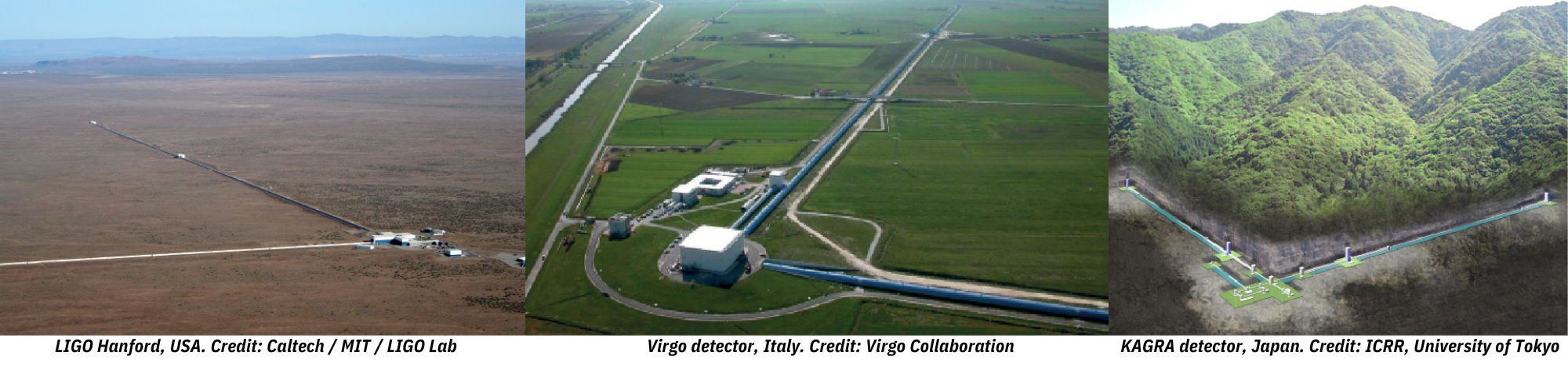
National and International Leadership Roles
OzGrav researchers make significant contributions to major national and international collaborations and peak bodies through leadership roles, including chairing working groups and serving in other key management positions.
- Jackie Bondell:
- Associate Member – ASTRO Accel Network
- Australian Representative for the International Particle Physics Outreach Group
- National Astronomy Education Coordinator for Australia to the International Astronomy Union
- Facilitator of the LVK Eastern Longitudes EPO Group
- Chair of the Education and Outreach Committee for the Astronomical Society of Australia
- Tara Murphy:
- Scientific Organising Committee, Dynamic Radio Sky conference
- Diana Haikal:
- Australian Research Translation and Innovation Consortium (ARTIC) Advisory Board
- Anais Möller:
- Fink collaboration Principal Investigator and management team
- Roman Space Telescope RAPID External Advisory Board (member)
- Member of Rubin LSST Dark Energy Science Collaboration time-domain and AI, LSST Transients and Variable Starts Collaboration Classification working groups; Dark Energy Survey Supernova working group; 4MOST Time Domain Extragalactic Survey and LSST Informatics and Statistics Science Collaboration
- Chair, Scientific Advisory Committee: OzFink workshop 2025
- Scientific Advisory Committee, Roman Space Telescope RAPID Response
- Scientific Advisory Committee, Astronomical Society of Australia Annual Science Meeting
- Scientific Advisory Committee, Dynamic Radio Sky conference
- Lauren Carter:
- Swinburne Accessibility Network – Staff Chair
- Phillip Charlton:
- LSC Co-chair of detector characterisation for the stochastic working group
- David McClelland:
- OzGrav representative, Gravitational Wave International Committee
- Member, International Gravitational Wave Network Planning Committee
- OzGrav Principal Investigator, LIGO Scientific Collaboration
- Australian GW Observatory Project (OzGWOP) Advisory Board
- Member, National Committee for Astronomy, Academy of Science
- Jade Powell:
- LVK Burst working group co-Chair
- Organizing Committee, March LVK conference in Melbourne, March 2025
- Organizing Committee, SN2025gw: The first IGWN symposium on core collapse supernova gravitational wave theory and detection, Warsaw, July 2025
- Simon Stevenson:
- Member of the AAL Science Advisory Committee
- David Ottaway:
- Chair of the LIGO Program Advisory Committee
- Member, IGWN Program Committee
- Paul Lasky:
- AAL Board member
- Chair, OzGWOP (Australian Gravitational Wave Observatory Project)
- Eric Thrane:
- Member, AAL Project Oversight Committee
- Co-Chair, LIGO Compact Binary Coalescence Group
- Bram Slagmolen:
- LSC Seismic Isolation & Suspensions WG Chair
- Ling (Lilli) Sun:
- Cosmic Explorer Data Analysis and Calibration Scientist
- LIGO Calibration Working Group Co-chair
- Scientific Organising Committee for the 19th International Conference on Topics in Astroparticle and Underground Physics (TAUP)
- Scientific Organising Committee for the Gravitational-Wave Physics and Astronomy Workshop (GWPAW)
- Karl Wette:
- Chair of Scientific Advisory Panel for the Australian Gravitational Wave Data Centre
- Treasurer, Australasian Society for General Relativity and Gravitation
- Member, Scientific Organising Committee, International Symposium on Cosmology & Particle Astrophysics 2026 and 13th Australasian Conference on General Relativity & Gravitation
- Member, GW Allies (Anti-harassment initiative for the LIGO Scientific Collaboration, Virgo Collaboration, and KAGRA collaboration)
- Matthew Bailes:
- LSC Standards & Conduct Committee Chair
- Chair of the Gravitational Wave International Committee
- Chair of the Australian Research Translation and Innovation Consortium (ARTIC)
- Matt Miles:
- Leader of the MeerKAT Pulsar Timing Array
- Ryan Shannon:
- Principal Investigator, CRAFT/ASKAP Survey Science Project
- Principal Investigator and Technical Lead, MeerKAT Pulsar Timing Array
- Member, International Pulsar Timing Array Steering Committee
- Member, IAU Organising Committee for Commission D1 (Gravitational Waves)
- Ilya Mandel:
- Aspen Center for Physics general member, treasurer
- President, IAU Binary and Multiple Star Systems Commission G1
- Member, ASTAC committee of the AAL
- International Statistics Institute (ISI) Astrostatistics Special Interest Group Management Committee
- Jarrod Hurley:
- AAL representative on the AusSRC board
- Swinburne representative on the Nectar Steering Committee
- Adam Deller:
- Member, ATNF Steering Committee
- Kirk McKenzie:
- Keck Institute for Space Studies – Caltech/JPL Think tank for the interplanetary laser trilateration network
- 2026 CLEO 2026 Technical Program Committee
- Tamara Davis:
- Member, Australia Telescope National Facility Steering Committee
- Editorial Board for Australian Astronomy’s Decadal Plan
- Dark Energy Spectroscopic Instrument (DESI) Ombudsperson
- Dark Energy Spectroscopic Instrument (DESI) Institutional Board
- Dark Energy Survey (DES), Management Committee
- Supernova Symposium 2027 Organising Committee
- COSMO25 Steering Committee
- Gosia Curylo:
- Member, MeerKAT Pulsar Timing Array (MPTA)
- Member, Parkes Pulsar Timing Array
- PPTA representative, International Pulsar Timing Array Steering Committee
- Member, PPTA Steering Committee
- Brian Schmidt:
- Board member, National Research Infrastructure Advisory Group Board that oversees Major Research Infrastructure
- Laura Driessen:
- Project Scientist, Variables and Slow Transients (VAST) survey with ASKAP
- Scientific organising committee, Stars in Brisbane conference
- Fiona Panther:
- Co-Chair, LIGO CBC-EM detection taskforce
- Chair, Australian National Institute for Theoretical Astrophysics
- External representative, ANU 2.3m telescope Time Allocation Committee
- Kelly Gourdji:
- Member, Australia Telescope National Facility time assignment committee
- Science organising committee for the 2025 FRB conference in Montreal, Canada
- Elaine Sadler:
- Scientific Advisory Board member, Max Planck Institute for Extraterrestrial Physics
- ACAMAR Management Group member (Australia-China)
- Australian SKA Science Advisory Committee (ASSAC) member
- Scientific Organising Committee member, 2026 ACAMAR 11 meeting (to be held in Geraldton, WA)
- Susan Scott:
- Editor-in-Chief of Classical and Quantum Gravity, IOP
- Series Editor for Springer Graduate Texts in Physics book series and Undergraduate Texts in Physics book series
- Member of International Society on General Relativity and Gravitation
- Member of the Local and Scientific Organising Committees for the LIGO-Virgo-KAGRA Collaboration Meeting held in Melbourne, 24–27 March 2025
- Member of the Organising Committee for “Celebrating 10 years of Gravitational Waves” held in Melbourne, 18–19 September 2025
- Member of Scientific Organising Committee for CosPA 2026 and ACGRG 13 to be held in Christchurch, 5–9 July 2026
- Andrew Melatos:
- International organising committee, Texas Symposium on Relativistic Astrophysics
- Daniel Holz:
- Presidential line for the International Astronomical Union Commission D1
- Panel on Public Affairs of the American Physical Society
- Hannah Middleton:
- LIGO Magazine (Editor in Chief)
- LISA Communications Implementation Working Group (co-chair)
- LISA Diversity, Equity and Inclusion Committee (member)
- Dougal Dobie:
- Primary organiser and SOC chair for Dynamic Radio Sky 2025 conference
- ASA Time Domain Astronomy Chapter Steering Committee
- Ryosuke (Ryo) Hirai:
- ALManaC (Australian LSST Management Committee) JA representative
- ANITA (Australian National Institute for Theoretical Astrophysics) steering committee member
- Daniel Reardon:
- Chair, International Pulsar Timing Array Steering Committee
- Co-Chair, Parkes Pulsar Timing Array collaboration
- Yeshe Fenner:
- Treasurer and Council member, Astronomical Society of Australia
- Member, LVK Standard and Conduct Committee
- Robert Song:
- Steering Committee member of the IDEA Chapter of the ASA
- Renate Meyer:
- Chair of the New Zealand Astrostatistics and General Relativity Group
- Representative of NZ within ESA DDPC
- Associate Editor, Journal of Statistical Computation and Simulation
- Chiara Di Fronzo:
- LIGO magazine editor
- Ju Li:
- LSC Speakers Board
- Georgia Bolingbroke:
- LIGO magazine editor
- Emma Carli:
- Member, TRAPUM collaboration
- Member, MPTA collaboration
- Alexey Bobrick:
- Member of the LISA Council
- Chair of the Appointments and Elections Committee in the LISA Consortium
- Co-coordinator of the LISA Synthetic UCB Catalogs Project
- Co-Chair in the SMWLV-Variable Stars SWG for LSST
- Chair in the SOC for the EAS 2025 Symposium on Binary Stellar Interactions
- Chair in the SOC for the EAS 2026 Symposium on LISA and PTAs
- Co-Chair, together with Sharan Banagiri, in the SOC for the OzGrav-supported Symposium on LISA in October/November 2026 in Melbourne
- Co-organiser of regularly meeting discussion groups on thermonuclear supernovae and contact binaries
Finance
ARC Centre Funds Overview
Governance
The OzGrav Executive Committee oversees the management, operations, and performance of the Centre across the six collaborating research nodes. Led by the Centre Director, the Centre Executive Committee comprises representation from each node. The Executive receives advice from four OzGrav committees/boards; the Governance Advisory Board, Scientific Advisory Board, Early Career Researcher Committee, and the Equity, Diversity & Inclusion Committee.
Day-to-day operational matters are managed by the core administrative team, led by the Chief Operating Officer, in consultation with the Centre Directorate (comprising the Centre Director, Deputy Directors, and Chief Operating Officer).
The Centre’s Governance Advisory Board includes prominent representatives from the Australian education, research, engineering and business sectors. This committee is responsible for advising on OzGrav’s strategic direction, governance and fiscal management, structure and operating principles, performance against Centre objectives, and intellectual property and commercialisation management.
The role of the OzGrav Scientific Advisory Board is to provide the Centre with independent scientific expertise, advice, and experience from established national centres and leading international laboratories regarding the OzGrav research program.
The Equity, Diversity & Inclusion Committee oversees the development and implementation of strategies to enable positive and supportive work environments for all our members, and to promote equity and diversity. The committee has developed an equity and diversity action plan, and regularly reviews and monitors the Centre’s performance against the plan.
The OzGrav Early Career Researcher Committee represents and supports students and postdocs across the Centre, driving initiatives that foster professional development, networking, mentoring, and inclusion. The committee plays a key role in shaping training programs and creating a positive, connected experience for early career members.
The Centre makes excellent use of videoconferencing to facilitate communications and collaboration among our dispersed team and committees. Our weekly centre-wide videoconferences have helped galvanise the Centre. These meetings are attended by as many as 100 people each week and give members an opportunity to discuss science and share general updates.
OzGrav Executive Committee 2025
- Prof Matthew Bailes – OzGrav Director, Swinburne University of Technology
- Prof David McClelland – OzGrav Deputy Director & Node Leader, Australian National University
- Prof Tamara Davis – OzGrav Deputy Director & Node Leader, University of Queensland
- Prof Robert Ward – Node Leader, Australian National University
- Prof Jarrod Hurley – Node Leader, Swinburne University of Technology
- Prof Andrew Melatos – Node Leader, University of Melbourne
- Prof Paul Lasky – Node Leader, Monash University
- Prof Peter Veitch – Node Leader, University of Adelaide
- Prof Chunnong Zhao – Node Leader, University of Western Australia
- Prof Tara Murphy – Node Leader, University of Sydney
Partner Investigators 2025
- David Reitze – Laser Interferometer Gravitational-Wave Observatory (LIGO), California Institute of Technology
- Matthew Evans – Massachusetts Institute of Technology
- Michael Kramer – Max Planck Institute for Radio Astronomy
- Keith Bannister – Commonwealth Scientific and Industrial Research Organisation (CSIRO)
- Enrico Ramirez-Ruiz – University of California, Santa Cruz
- Selma de Mink – Max Planck Institute for Astronomy
- Vassiliki (Vicky) Kalogera – Northwestern University
- Sheila Rowan – University of Glasgow
- Viviana Fafone – Advanced Virgo, European Gravitational Observatory
- Patrick Brady – University of Wisconsin–Milwaukee
- Daniel Holz – University of Chicago
- James (Ira) Thorpe – NASA Goddard Space Flight Center
Governance and Advisory Boards
OzGrav is guided by two key advisory bodies: the Governance Advisory Board (GAB) and the Scientific Advisory Board (SAB), which provide strategic and scientific oversight, respectively. Chairs for both boards have been confirmed for the current term.
Governance Advisory Board (GAB)
The GAB provides oversight on strategic direction, governance, and Centre operations. The full board includes representatives from academia, industry, and government, reflecting the broad stakeholder base of the Centre.
Chair: Prof. Stuart Wyithe – Director, Research School of Astronomy and Astrophysics, Australian National University
- Sarah Pearce – Director, SKA-Low Telescope, SKA Observatory
- Karen Hapgood – ex-officio DVC-R, Swinburne University of Technology
- Tanya Hill – Senior Curator Astronomy, Museum Victoria
- Werner van der Merwe – Vice President (Innovation and Enterprise), Swinburne University of Technology
- Jess McIver – Associate Professor, University of British Columbia
- David Shoemaker – Senior Research Scientist, Massachusetts Institute of Technology
- Paul Bonnington – ex-officio DVC-R delegate, University of Queensland
Scientific Advisory Board (SAB)
The SAB provides expert advice on scientific priorities, performance, and international alignment. Members are drawn from leading research institutions across the globe.
Chair: Prof. Stan Whitcomb – LIGO, American Physical Society (APS) and Optical Society (OSA)
- Maya Fishbach – Assistant Professor, University of Toronto
- Lisa Barsotti – Senior Research Scientist, MIT Kavli Institute – LIGO Laboratory
- Rachel Gray – Lecturer, University of Glasgow
- Katerina Chatziioannou – Assistant Professor of Physics, California Institute of Technology
- Giles Hammond – Professor, University of Glasgow
- Stephen Taylor – Associate Professor, Vanderbilt University
Equity, Diversity & Inclusion Committee 2025
- Scarlett Abramson, University of Melbourne
- Eric Thrane, Monash University
- Yuzhe Song, Swinburne University of Technology
- Olivia Vidal Velazquez, Swinburne University of Technology
- Karl Wette, Australian National University
- Deeksha Beniwal, University of Adelaide
- Katie Auchettl, University of Melbourne
- Lauren Carter (ex-officio), Swinburne University of Technology
- Yeshe Fenner, Swinburne University of Technology
Early Career Researcher Committee 2025
- Ari Hernandez, Swinburne University of Technology
- Ashwathi Nair, Swinburne University of Technology
- Blaze Houlden, University of Melbourne
- Chiara Di Fronzo, University of Western Australia
- Diana Haikal, Swinburne University of Technology
- Dimitra Dannappel, Swinburne University of Technology
- Dougal Dobie, University of Sydney
- Hayley Valiantis, University of Queensland
- Iris de Ruiter, University of Sydney
- Jian Liu, University of Western Australia
- Joshua Baines, University of Melbourne
- Kavya Shaji, University of Sydney
- Khaled Said, University of Queensland
- Lauren Carter, Swinburne University of Technology
- Liana Rauf, Australian National University
- Madison Simmonds, Adelaide University
- Mallika Sinha, Monash University
- Nandita Khetan, University of Queensland
- Neil Lu, Australian National University
- Olivia Vidal Velázquez, Swinburne University of Technology
- Rowina Nathan, Australian National University
- Saurav Mishra, Swinburne University of Technology
- Sparrow Roch, Swinburne University of Technology
- Tong Cheunchitra, University of Melbourne
- Yeshe Fenner, Swinburne University of Technology
Outreach Working Group 2025
- Matthew Bailes, Swinburne University of Technology
- Jackie Bondell, Swinburne University of Technology
- Yeshe Fenner, Swinburne University of Technology
- Chiara Di Fronzo, University of Western Australia
- Diana Haikal, Swinburne University of Technology
- Jyoti Kaur, University of Western Australia
- Yi Shuen Christine Lee, University of Melbourne
- Saurav Mishra, Swinburne University of Technology
- Rowina Nathan, Monash University
- Liana Rauf, Australian National University
Outreach Ambassadors 2025
- Alexis Ansell, Monash University
- Ashna Gulati, University of Sydney
- Ashwathi Nair, Swinburne University of Technology
- Bailee Wolfe, Swinburne University of Technology
- Blaze Houlden, University of Melbourne
- Diana Haikal, Swinburne University of Technology
- Ella Martin, Monash University
- Hendrik Combrinck, Swinburne University of Technology
- Jackie Bondell, Swinburne University of Technology
- Joshua Baines, University of Melbourne
- Justin Yu, University of Melbourne
- Jyoti Kaur, University of Western Australia
- Laura Burn, University of Auckland
- Leonardo Giani, Swinburne University of Technology
- Madeleine Willshire, Monash University
- Madeline Cross-Parkin, University of Queensland
- Mitchell Hooymans, University of Queensland
- Mitchell Richardson, Adelaide University
- Nandita Khetan, University of Queensland
- Natalie Bowesman, University of Sydney
- Neil Lu, Australian National University
- Nir Guttman, Monash University
- Olivia Vidal Velázquez, Swinburne University of Technology
- Petra Tang, University of Auckland
- Rianna Bell, University of Queensland
- Rowina Nathan, Monash University
- Samuel Sentschuk, Adelaide University
- Saurav Mishra, Swinburne University of Technology
- Simon Ho, Australian National University
- Sparrow Roch, Swinburne University of Technology
- Tong Cheunchitra, University of Melbourne
- Yi Shuen Christine Lee, University of Melbourne
Publications
Publications
Formatted as: Authors (Year). Title. Journal. DOI
Abac, A. G. et al. (2025). Search for Continuous Gravitational Waves from Known Pulsars in the First Part of the Fourth LIGO-Virgo-KAGRA Observing Run. The Astrophysical Journal. DOI
Abac, A. G. et al. (2025). Search for Gravitational Waves Emitted from SN 2023ixf. The Astrophysical Journal. DOI
Abac, A. G. et al. (2025). GW250114: Testing Hawking’s Area Law and the Kerr Nature of Black Holes. Physical Review Letters. DOI
Abac, A. G. et al. (2025). All-sky search for short gravitational-wave bursts in the first part of the fourth LIGO-Virgo- KAGRA observing run. Physical Review D. DOI
Abac, A. G. et al. (2025). GW231123: A Binary Black Hole Merger with Total Mass 190–265 M⊙. The Astrophysical Journal. DOI
Abac, A. G. et al. (2025). GW241011 and GW241110: Exploring Binary Formation and Fundamental Physics with Asymmetric, High-spin Black Hole Coalescences. The Astrophysical Journal. DOI
Abac, A. G. et al. (2025). GWTC-4.0: An Introduction to Version 4.0 of the Gravitational- Wave Transient Catalog. The Astrophysical Journal. DOI
Abbott, R. et al. (2025). Tests of general relativity with GWTC-3. Physical Review D. DOI
Abdalla, A. et al. (2025). Terrestrial Very-Long-Baseline Atom Interferometry: summary of the second workshop. EPJ Quantum Technology. DOI
Afshordi N., Akcay S., Amaro Seoane P., Antonelli A. et al., Waveform modelling for the Laser Interferometer Space Antenna: Waveform modelling for LISAN (2025). Living Reviews in Relativity. DOI
Agrawal, P., Breivik, K., Hurley, J., Rodriguez, C., Stevenson, S., Kemp, A., & Szécsi, D. (2025). METISSE: METhod of Interpolation for Single Star Evolution. The Journal of Open Source Software. DOI
Ajith, P. et al. (2025). The Lunar Gravitational-wave Antenna: mission studies and science case. Journal of Cosmology and Astroparticle Physics. DOI
Akutsu, T. et al. (2025). Identification of Noise-Associated Glitches in KAGRA O3GK with Hierarchical Veto. Progress of Theoretical and Experimental Physics. DOI
Andrés-Carcasona, M., Piccinni, O. J., Martínez, M., & Mir, L. M. (2025). New approach to search for long transient gravitational waves from inspiraling compact binary systems. Physical Review D. DOI
Anumarlapudi, A. et al. (2025). ASKAP J144834−685644: a newly discovered long period radio transient detected from radio to X-rays. Monthly Notices of the Royal Astronomical Society. DOI
Arcus, W. R. et al. (2025). The fast radio burst population energy distribution. Publications of the Astronomical Society of Australia. DOI
Aswathi, P. S., East, W. E., Siemonsen, N., Sun, L., & Jones, D. (2025). Ultralight boson constraints from gravitational wave observations of spinning binary black holes. Physical Review D. DOI
Baker, A. M., Lasky, P. D., Thrane, E., & Golomb, J. (2025). Significant challenges for astrophysical inference with next-generation gravitational-wave observatories. Physical Review D. DOI
Behiri, M., Mahony, E. K., Sadler, E., Kerrison, E., Traina, A., Zanchettin, M. V., Galluzzi, V., Lapi, A., & Massardi, M. (2025). A FLASH on blazars: Capturing the radio realm of 4FGL blazars with SKA Observatory pathfinders. Astronomy and Astrophysics. DOI
Benitez-Palacios, D., Uzundag, M., Vučković, M., Arancibia-Rojas, E., Durán-Reyes, A., Vos, J., Bobrick, A., Zorotovic, M., & Jones, M. I. (2025). Volume-limited sample of low-mass red giant stars, the progenitors of hot subdwarf stars: II. Sample validation. Astronomy and Astrophysics. DOI
Bera, A., James, C. W., McKinnon, M. M., Ekers, R. D., Dial, T., Deller, A. T., Bannister, K. W., Glowacki, M., & Shannon, R. M. (2025). Unusual Intraburst Variations of Polarization States in FRB 20210912A and FRB 20230708A: Epects of Plasma Birefringence?. The Astrophysical Journal. DOI
Bezuidenhout, M. C. et al. (2025). Slow and steady: long-term evolution of the 76-s pulsar J0901-4046. Monthly Notices of the Royal Astronomical Society. DOI
Blake, C., & Turner, R. J. (2025). The role of peculiar velocity uncertainties in standard siren cosmology. The Open Journal of Astrophysics. DOI
Bobrick, A., Davies, M. B., & Perets, H. B. (2025). Gas in globular clusters – I. Gas retention and its possible consequences. Monthly Notices of the Royal Astronomical Society. DOI
Bodensteiner, J. et al. (2025). Binarity at LOw Metallicity (BLOeM): Multiplicity properties of Oe and Be stars. Astronomy and Astrophysics. DOI
Boubel, P., Colless, M., Said, K., & Staveley-Smith, L. (2025). Testing anisotropic Hubble expansion. Journal of Cosmology and Astroparticle Physics. DOI
Bower, G. C. et al. (2025). Long-term Astrometric Monitoring of the Galactic Center Magnetar PSR J1745-2900. The Astrophysical Journal. DOI
4357/ade0be Britavskiy, N. et al. (2025). Binarity at LOw Metallicity (BLOeM): Multiplicity of early B-type supergiants in the Small Magellanic Cloud. Astronomy and Astrophysics. DOI
Bu, Y., Melatos, A., & Evans, R. (2025). How trust networks shape students’ opinions about the proficiency of artificially intelligent assistants. Physica A Statistical Mechanics and its Applications. DOI
Capote, E. et al. (2025). Advanced LIGO detector performance in the fourth observing run. Physical Review D. DOI
Carlin, J. B., & Melatos, A. (2025). How much spin wandering can continuous gravitational wave search algorithms handle?. Physical Review D. DOI
Chabbra, N., Wade, A., McKenzie, K., Demos, N., Gras, S., & Evans, M. (2025). Measurement of thermo-optic and coating Brownian noise in a novel coating design. Physical Review D. DOI
Chan, A. O., Wong, J., Sibley, P. G., & Bandutunga, C. P. (2025). Narrow-band readout and compression of a single acousto-optic frequency comb using digitally enhanced heterodyne interferometry. Optics Express. DOI
Chen, A. Y. A. et al. (2025). Brown dwarf number density in the JWST COSMOS- Web field. Publications of the Astronomical Society of Australia. DOI
Cheunchitra, T., Melatos, A., & Webster, R. L. (2025). Luminosity Distance Dispersion in Swiss-cheese Cosmology as a Function of the Hole Size Distribution. The Astrophysical Journal. DOI
Chisabi, M. et al. (2025). Timing and noise analysis of five millisecond pulsars observed with MeerKAT. Monthly Notices of the Royal Astronomical Society. DOI
Christodoulou, D. M., O’Leary, J., Melatos, A., Kimpson, T., Bhattacharya, S., O’Neill, N. J., Laycock, S. G. T., & Kazanas, D. (2025). Magellanic Accretion-powered Pulsars Studied via an Unscented Kalman Filter. The Astrophysical Journal. DOI
Clarke, R. W., Bianco, F., Davenport, J. R. A., Cooke, J., Webb, S., Andreoni, I., Pritchard, T., & Roodman, A. (2025). First Temperature Profile of a Stellar Flare Using Diperential Chromatic Refraction. The Astrophysical Journal. DOI
Clarke, T. A., Lasky, P. D., & Thrane, E. (2025). Inferring Jet Physics from Neutron Star–Black Hole Mergers with Gravitational Waves. The Astrophysical Journal. DOI
4357/adc804 Clarke, T. A., Sarin, N., Howell, E. J., Lasky, P. D., & Thrane, E. (2025). Quantifying the coincidence between gravitational waves and fast radio bursts from neutron star-black hole mergers. Physical Review D. DOI
Collaviti, S., Sun, L., Galanis, M., & Baryakhtar, M. (2025). Observational prospects of self-interacting scalar superradiance with next-generation gravitational-wave detectors. Classical and Quantum Gravity. DOI
Cross-Parkin, M. L., Howlett, C., Davis, T. M., & Khetan, N. (2025). Dark sirens and the impact of redshift precision. Publications of the Astronomical Society of Australia. DOI
Das, B., Driessen, L. N., Shultz, M. E., Pritchard, J., Rose, K., Wang, Y., Lee, Y. W. J., Sivakop, G., Zic, A., & Murphy, T. (2025). VAST-MeMeS: Characterising non-thermal radio emission from magnetic massive stars using the Australian SKA Pathfinder. Publications of the Astronomical Society of Australia. DOI
Das, B., Shultz, M. E., Pritchard, J., Rose, K., Driessen, L. N., Wang, Y., Zic, A., Murphy, T., & Sivakop, G. (2025). Discovery of Main-sequence Radio Pulse emitters from widefield sky surveys. Publications of the Astronomical Society of Australia. DOI
Das, P. et al. (2025). Calcium in a supernova remnant as a fingerprint of a sub- Chandrasekhar-mass explosion. Nature Astronomy. DOI
de Ruiter, I. et al. (2025). Publisher Correction: Sporadic radio pulses from a white dwarf binary at the orbital period. Nature Astronomy. DOI
de Ruiter, I. et al. (2025). Sporadic radio pulses from a white dwarf binary at the orbital period. Nature Astronomy. DOI
Dey, A., Sibley, P. G., Gray, M. B., & Bandutunga, C. P. (2025). Single code pseudo-random quadrature phase shifting homodyne interferometry. Optics Express. DOI
Di Fronzo, C., Driggers, J., Warner, J., Schwartz, E., Lantz, B., Pelé, A., Biscans, S., Mow-Lowry, C. M., & Mittleman, R. (2025). A control strategy for seismic noise reduction on advanced LIGO gravitational-wave detector. Classical and Quantum Gravity. DOI
Di Marco, V., Zic, A., Shannon, R. M., Thrane, E., & Kulkarni, A. D. (2025). Choosing Suitable Noise Models for Nanohertz Gravitational-wave Astrophysics. The Astrophysical Journal. DOI
Di Valentino, E. et al. (2025). The CosmoVerse White Paper: Addressing observational tensions in cosmology with systematics and fundamental physics. Physics of the Dark Universe. DOI
Dial, T. et al. (2025). FRB 20230708A, a quasi-periodic FRB with unique temporal-polarimetric morphology. Monthly Notices of the Royal Astronomical Society. DOI
Dimple, Gompertz, B. P. et al. (2025). Monthly Notices of the Royal Astronomical Society. DOI
Disberg, P. H. W. (2025). Imagination and Understanding through Astrophysical Imagery. Perspectives in Science. DOI
Disberg, P., & Mandel, I. (2025). The Kick Velocity Distribution of Isolated Neutron Stars. The Astrophysical Journal. DOI
Disberg, P., Gaspari, N., & Levan, A. J. (2025). A kinematically constrained kick distribution for isolated neutron stars. Astronomy and Astrophysics. DOI
Disberg, P., Lankreijer, A., Chruślińska, M., Levan, A. J., Nelemans, G., Tanvir, N. R., Angus, C. R., & Mandel, I. (2025). The metallicity dependence of long-duration gamma-ray bursts. Astronomy and Astrophysics. DOI
Dixon, M. et al. (2025). Calibrating the absolute magnitude of type Ia supernovae in nearby galaxies using [O II] and implications for H0. Monthly Notices of the Royal Astronomical Society. DOI
Dohi, A. et al. (2025). Evidence of non-solar elemental composition in the clocked X-ray burster SRGA J144459.2- 604207. Publications of the Astronomical Society of Japan. DOI
Dong, W., & Melatos, A. (2025). Gravitational waves from r-mode oscillations of stochastically accreting neutron stars. Monthly Notices of the Royal Astronomical Society. DOI
D’Orazi, V. et al. (2025). The elderly among the oldest: new evidence for extremely metal-poor RR Lyrae stars. Astronomy and Astrophysics. DOI
D’Orazi, V. et al. (2025). Rare find: Discovery and chemo-dynamical properties of two s-process-enhanced RR Lyrae stars. Astronomy and Astrophysics. DOI
Duchesne, S., Ross, K., Thomson, A. J. M., Lenc, E., Murphy, T., Galvin, T. J., Hotan, A. W., Moss, V. A., & Whiting, M. T. (2025). The Rapid ASKAP Continuum Survey (RACS) VI: The RACS-high 1655.5 MHz images and catalogue. Publications of the Astronomical Society of Australia. DOI
Dunn, L., Flynn, C., Bailes, M., Lee, Y. S. C., Howitt, G., Melatos, A., Gupta, V., Mandlik, A., & Deller, A. (2025). First results from the UTMOST-NS pulsar timing programme. Monthly Notices of the Royal Astronomical Society. DOI
Dunn, L., Melatos, A., Clearwater, P., Suvorova, S., Sun, L., Moran, W., & Evans, R. J. (2025). Search for continuous gravitational waves from neutron stars in five globular clusters with a phase-tracking hidden Markov model in the third LIGO observing run. Physical Review D. DOI
Dutta, A. et al. (2025). NGC 1851A: Revealing an ongoing three-body encounter in a dense globular cluster. Astronomy and Astrophysics. DOI
Eden, S. L., Sadler, E. M., Pimbblet, K. A., Mahony, E. K., & Yoon, H. (2025). A search for H I absorption in distant star-forming galaxies with ASKAP-FLASH – I. Selection and analysis of the radio sample. Monthly Notices of the Royal Astronomical Society. DOI
Eyles-Ferris, R. A. J. et al. (2025). The Kangaroo’s First Hop: The Early Fast Cooling Phase of EP250108a/SN 2025kg. The Astrophysical Journal. DOI
Filipović, M. D. et al. (2025). ASKAP and VLASS Search for a Radio-continuum Counterpart of Ultra-high-energy Neutrino Event KM3–230213A. The Astrophysical Journal. DOI
Freeburn, J. et al. (2025). The Deeper, Wider, Faster programme’s first DECam optical data release. Publications of the Astronomical Society of Australia. DOI
Freeburn, J. et al. (2025). GRB 220831A: a hostless, intermediate gamma-ray burst with an unusual optical afterglow. Monthly Notices of the Royal Astronomical Society. DOI
Gagliano, A. et al. (2025). Evidence for an Instability-induced Binary Merger in the Double- peaked, Helium-rich Type IIn Supernova 2023zkd. The Astrophysical Journal. DOI
Galaudage, S., & Lamberts, A. (2025). Compactness peaks: An astrophysical interpretation of the mass distribution of merging binary black holes. Astronomy and Astrophysics. DOI
Gardner, J. W., Gefen, T., Haine, S. A., Hope, J. J., Preskill, J., Chen, Y., & McCuller, L. (2025). Stochastic Waveform Estimation at the Fundamental Quantum Limit. PRX Quantum. DOI
Gardner, J. W., Haine, S. A., Hope, J. J., Chen, Y., & Gefen, T. (2025). Lindblad estimation with fast and precise quantum control. Physical Review Applied. DOI
Gendre, B. (2025). A Review of Long-Lasting Activities of the Central Engine of Gamma-Ray Bursts. Galaxies. DOI
Giani, L., Von Marttens, R., & Piattella, O. F. (2025). The matter with(in) CPL. The Open Journal of Astrophysics. DOI
Gilbaum, S., Grishin, E., Stone, N. C., & Mandel, I. (2025). How to Escape from a Trap: Outcomes of Repeated Black Hole Mergers in Active Galactic Nuclei. The Astrophysical Journal. DOI
Gitika, P., Shannon, R. M., Bailes, M., Reardon, D. J., Miles, M. T., Champion, D. J., & Grunthal, K. (2025). Optimising the MeerKAT pulsar timing array and towards precision pulsar timing with SKA- mid. Publications of the Astronomical Society of Australia. DOI
Glowacki, M. et al. (2025). An investigation into correlations between FRB and host galaxy properties. Publications of the Astronomical Society of Australia. DOI
Goode, S. R., Schiworski, M., Brown, D., Thrane, E., & Lasky, P. D. (2025). You only thermoelastically deform once: point absorber detection in LIGO test masses with YOLO. Optics Express. DOI
Goode, S. R. et al. (2025). A machine-learning empowered search for sub-minute optical transient events with the Deeper, Wider, Faster programme. Monthly Notices of the Royal Astronomical Society. DOI
Gordon, A. C. et al. (2025). Mapping the Spatial Distribution of Fast Radio Bursts within their Host Galaxies. The Astrophysical Journal. DOI
Grunthal, K. et al. (2025). The MeerKAT Pulsar Timing Array: Maps of the gravitational wave sky with the 4.5-yr data release. Monthly Notices of the Royal Astronomical Society. DOI
Gulati, A., Murphy, T., Dobie, D., Deller, A., Kaplan, D. L., Lenc, E., Mandel, I., Duchesne, S., & Moss, V. (2025). Constraints on LIGO/Virgo compact object mergers from late-time radio observations. Monthly Notices of the Royal Astronomical Society. DOI
Gupta, V., Bannister, K., Flynn, C., & James, C. (2025). Epicient summation of arbitrary masks – ESAM. Publications of the Astronomical Society of Australia. DOI
Gusinskaia, N. V., Jaodand, A. D., Hessels, J. W. T., Bogdanov, S., Deller, A. T., Miller-Jones, J. C. A., Russell, T. D., Patruno, A., & Archibald, A. M. (2025). Simultaneous radio and X-ray observations of the transitional millisecond pulsar candidate 3FGL J1544.6-1125. Monthly Notices of the Royal Astronomical Society. DOI
Guttman, N., Lasky, P. D., & Thrane, E. (2025). Modeling noise in gravitational-wave observatories with transdimensional models. Physical Review D. DOI
Han, C. et al. (2025). & PPTA Collaboration, Constraining inflation with nonminimal derivative coupling with the Parkes Pulsar Timing Array third data release. Physical Review D. DOI
Hanmer, K. Y. et al. (2025). Contemporaneous optical-radio observations of a fast radio burst in a close galaxy pair. Monthly Notices of the Royal Astronomical Society. DOI
Hirai, R., Podsiadlowski, P., Hoeflich, P., Barkov, M. V., Chan, C., Liptai, D., & Nagataki, S. (2025). Supernova-induced Binary-interaction-powered Supernovae: A Model for SN2022jli. The Astrophysical Journal. DOI
Ho, S. C.-C., Bailes, M., Flynn, C., & Abbate, F. (2025). Detection of over 37 000 giant pulses per hour from PSR J1823-3021A with UHF baseband observations from MeerKAT. Monthly Notices of the Royal Astronomical Society. DOI
Hopmann, J. L., James, C., Glowacki, M., Prochaska, X., Gordon, A., Deller, A., Shannon, R. M., & Ryder, S. (2025). Modelling DSA, FAST, and CRAFT surveys in a z-DM analysis and constraining a minimum FRB energy. Publications of the Astronomical Society of Australia. DOI
Horstman, J., Melatos, A., & Farokhi, F. (2025). Discerning media bias within a network of political allies: An analytic condition for disruption by partisans. Physica A Statistical Mechanics and its Applications. DOI
Howell, E. J., Burns, E., & Goldstein, A. (2025). The apparent and cosmic event rate densities of short gamma-ray bursts. Monthly Notices of the Royal Astronomical Society. DOI
Hoy, C., Fairhurst, S., & Mandel, I. (2025). Rarity of precession and higher-order multipoles in gravitational waves from merging binary black holes. Physical Review D. DOI
Hsu, T.-Y., Hashimoto, T., Yang, T.-C., Yamasaki, S., Goto, T., Lo, J., Wang, P.-Y., Lin, Y.-W., Ho, S. C.-C., & Raquel, B. J. R. (2025). Decoding the cosmological baryonic fluctuations using localized fast radio bursts. Astronomy and Astrophysics. DOI
Hu, F. (Fitz), Goodwin, A., Price, D. J., Mandel, I., Sari, R., & Hayasaki, K. (2025). Radio Emission from Tidal Disruption Events Produced by the Collision between Super-Eddington Outflows and the Circumnuclear Medium. The Astrophysical Journal. DOI
Hu, L. et al. (2025). Kilonova Constraints for the LIGO/Virgo/KAGRA Neutron Star Merger Candidate S250206dm: GW-MMADS Observations. The Astrophysical Journal. DOI
Huang, S. et al. (2025). Unveiling the Cosmic Dance of Repeated Nuclear Transient ASASSN-14ko: Insights from Multiwavelength Observations. The Astrophysical Journal. DOI
Huang, Y., Chen, H.-Y., Haster, C.-J., Sun, L., Vitale, S., & Kissel, J. S. (2025). Impact of calibration uncertainties on Hubble constant measurements from gravitational-wave sources. Physical Review D. DOI
Huang, Y. et al. (2025). FRB Line-of-sight Ionization Measurement from Lightcone AAOmega Mapping Survey: The First Data Release. The Astrophysical Journal Supplement Series. DOI
4365/adbc7f Jacobson-Galán, W. V. et al. (2025). Wang, X.- F., Wasserman, A. R., Yan, S., Yang, Y., Zhang, J., & Zheng, W., Final Moments. III. Explosion Properties and Progenitor Constraints of CSM-interacting Type II Supernovae. The Astrophysical Journal. DOI
Jahns-Schindler, J. N., & Spitler, L. G. (2025). Breaking the baryon density-Hubble constant degeneracy in fast radio burst applications with associated gravitational waves. Physical Review D. DOI
Jaini, A., Deller, A. T., Wang, Y., Lenc, E., & Glowacki, M. (2025). Enhanced astrometry of the rapid ASKAP continuum survey for precise localisation of fast radio bursts. Publications of the Astronomical Society of Australia. DOI
Jakobus, P., Müller, B., & Heger, A. (2025). Convection and the core g mode in proto-compact stars – a detailed analysis. Monthly Notices of the Royal Astronomical Society. DOI
James, C. W. et al. (2025). A Nanosecond-duration Radio Pulse Originating from the Defunct Relay 2 Satellite. The Astrophysical Journal. DOI
Janquart, J. et al. (2025). What is the nature of GW230529? An exploration of the gravitational lensing hypothesis. Monthly Notices of the Royal Astronomical Society. DOI
Jaroenjittichai, P., Johnston, S., Dai, S., Kerr, M., Lower, M. E., Manchester, R. N., Oswald, L. S., Shannon, R. M., Sobey, C., & Weltevrede, P. (2025). Frequency evolution of pulsar emission: Further evidence for the fan beam model. Astronomy and Astrophysics. DOI
Jiang, S.-Q. et al. (2025). EP240801a/XRF 240801B: An X-Ray Flash Detected by the Einstein Probe and the Implications of Its Multiband Afterglow. The Astrophysical Journal. DOI
Jones, D., Siemonsen, N., Sun, L., East, W. E., Miller, A. L., Wette, K., & Piccinni, O. J. (2025). Methodology for constraining ultralight vector bosons with gravitational wave searches targeting merger remnant black holes. Physical Review D. DOI
Junker, J., Qin, J., Adya, V. B., Kijbunchoo, N., Chua, S. S. Y., McRae, T. G., Slagmolen, B. J. J., & McClelland, D. E. (2025). Squeezing at the Normal-Mode Splitting Frequency of a Nonlinear Coupled Cavity. Physical Review Letters. DOI
Kang, Y., Zhu, J.-P., Yang, Y.-H., Wang, Z., Troja, E., Zhang, B., Shao, L., & Li, Z. (2025). Shared properties of merger-driven long-duration gamma-ray bursts. Astronomy and Astrophysics. DOI
Kapasi, D. P., McRae, T. G., Eichholz, J., Altin, P. A., McClelland, D. E., & Slagmolen, B. J. J. (2025). Low- vibration cryogenic test facility for next generation of ground-based gravitational-wave observatories. Review of Scientific Instruments. DOI
Kasliwal, M. M. et al. (2025). Cryoscope: A Cryogenic Infrared Survey Telescope in Antarctica. Publications of the Astronomical Society of the Pacific. DOI
Kerrison, E. F., Sadler, E. M., Moss, V. A., Mahony, E. K., Driessen, L., Ross, K., Rose, K., Dobie, D., & Murphy, T. (2025). RadioSED – II. Discovering the peaked spectrum radio sources in Stripe 82. Monthly Notices of the Royal Astronomical Society. DOI
Kimpson, T. et al. (2025). State-space algorithm for detecting the nanohertz gravitational wave background. Monthly Notices of the Royal Astronomical Society. DOI
Kirch C., Meier A., Meyer R., & Tang Y. (2025). Asymptotic considerations in a Bayesian linear model with nonparametrically modelled time series innovations, Journal of Nonparametric Statistics. DOI
Ko, T., Kinugawa, T., Tsuna, D., Hirai, R., & Takei, Y. (2025). Population Synthesis Study on the Binary Origin of Type Ibn Supernovae. Monthly Notices of the Royal Astronomical Society. DOI
Kou, X.-X., Saleem, M., Mandic, V., Talbot, C., & Thrane, E. (2025). Progress toward the detection of the gravitational-wave background from stellar-mass binary black holes: A mock data challenge. Physical Review D. DOI
Kulkarni, A. D., Shannon, R. M., Reardon, D. J., & Miles, M. T. (2025). Measuring scattering variations in pulsar timing observations: a test of the fidelity of current methods. Monthly Notices of the Royal Astronomical Society. DOI
Kumar, A., Deller, A. T., Jain, P., & Moldón, J. (2025). VLBA astrometry of PSRs B0329+54 and B1133+16: Improved pulsar distances and comparison of global ionospheric models. Publications of the Astronomical Society of Australia. DOI
Kumar, A., et al. (2025). Discovery and analysis of afterglows from poorly localized GRBs with the Gravitational-wave Optical Transient Observer (GOTO) All-sky Survey. Monthly Notices of the Royal Astronomical Society. DOI
Kummer, F., Toonen, S., Dorozsmai, A., Grishin, E., & de Koter, A. (2025). Black hole-black hole mergers with and without an electromagnetic counterpart: A model for stable tertiary mass transfer in hierarchical triple systems. Astronomy and Astrophysics. DOI
Kwok, L. A. et al. (2025). JWST and Ground-based Observations of the Type Iax Supernovae SN 2024pxl and SN 2024vjm: Evidence for Weak Deflagration Explosions. The Astrophysical Journal. DOI
Lamb, G. P. et al. (2025). Prompt periodicity in the GRB 211211A precursor: black-hole or magnetar engine? Monthly Notices of the Royal Astronomical Society. DOI
Land-Strykowski, M., Lewis, G. F., & Murphy, T. (2025). Cosmic dipole tensions: confronting the cosmic microwave background with infrared and radio populations of cosmological sources. Monthly Notices of the Royal Astronomical Society. DOI
Larsen, B. et al. (2025). Rapid construction of joint pulsar timing array data sets: the Lite method. Monthly Notices of the Royal Astronomical Society. DOI
Lau, M. Y. M., Cantiello, M., Jermyn, A. S., MacLeod, M., Mandel, I., & Price, D. J. (2025). Hot Jupiter engulfment by an early red giant in 3D hydrodynamics. Astronomy and Astrophysics. DOI
Lau, M. Y. M., Hirai, R., Price, D. J., Mandel, I., & Bate, M. R. (2025). Common envelopes in massive stars: III. The obstructive role of radiation transport in envelope ejection. Astronomy and Astrophysics. DOI
Lee, Y. S. C., Doshi, S., Millhouse, M., & Melatos, A. (2025). Multidetector characterization of gravitational-wave burst tensor polarizations with the BayesWave algorithm. Physical Review D. DOI
Lee, Y. S. C., Szczepańczyk, M. J., Mishra, T., Millhouse, M., & Melatos, A. (2025). Dedicated-frequency analysis of gravitational-wave bursts from core-collapse supernovae with minimal assumptions. Physical Review D. DOI
Lee, Y. W. J. et al. (2025). The emission of interpulses by a 6.45-h-period coherent radio transient. Nature Astronomy. DOI
Lei, H., & Grishin, E. (2025). Extensions of Brown Hamiltonian – I. A high-accuracy model for von Zeipel-Lidov-Kozai oscillations. Monthly Notices of the Royal Astronomical Society. DOI
Lei, H., & Grishin, E. (2025). Extensions of Brown Hamiltonian – II. Analytical study on the modified von Zeipel–Lidov–Kozai epects. Monthly Notices of the Royal Astronomical Society. DOI
Lenc, E., Edwards, P. G., Sett, S., & Caleb, M. (2025). ASKAP Detection of the Ultra-Long Spin Period Pulsar PSR J0901-4046. Galaxies. DOI
Levin, L. et al. (2025). Understanding the Neutron Star Population with the SKAO telescopes. The Open Journal of Astrophysics. DOI
Liu, J., Pan, J., Blair, C., Zhang, J., Sun, H., Ma, Y., Ju, L., & Zhao, C. (2025). Amplifying optical spring epect in an optical cavity with an optical parametric amplifier. Optics Letters. DOI
Liu, J., Vajpeyi, A., Meyer, R., Janssens, K., Lee, J. E., Maturana-Russel, P., Christensen, N., & Liu, Y. (2025). Variational inference for correlated gravitational wave detector network noise. Physical Review D. DOI
Liu, X.-J. et al. (2025). PSR J1922+37: a 1.9 s Pulsar Discovered in the Direction of the Old Open Cluster NGC 6791. The Astrophysical Journal. DOI
Liu, Y. et al. (2025). Soft X-ray prompt emission from the high-redshift gamma-ray burst EP240315a. Nature Astronomy. DOI
Lower, M. E. et al. (2025). The ubiquity of variable radio emission and spin-down rates in pulsars. Monthly Notices of the Royal Astronomical Society. DOI
Lu, N., Ma, S., Piccinni, O. J., Sun, L., & Finch, E. (2025). Statistical identification of ringdown modes with rational filters. Physical Review D. DOI
Lukas, E., Santos, A. M. C., Ganija, M., & Veitch, P. (2025). Evaluating the epects of increased stimulation power on a beryllium oxide real-time optically stimulated luminescence fibre- coupled dosimeter. Radiation Measurements. DOI
Magnall, S. J., Ecker, C., Rezzolla, L., Lasky, P. D., & Goode, S. R. (2025). Physics-informed Priors Improve Gravitational-wave Constraints on Neutron-star Matter. The Astrophysical Journal. DOI
Magnall, S. J., Goode, S. R., Sarin, N., & Lasky, P. D. (2025). Directly inferring cosmology and the neutron-star equation of state from gravitational-wave mergers. Monthly Notices of the Royal Astronomical Society. DOI
Maltsev, K., Schneider, F. R. N., Mandel, I., Müller, B., Heger, A., Röpke, F. K., & Laplace, E. (2025). Explodability criteria for the neutrino-driven supernova mechanism. Astronomy and Astrophysics. DOI
Mandow, R. F. et al. (2025). Ultra-wideband polarimetry of the April 2021 profile change event in PSR J1713+0747. Publications of the Astronomical Society of Australia. DOI
Mao, R., Lee, J. E., & Edwards, M. C. (2025). Novel stacked hybrid autoencoder for imputing LISA data gaps. Physical Review D. DOI
McNeill, L. O., & Hirai, R. (2025). Tidal Heating in Detached Double White Dwarf Binaries. The Astrophysical Journal. DOI
McSweeney, S. J., Hurley-Walker, N., Horváth, C., Anumarlapudi, A., Waszewski, A., Dobie, D., Kaplan, D. L., Morgan, J., Rose, K., & Wang, Z. (2025). A new long-period radio transient: discovery of pulses repeating every 1.16 h from ASKAP J175534.9-252749.1. Monthly Notices of the Royal Astronomical Society. DOI
Middleton, H. et al. (2025). A simple optimization for the MeerKAT pulsar timing array. Monthly Notices of the Royal Astronomical Society. DOI
Miles, M. T. et al. (2025). The MeerKAT Pulsar Timing Array: the 4.5- yr data release and the noise and stochastic signals of the millisecond pulsar population. Monthly Notices of the Royal Astronomical Society. DOI
Miles, M. T. et al. (2025). The MeerKAT Pulsar Timing Array: the first search for gravitational waves with the MeerKAT radio telescope. Monthly Notices of the Royal Astronomical Society. DOI
Möller, A., Ishida, E., Peloton, J., Vidal Velázquez, O., Soon, J., Martin, B., Cluver, M., Leoni, M., & Taylor, E. N. (2025). Real-time active learning for optimised spectroscopic follow-up: Enhancing early SN Ia classification with the Fink broker. Publications of the Astronomical Society of Australia. DOI
Moncriep, J. W. N., & Panther, F. H. (2025). Connecting the hierarchically merging binary black hole population to their host galaxies. Monthly Notices of the Royal Astronomical Society. DOI
Müller, B., Heger, A., & Powell, J. (2025). Minimum Neutron Star Mass in Neutrino-Driven Supernova Explosions. Physical Review Letters. DOI
Murphy, T., & Kaplan, D. L. (2025). The Dawes review 13: A new look at the dynamic radio sky. Publications of the Astronomical Society of Australia. DOI
Nair, A., & Stevenson, S. (2025). Formation of heavy double neutron stars – I. Eddington-limited accretion for a 1.4 M⊙ neutron star at solar metallicity. Monthly Notices of the Royal Astronomical Society. DOI
Nishino, Y., Gardner, J. W., Chen, Y., & Somiya, K. (2025). Quantum backaction evasion with reservoir engineering. Physical Review A. DOI
Nishino, Y., Gardner, J. W., Chen, Y., & Somiya, K. (2025). Teleportation-based speed meter for precision measurement. npj Quantum Information. DOI
O’Connor, B. et al. (2025). Characterization of a Peculiar Einstein Probe Transient EP240408a: An Exotic Gamma-Ray Burst or an Abnormal Jetted Tidal Disruption Event?. The Astrophysical Journal. DOI
Oh, K. et al. (2025). Spectral insights and evolutionary pathways of globular cluster ULX in NGC 1399: a two-decade X-ray and optical study. Monthly Notices of the Royal Astronomical Society. DOI
O’Leary, J., Melatos, A., Kimpson, T., Christodoulou, D. M., O’Neill, N. J., Meyers, P. M., Bhattacharya, S., & Laycock, S. G. T. (2025). Observing Rayleigh–Taylor Stable and Unstable Accretion Through a Kalman Filter Analysis of X-Ray Pulsars in the Small Magellanic Cloud. The Astrophysical Journal. DOI
Patrick, L. R. et al. (2025). Binarity at LOw Metallicity (BLOeM): The multiplicity properties and evolution of BAF-type supergiants. Astronomy and Astrophysics. DOI
Pavlík, V., Davies, M. B., Leitinger, E. I., Baumgardt, H., Bobrick, A., Cabrera-Ziri, I., Hilker, M., & Winter, A. J. (2025). Spatial mixing of stellar populations in globular clusters via binary–single star scattering. Astronomy and Astrophysics. DOI
Peterson, E. R. et al. (2025). Improving the Determination of Supernova Cosmological Redshifts by Using Galaxy Groups. The Astrophysical Journal. DOI
Petrou, F. et al. (2025). Investigating four new candidate redback pulsars discovered in the image plane. Publications of the Astronomical Society of Australia. DOI
Petrou, F. et al. (2025). Discovery of the redback millisecond pulsar PSR J1728–4608 with ASKAP. Publications of the Astronomical Society of Australia. DOI
Phan, T. L., Goto, T., Yamamura, I., Nakagawa, T., Chen, A. Y.-A., Wu, C. K.-W., Hashimoto, T., Ho, S. C.-C., & Kim, S. J. (2025). A search for Planet Nine with IRAS and AKARI data. Publications of the Astronomical Society of Australia. DOI
Popov, S., Müller, B., & Mandel, I. (2025). Natal kicks of compact objects. New Astronomy Reviews. DOI
Powell, J., & Lasky, P. D. (2025). The Dawes Review 12: Gravitational-wave burst astrophysics. Publications of the Astronomical Society of Australia. DOI
Powell, J., & Müller, B. (2025). Gravitational waves from core-collapse supernovae with no electromagnetic counterparts. Classical and Quantum Gravity. DOI
Prathap, J. et al. (2025). EMU/GAMA: A new approach to characterising radio luminosity functions. Publications of the Astronomical Society of Australia. DOI
Qin, J., Kinder, K., Jadhav, S., Chugh, P., & Slagmolen, B. J. J. (2025). Automated alignment of an optical cavity using machine learning. Classical and Quantum Gravity. DOI
Rajwade, K. M. et al. (2025). A Coherent Radio Burst from an X-Ray Neutron Star in the Carina Nebula. The Astrophysical Journal. DOI
Raman, G. et al. (2025). The Kagra Collaboration, Swift-BAT GUANO Follow-up of Gravitational-wave Triggers in the Third LIGO–Virgo–KAGRA Observing Run. The Astrophysical Journal. DOI
Rastinejad, J. C., Levan, A. J., Jonker, P. G., Kilpatrick, C. D., Fryer, C. L., Sarin, N., Gompertz, B. P., Liu, C., Eyles-Ferris, R. A. J. (2025). Observations of the Most Nearby Broad-line Type Ic Supernova Following an Einstein Probe Fast X-Ray Transient. The Astrophysical Journal. DOI
Reardon, D. J. et al. (2025). Bow shock and Local Bubble plasma unveiled by the scintillating millisecond pulsar J0437−4715. Nature Astronomy. DOI
Rehemtulla, N. et al. (2025). The BTSbot-nearby Discovery of SN 2024jlf: Rapid, Autonomous Follow-up Probes Interaction in an 18.5 Mpc Type IIP Supernova. The Astrophysical Journal. DOI
Rodríguez-Segovia, N., & Ruiter, A. J. (2025). Population synthesis of hot subdwarf B stars with COMPAS: on the observed Galactic population. Monthly Notices of the Royal Astronomical Society. DOI
Rossetto, P. H. B., Frauendiener, J., & Melatos, A. (2025). Quadrupole Moment of a Magnetically Confined Mountain on an Accreting Neutron Star in General Relativity. The Astrophysical Journal. DOI
Roxburgh, H. et al. (2025). The distribution of atomic hydrogen in the host galaxies of FRBs. Publications of the Astronomical Society of Australia. DOI
Roxburgh, H. et al. (2025). TESSELLATE: Piecing Together the Variable Sky with TESS. The Astronomical Journal. DOI
Ruiter, A. J., & Seitenzahl, I. R. (2025). Type Ia supernova progenitors: a contemporary view of a long- standing puzzle. Astronomy and Astrophysics Review. DOI
Ryczanowski, D., Cooke, J., Freeburn, J., Gompertz, B., Haines, C. P., Nicholl, M., Smith, G., Van Bemmel, N., & Zhang, J. (2025). A follow-up strategy enabling discovery of electromagnetic counterparts to highly magnified gravitationally lensed gravitational waves. Philosophical Transactions of the Royal Society of London Series A. DOI
Said, K. et al. (2025). DESI peculiar velocity survey – Fundamental Plane. Monthly Notices of the Royal Astronomical Society. DOI
Sambridge, C. S., & McKenzie, K. (2025). Dual-quadrature phasemeter for space-based interferometry. Physical Review Applied. DOI
Sambridge, C. S., McKenzie, K., Francis, S. P., Sánchez, J. V., & Woodrup, C. (2025). Characterizing the phase-tracking limits of the GRACE follow-on flight laser. Physical Review Applied. DOI
Sana, H. et al. (2025). A high fraction of close massive binary stars at low metallicity. Nature Astronomy. DOI
Sander, A. A. C. et al. (2025). Discovery of a transitional type of evolved massive star with a hard ionizing flux. Nature Astronomy. DOI
Scolnic, D. et al. (2025). The Hubble Tension in Our Own Backyard: DESI and the Nearness of the Coma Cluster. The Astrophysical Journal. DOI
Scott, D. R. et al. (2025). High-time-resolution properties of 35 fast radio bursts detected by the Commensal Real-time ASKAP Fast Transients survey. Publications of the Astronomical Society of Australia. DOI
Sengar, R. et al. (2025). The High Time Resolution Universe Pulsar Survey – XIX. A coherent GPU-accelerated reprocessing and the discovery of 71 pulsars in the Southern Galactic plane. Monthly Notices of the Royal Astronomical Society. DOI
Shannon, R. M. et al. (2025). The commensal real-time ASKAP fast transient incoherent-sum survey. Publications of the Astronomical Society of Australia. DOI
Sharma, S. S., Hashimoto, T., Goto, T., Yamasaki, S., & Ho, S. C.-C. (2025). Retracing the Cold Plasma Dispersion Law in Pulsar B0329+54: New Insights into Frequency-dependent Dispersion Measures. The Astrophysical Journal. DOI
Shikauchi, M., Hirai, R., & Mandel, I. (2025). Evolution of the Convective Core Mass during the Main Sequence. The Astrophysical Journal. DOI
Singh, S., Eisenmann, M., Aso, Y., & Somiya, K. (2025). Complete birefringence and Jones matrix characterization using arbitrary polarization. Optics Express. DOI
Sinha, M. R., Sun, L., & Ma, S. (2025). Impact of detector calibration accuracy on black hole spectroscopy. Physical Review D. DOI
Song, Y., Stevenson, S., Chattopadhyay, D., Tan, J., & Paglione, T. A. D. (2025). Binary population synthesis of the Galactic canonical pulsar population. Publications of the Astronomical Society of Australia. DOI
Soni, S. et al. (2025). LIGO Detector Characterization in the first half of the fourth Observing run. Classical and Quantum Gravity. DOI
Srinivasaragavan, G. P. et al. (2025). EP250108a/SN 2025kg: A Jet-driven Stellar Explosion Interacting with Circumstellar Material. The Astrophysical Journal. DOI
Sun, L., Slagmolen, B. J. J., & Qin, J. (2025). Diperential torsion sensor for direct detection of ultralight vector dark matter. Physical Review D. DOI
Sunderland, A., Ju, L., Steele, E., & Hage, T. (2025). Diperential Amplifier for Inductive Sensors. IEEE Sensors Journal. DOI
Suzuki, K. (2025). Harada, K.-. ichi ., Iden, R., Otabe, S., Komori, K., Michimura, Y., & Somiya, K., Observation of an optical spring in a robustly controlled signal-recycled Michelson interferometer. Optics Express. DOI
Takeda, T. et al. (2025). NinjaSat monitoring of Type I X-ray bursts from the clocked burster SRGA J144459.2-604207. Publications of the Astronomical Society of Japan. DOI
Tang, P., Meyer, R., & Eldridge, J. J. (2025). Gravitational wave energy spectral density properties from BPASS Galactic binary population in the Milky Way galaxy. Monthly Notices of the Royal Astronomical Society. DOI
Team Compas, Mandel, I., Riley, J., Boesky, A., Brček, A., Hirai, R., Kapil, V., Lau, M. Y. M., Merritt, J., Rodríguez-Segovia, N., Romero-Shaw, I., Song, Y., Stevenson, S., Vajpeyi, A., van Son, L. A. C., Vigna-Gómez, A., & Willcox, R., (2025). Rapid Stellar and Binary Population Synthesis with COMPAS: Methods Paper II. The Astrophysical Journal Supplement Series. DOI
Thong, K. H., & Melatos, A. (2025). Flux tube clustering from magnetic coupling of adjacent type-I and – II superconductors in a neutron star: persistent gravitational radiation. Monthly Notices of the Royal Astronomical Society. DOI
Tian, J. et al. (2025). MeerKAT discovery of a hyperactive repeating fast radio burst source. Monthly Notices of the Royal Astronomical Society. DOI
Tian, J. et al. (2025). Discovery of 30 Galactic radio transient pulsars with MeerTRAP. Monthly Notices of the Royal Astronomical Society. DOI
Tiburzi, C. et al. (2025). Exploring the Galactic plasma with pulsars in the SKA Era. The Open Journal of Astrophysics. DOI
Tong, H., Fishbach, M., & Thrane, E. (2025). Spinning Spectral Sirens: Robust Cosmological Measurement Using Mass–Spin Correlations in the Binary Black Hole Population. The Astrophysical Journal. DOI
Tong, H. et al. (2025). Transdimensional Inference for Gravitational-wave Astronomy with Bilby. The Astrophysical Journal Supplement Series. DOI
Turner, J. D. et al. (2025). Discovery of 26 new Galactic radio transients by MeerTRAP. Monthly Notices of the Royal Astronomical Society. DOI
Uno, Y. et al. (2025). Do they repeat? Monitoring 36 non-repeating FRBs with FAST. Monthly Notices of the Royal Astronomical Society. DOI
Van Bemmel, N. et al. (2025). An optically led search for kilonovae to z~0.3 with the Kilonova and Transients Programme (KNTraP). Monthly Notices of the Royal Astronomical Society. DOI
Van Son, L. A. C., Roy, S. K., Mandel, I., Farr, W. M., Lam, A., Merritt, J., Broekgaarden, F. S., Sander, A. A. C., & Andrews, J. J. (2025). Not Just Winds: Why Models Find That Binary Black Hole Formation Is Metallicity-dependent, while Binary Neutron Star Formation Is Not. The Astrophysical Journal. DOI
Vargas, A. F., & Melatos, A. (2025). Search for gravitational waves from Scorpius X-1 with a hidden Markov model in O3 LIGO data with a corrected orbital ephemeris. Physical Review D. DOI
Vargas, A. F., Carlin, J. B., & Melatos, A. (2025). Hierarchical Bayesian estimation of population-level torque law parameters from anomalous pulsar braking indices. Monthly Notices of the Royal Astronomical Society. DOI
Venkatraman Krishnan, V. et al. (2025). Testing Gravity with Binary Pulsars in the SKA Era. The Open Journal of Astrophysics. DOI
Vigna-Gómez, A., Grishin, E., Stegmann, J., Olejak, A., Popa, S. A., Liu, B., Rajamuthukumar, A. S., van Son, L. A. C., Bobrick, A., & Dorozsmai, A. (2025). Prompt stellar and binary black hole mergers in tight triples: Insights from chemically homogeneous evolution. Astronomy and Astrophysics. DOI
Villaseñor, J. I. et al. (2025). Binarity at LOw Metallicity (BLOeM): Enhanced multiplicity of early B-type dwarfs and giants at Z = 0.2 Z⊙. Astronomy and Astrophysics. DOI
Virgo Collaboration (2025). Optical characterization of the Advanced Virgo gravitational wave detector for the O4 observing run, Applied Optics. DOI
Wade, M. et al. (2025). Toward low-latency, high-fidelity calibration of the LIGO detectors with enhanced monitoring tools. Classical and Quantum Gravity. DOI
Wang, T., Blair, C., Al-Jodah, A., Winterflood, J., Liu, J., Adam, A., Goodwin-Jones, A., Zhao, C., & Ju, L. (2025). Seismic isolation of optical tables using piezo actuators. Review of Scientific Instruments. DOI
Wang, Y. et al. (2025). The Discovery of a 41 s Radio Pulsar PSR J0311+1402 with ASKAP. The Astrophysical Journal. DOI
Wang, Z. et al. (2025). The CRAFT coherent (CRACO) upgrade I: System description and results of the 110-ms radio transient pilot survey. Publications of the Astronomical Society of Australia. DOI
Wang, Z. et al. (2025). Detection of X-ray emission from a bright long-period radio transient. Nature. DOI
Weng, S. et al. (2025). ALMACAL – XIV. X-Shooter spectroscopy, infrared properties, and radio SEDs of calibrators. Monthly Notices of the Royal Astronomical Society. DOI
Wu, C. K.-W. et al. (2025). Photometrically selected protocluster candidates at 𝑧 ∼9 −10 in the JWST COSMOS-Web field. Publications of the Astronomical Society of Australia. DOI
Xia, Y. et al. (2025). Searching for Gravitational-Wave Bursts from Cosmic String Cusps with the Parkes Pulsar Timing Array’s Third Data Release. Universe. DOI
Xing, Z. et al. (2025). Formation of wind-fed black hole high-mass X-ray binaries: The role of Roche-lobe-overflow post black hole formation. Astronomy and Astrophysics. DOI
Yang, T.-C., Hashimoto, T., Hsu, T.-Y., Goto, T., Ling, C.-T., Ho, S. C.-C., Chen, A. Y.-A., & Kilerci, E. (2025). Constraining the Hubble constant with scattering in host galaxies of fast radio bursts. Astronomy and Astrophysics. DOI
Yoon, H. et al. (2025). The first large absorption survey in H I (FLASH): II. Pilot survey data release and first results. Publications of the Astronomical Society of Australia. DOI
You, Z.-Q. et al. (2025). Determination of the birth-mass function of neutron stars from observations. Nature Astronomy. DOI
Zahraoui, E. M., Maturana-Russel, P., van Straten, W., Meyer, R., & Gulyaev, S. (2025). Generalized stepping-stone sampling: epicient marginal likelihood estimation in gravitational wave analysis of pulsar timing array data. Monthly Notices of the Royal Astronomical Society. DOI
Zenati, Y. et al. (2025). SN 2019tsf: Evidence for Extended Hydrogen-poor CSM in the Three- peaked Light Curve of Stripped Envelope of a Type Ib Supernova. The Astrophysical Journal. DOI
Zhāng, H., Iorio, G., Belokurov, V., Evans, N. W., Bobrick, A., & D’Orazi, V. (2025). Revealing the ages of metal-rich RR Lyrae via kinematic label transfer. Monthly Notices of the Royal Astronomical Society. DOI
Zhang, L. et al. (2025). Probing globular cluster with MeerKAT and FAST: a pulsar polarization census. Science Bulletin. DOI
Zhang, M. et al. (2025). A Carbon-rich Atmosphere on a Windy Pulsar Planet. The Astrophysical Journal. DOI
Zhao, S.-Y. et al. (2025). Searching for Continuous Gravitational Waves in the Parkes Pulsar Timing Array Data Release 3. The Astrophysical Journal. DOI
Zhong, X.-Y., Han, W.-B., & Sun, L. (2025). Mapping inspiral-merger-ringdown waveforms of binary black holes from black hole perturbation waveforms by machine learning. Physical Review D. DOI
Zhu, J.-P., Zheng, J.-H., & Zhang, B. (2025). EP 250108a/SN 2025kg: a magnetar-powered gamma-ray burst supernova originating from a close helium-star binary via isolated binary evolution. Monthly Notices of the Royal Astronomical Society. DOI
FREQUENTLY USED ACRONYMS
- AAT – Anglo-Australian Telescope
- AdV – Advanced Virgo
- AGN – active galactic nuclei
- AlGaAs – Aluminum Gallium Arsenide
- aLIGO – advanced LIGO
- ARC – Australian Research Council
- ASKAP – Australian Square Kilometre Array Pathfinder
- BBH – Binary Black Hole
- BHBH – Black Hole-Black Hole system
- BNS – Binary Neutron Star
- CBC – Compact Binary Coalescence
- CE – Cosmic Explorer
- CoE – Centre of Excellence
- COMPAS – Compact Object Mergers: Population Astrophysics and Statistics
- CRACO – Commensal Realtime ASKAP Fast Transient COherent
- DR – Data Release
- DWF – Deeper, Wider, Faster
- EM – Electromagnetic
- ET – Einstein Telescope
- FRB – Fast Radio Burst
- GR – General Relativity
- GRACE – Gravity Recovery and Climate Experiment
- GRACE FO – The Gravity and Climate Experiment Follow On
- GRB – Gamma-Ray Burst
- GWIC 3G – The Gravitational Wave International Committee Third Generation
- GWOSC – Gravitational Wave Open Science Center
- HWS – Hartmann wavefront sensor
- IMBH – Intermediate Mass Black Hole
- IPTA – International Pulsar Timing Array
- ITM – input test mass
- LI – Liquid Instrument Pty Ltd
- LIDAR – Light Detection and Ranging
- LIEF – Linkage Infrastructure, Equipment and Facilities
- LIGO – Laser Interferometer Gravitational-Wave Observatory
- LISA – Laser Interferometer Space Antenna
- LMXB – low-mass X-ray binary
- LRN – luminous red novae
- LSC – LIGO Scientific Collaboration
- LVK – LIGO-Virgo-KAGRA Collaboration
- ML – Machine Learning
- MMA – Multi-messenger astronomy
- MOU – Memorandum of Understanding
- NICER – Neutron star Interior Composition Explorer (NICER) X-ray telescope
- NSBH – Neutron Star-Black Hole system
- NSNS – Neutron Star-Neutron Star system
- O1, O2, etc – Observation Run 1, 2, etc
- PD – Photodiode
- PPKTP – Periodically poled potassium titanyl phosphate
- PPTA – Parkes Pulsar Timing Array
- PSR – pulsar
- PST – Pulsar Timing Sub-element
- PTA – Pulsar Timing Array
- PV – peculiar velocity
- PWT – Parameter Waveform Table
- SKA – Square Kilometre Array
- SNR – Signal-to-Noise Ratio
- TDE – tidal disruption event
- TDI – time delay interferometry
- TGR – testing general relativity
- TORPEDO – TORsion PEndulum Dual Oscillator I
- VLBI – Very Long Baseline Interferometry
- VLT – Very Large Telescope
- VR – Virtual Reality