We are thrilled to congratulate OzGrav member Dr Kirsten Banks, widely known as AstroKirsten, on making to the 2026 Forbes 30 Under 30 Asia list.
Kirsten is an Australia-based astrophysicist whose work sits at the intersection of cutting-edge science and community, translating complex topics such as black holes, cosmic discoveries, and the search for life beyond Earth into content that resonates with hundreds of thousands of people across the globe. As a proud Wiradjuri woman, she draws on Indigenous knowledge of the night sky to enrich and broaden the way we understand our place in the universe.
A lecturer at Swinburne University of Technology and brand ambassador for Samsung’s Solve for Tomorrow program, Kirsten brings that same passion for accessibility and inclusion to everything she does.
Her Forbes recognition reflects not only her remarkable reach, but the depth and thoughtfulness of her commitment to making science a space where everyone belongs. OzGrav is proud to have her as member and our in-house content creator. We look forward to seeing all that she continues to achieve.
Congratulations to OzGrav’s Dr Iris de Ruiter, who has been awarded a prestigious 2026 Gruber Foundation Fellowship.
Each year, The Gruber Foundation (TGF), in collaboration with the International Astronomical Union (IAU), funds a US$ 75,000 fellowship programme for promising early-career astronomers. As in recent years, the Selection Committee has decided to award this year’s fellowship jointly to three outstanding candidates, each receiving US$ 25,000.
Iris de Ruiter is a Dutch astronomer who received her PhD from the University of Amsterdam in 2024. Since November 2024, she has been a postdoctoral researcher with OzGrav at The University of Sydney, Australia. Her research focuses on white dwarf binaries and long-period radio transients. Her project aims to establish and characterize this newly identified class of sources through systematic surveys and multi-wavelength observations, with the goal of uncovering their emission mechanisms and implications for stellar magnetism and compact binary evolution. She plans to use the grant to support research visits, conference participation, and organising a specialist workshop.
The 2026 fellowship recipients also include Ignas Juodžbalis from University of Cambridge and Mor Rozner from the Institute for Advanced Study and University of Cambridge.
The 2026 TGF Selection Committee, consisting of IAU Vice-Presidents Monica Rubio, Gražina Tautvaišienė, and Hyesung Kang (Chair), would like to emphasize the exceptional quality of all applicants.
“The committee was deeply impressed by the quality, originality, and breadth of this year’s applications. The proposals reflect a wide range of topics in modern astrophysics, marked by strong scientific ambition and creativity. The selection process was highly competitive, and we warmly congratulate the awardees while also expressing our sincere appreciation to all applicants for their excellent work.” said Hyesung Kang.
The next call for TGF Fellowship applications is expected to open in September 2026, with a submission deadline of 22 March 2027.
Further information on eligibility and application procedures will be available on the IAU website.
The LIGO-Virgo-KAGRA (LVK) Collaboration has today released its latest catalog of gravitational-wave detections. The data analysed for this update were collected by the twin Laser Interferometer Gravitational-wave Observatory (LIGO) detectors and the Virgo detectors. They are the world’s premier observatory of gravitational waves, ripples in the fabric of spacetime.
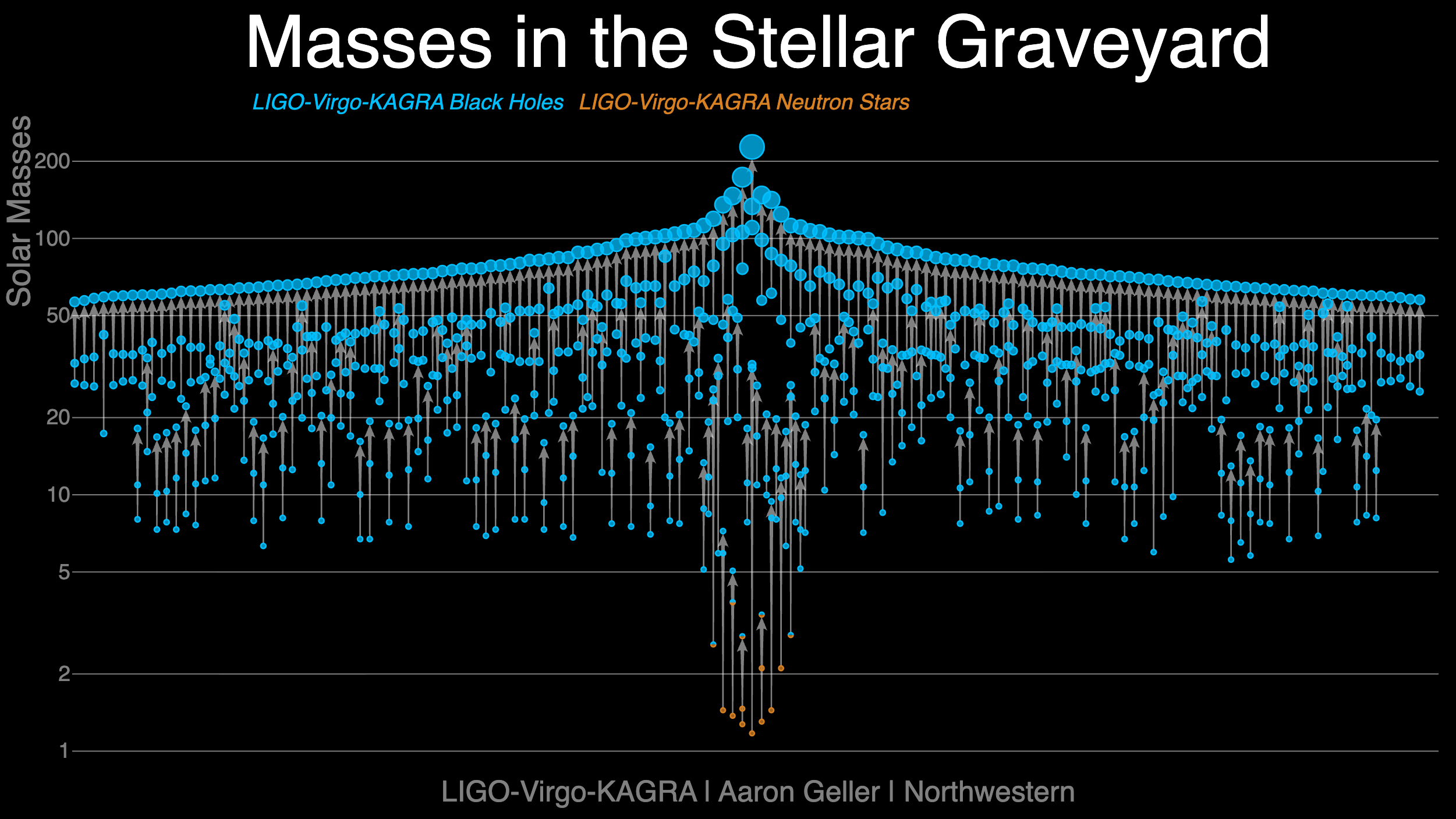
This catalog aggregates hundreds of cosmic collisions between pairs of black holes, each producing a new, heavier black hole. These distant events provide a rich dataset for scientists to map out how the Universe builds black hole systems.
Using the new data, compiled in the Gravitational-Wave Transient Catalog (GWTC-5.0), scientists from the LVK collaboration and the ARC Centre of Excellence for Gravitational Wave Discovery (OzGrav) at Monash University, have identified clear evidence that black hole binaries are born in distinct sub-populations. Effectively, different cosmic assembly lines that operate in unique environments.
Project lead, Sharan Banagiri, a Research Fellow from Monash University’s School of Physics and Astronomy and OzGrav, used this data to observe the shared characteristics of colliding black holes and neutron stars.
“This set of nearly 400 gravitational-wave detections from LIGO and Virgo provides us with a clear indication that the binary black hole mergers we see are forming in several different ways. Some might form as one giant cloud of gas that collapses to give two massive stars that then become black holes. Others might be black holes that wander into each other in dense environments called clusters that are packed with stars. While others are the product of a previous generation of mergers between two black holes,” Dr Banagiri said.
The paper, released as a preprint, found that there is a presence of multiple sub-populations of merging black holes that can potentially arise from different formation pathways.
Assistant Professor of physics at Princeton University, Sylvia Biscoveanu, co-author of the study and previously a Fulbright postgraduate scholar at Monash University, commented on the unprecedented scale of the catalog update.
“GWTC-5 represents the largest single increase in the size of the gravitational-wave catalog, including events with remarkable properties such as GW241127, which contains BHs of very different masses with clearly wobbling orbits due to tilted spins. The new catalog also contains the event with the best localisation on the sky to date, GW240615.”
The researchers also found that some of these black holes are spinning very rapidly. These fast spinning black holes have two different sets of masses; the first set are between 10-20 times the sun’s mass and the second set have masses greater than 45 times the sun’s mass.
“One of the most fascinating things we’ve discovered about these new black holes is that they are spinning very fast. The sun rotates once every 25 days. If it became a black hole and started spinning as quickly as the ones we discovered, it would be rotating several thousand times every second. So where do these rapidly-spinning black holes come from? One leading explanation is that they are ‘hierarchical’ products of a previous generation of merger between two black holes,” Dr Banagiri said.
The paper identified that black holes which are hierarchical in origin, are more massive than other black holes nearby. By analysing the new data set, the researchers found that the black holes more massive than 45 times the sun, are more likely to merge with lower mass black holes.
The new dataset will provide rich new information about black holes for astronomers and scientists to research.
Chief Investigator at OzGrav and Professor of Physics and Astronomy at Monash University, Eric Thrane, said this is a milestone as gravitational-wave astronomy transitions from the discovery of individual events to the statistical profiling of cosmic population
“We are no longer just looking at individual anomalies, instead, we are seeing a true kaleidoscope of cosmic collisions. We are pushing the edges of what we know, seeing things that are more massive, spinning faster, and more unusual than ever before,” Professor Thrane said.
An international team of scientists from the LIGO, Virgo, and KAGRA collaborations, including researchers from the ARC Centre of Excellence for Gravitational Wave Discovery (OzGrav), has completed one of the most sensitive searches yet for continuous gravitational waves from young supernova remnants.
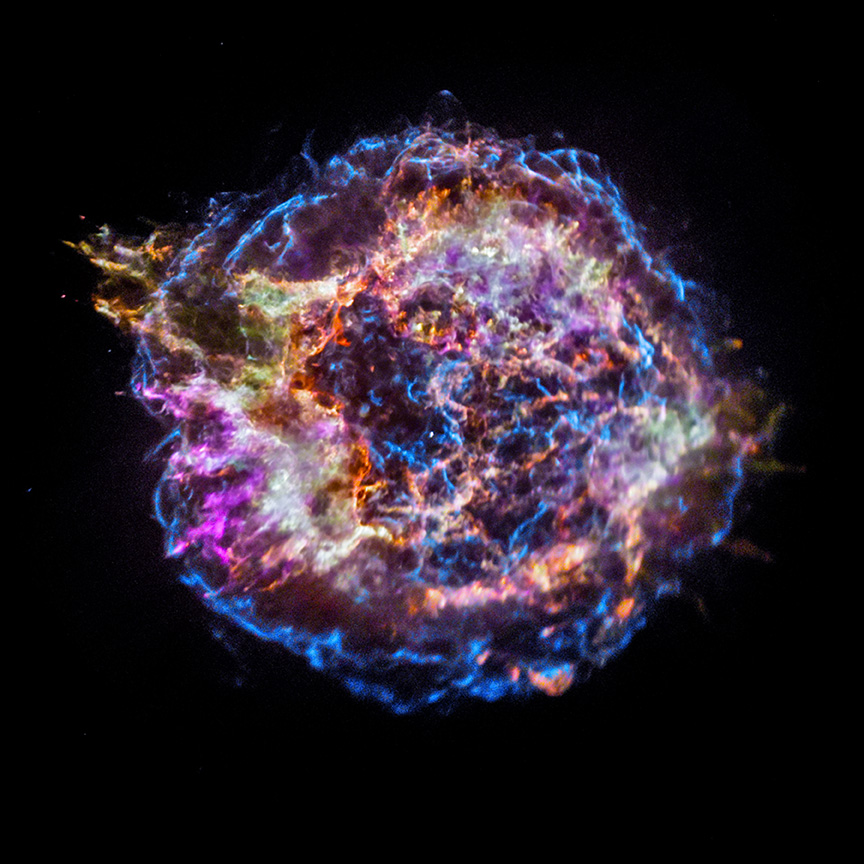
Neutron stars (NSs) are among the most exotic objects in the Universe. They are born when massive stars die in energetic explosions called core-collapse supernovae. These explosions rip the star apart and leave behind a beautiful diffuse nebula called a supernova remnant.
The supernova remnant Cassiopeia A, one the youngest and brightest known core-collapse supernova remnants in our Galaxy, as seen by the Chandra X-ray Observatory. The central white dot is a point-like X-ray source believed to be the neutron star left behind the supernova explosion and known as a ‘Central Compact Object’. Image credit: X-ray: NASA/CXC/Meiji Univ./T. Sato et al.; Image Processing: NASA/CXC/SAO/N. Wolk.
“These objects are incredibly extreme environments,” said Dr Ornella Piccinni, from the University of the Balearic Islands and Associate Investigator at OzGrav, who led the study while at the Australian National University. “They give us a way to test physics in conditions we can’t reproduce on Earth.”
NSs are also the strongest magnets in the Universe and can rotate astonishingly fast, with some rotating hundreds of times per second. Astrophysical estimates suggest that millions of NS may have formed in our Galaxy. However, only a fraction of neutron stars are observed as pulsars (they emit pulses of light). This lack of observation may be either because their emission beams do not intersect the Earth or because they have become too weak to detect. As a result, most neutron stars remain electromagnetically silent, and their internal properties are largely inaccessible even to the most sensitive telescopes.
“Gravitational-wave signals from neutron stars are incredibly faint, which makes them difficult to detect,” said Dr Ling (Lilli) Sun. “But they carry unique information about the structure of neutron stars.”
Continuous gravitational waves (CWs) provide a new tool to discover previously missed pulsars and unobserved NSs and probe their exotic interiors.
In a recent paper, the team searched for continuous gravitational waves from 15 young to middle-aged supernova remnants, ranging from approximately 40 years old (SN 1987A) to tens of thousands of years old, 14 of which are in our galaxy and one in our neighbouring galaxy, the Large Magellanic Cloud.
The search used eight months of data from May 2023 to Jan 2024 during the first phase of the detectors’ fourth observing run (O4a).
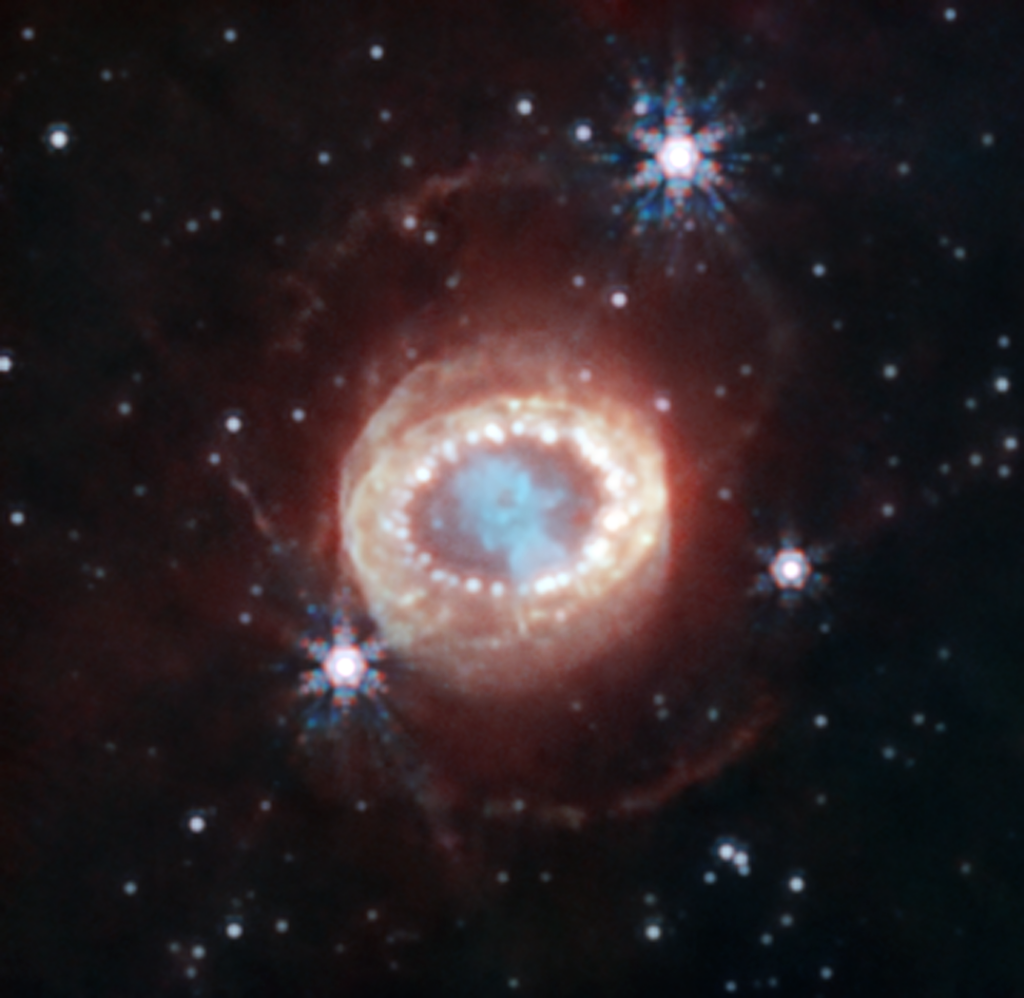
Supernova 1987A is a supernova that was discovered in 1987 in the Large Magellanic Cloud, a nearby galaxy. Credit: NASA, ESA, CSA, Mikako Matsuura (Cardiff University), Richard Arendt (NASA-GSFC, UMBC), Claes Fransson (Stockholm University), Josefin Larsson (KTH); Image Processing: Alyssa Pagan (STScI)
While transient bursts of gravitational waves are now regularly observed, CWs are much harder to detect because these signals are expected to be far weaker than the bursts seen from neutron star or black hole mergers, often weaker by several orders of magnitude.
But no detection does not mean there are no results.
By measuring how sensitive the search was, the team was able to place the strongest limits so far on how strong these signals could be, improving on previous observing runs. These limits help narrow what scientists think neutron stars can look like, including how “bumpy” they are and how matter behaves under the most extreme conditions in the Universe.
“Even when we don’t see a signal, we’re still learning,” said Yutong (Tracy) Bu from the University of Melbourne, who worked on the analysis. “We can place stronger constraints on what these neutron stars are doing.”
These systems may host young neutron stars where the rotation frequency is still unknown. Their relatively young age implies that the neutron star candidates are more likely to have non-uniform deformations than older ones and emit stronger continuous gravitational waves.
“We’re pushing the sensitivity of these searches further than ever before,” said Dr Piccinni. “Each step brings us closer to a detection.”
These results are the most sensitive broadband frequency searches so far for continuous gravitational waves from supernova remnants.
As data collection continues and sensitivity improves, researchers are closing in on the first detection of continuous gravitational waves — a breakthrough that would open an entirely new way of studying neutron stars.
An international team of scientists from the LIGO, Virgo, and KAGRA collaborations, including researchers from the ARC Centre of Excellence for Gravitational Wave Discovery (OzGrav), has shown for the first time that gravitational waves, ripples in space and time produced by some of the most violent events in the Universe, such as the collision of two black holes, can be used to measure and correct the calibration of the detectors that observe them.
The breakthrough comes from the study of two exceptionally strong gravitational-wave signals, known as GW240925 and GW250207, produced by the collisions of pairs of black holes and detected by the twin detectors of the US National Science Foundation Laser Interferometer Gravitational-wave Observatory (NSF LIGO). These events were so strong that they allowed researchers not only to study the black holes that created them, but also to check how accurately the detectors were recording the signals.
“In a way, we are using black holes to help check the accuracy of our detectors. How cool is that!” said Dr Ling (Lilli) Sun from the Australian National University.
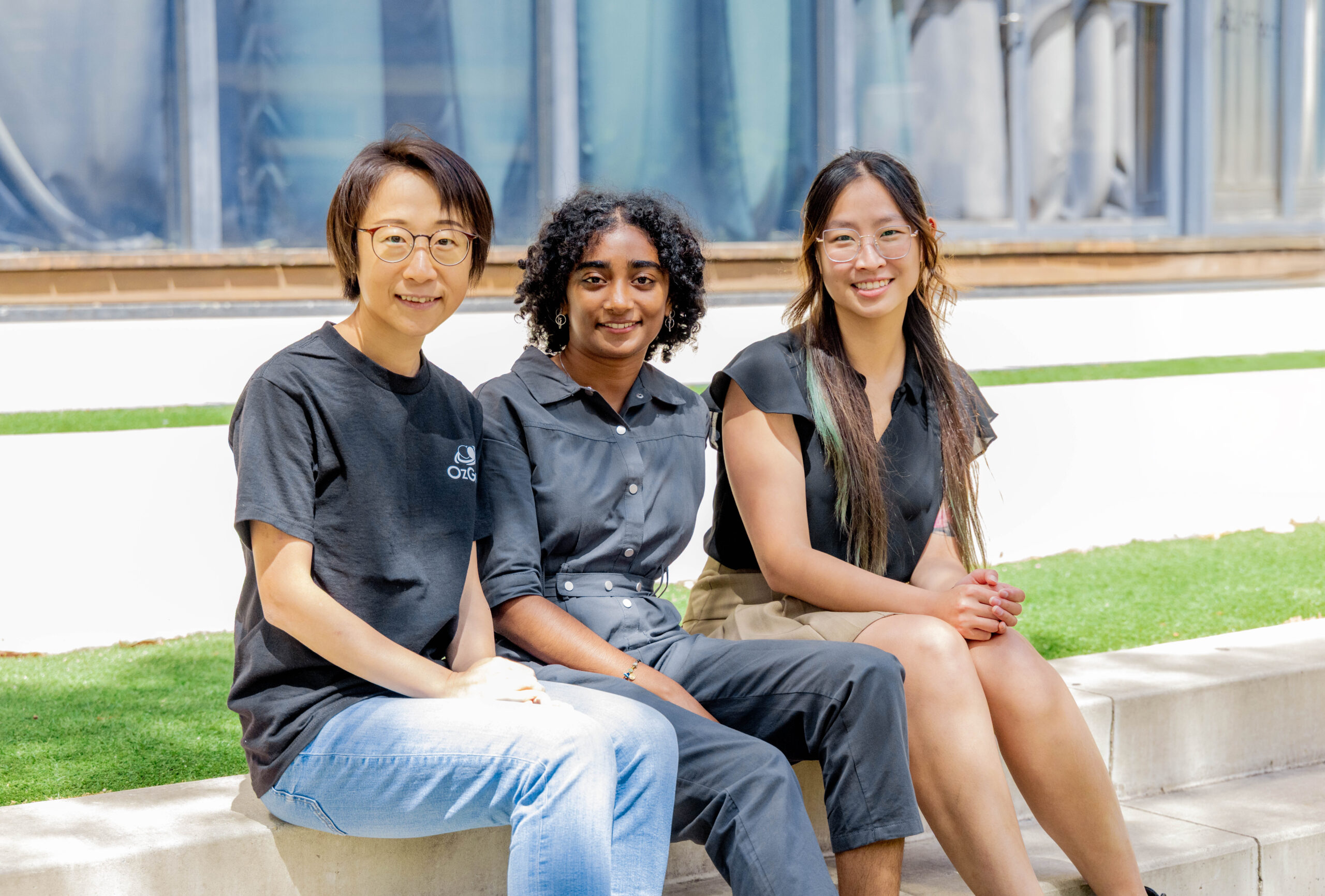
Three OzGrav researchers from three different Australian universities played key scientific roles in the study. Dr Ling (Lilli) Sun from the Australian National University provided scientific leadership on the paper, while Mallika Sinha, a PhD student at Monash University, and Dr Yi Shuen Christine Lee, a Postdoctoral researcher at the University of Melbourne, made important contributions to the analysis and interpretation of the results.
From left to right: Dr Ling (Lilli) Sun (Australian National University), Mallika Sinha (Monash University), and Dr Yi Shuen Christine Lee (University of Melbourne). Credit: Carl Knox, OzGrav/Swinburne
The LIGO–Virgo–KAGRA collaboration has now confidently detected more than 200 gravitational-wave signals from merging black holes and neutron stars. Each signal carries information about its source and the extreme physics governing these collisions. Extracting that information requires the detectors to measure gravitational waves with extraordinary precision and to carefully account for any uncertainties in those measurements.
Gravitational waves stretch and squeeze spacetime as they pass through Earth. The detectors measure this by sending laser light down two perpendicular arms and looking for tiny differences in the time it takes the light to travel back and forth. A typical gravitational wave changes the arm length by about one ten-billionth of a billionth of a metre, smaller than the width of a proton.
“Thanks to major upgrades over the past decade, our detectors are now so sensitive that signals from colliding black holes come through loud and clear,” said Dr Sun. “If Einstein’s theory of general relativity is correct, those signals should follow a very specific pattern.”
Turning those minute measurements into a physical gravitational-wave signal requires a detailed model of the detector’s response. This includes accounting for the complex control systems used to keep the instruments stable. Normally, calibration uncertainties are measured and estimated using auxiliary lasers, sensors, and engineering data. However, during the detections of GW240925 and GW250207, the LIGO Hanford detector happened to have a larger calibration error than usual.
According to Dr Sun, “by comparing the predicted signal with what we actually record, we can spot tiny mismatches that sometimes reveal the detector wasn’t perfectly calibrated at the time.”
Because both signals were exceptionally loud, the researchers were able to disentangle the true gravitational-wave signal from the detector’s calibration error, a process known as astrophysical calibration. GW240925 served as a verification case, allowing the team to compare results from astrophysical calibration with data that was later corrected using standard methods.
GW250207, meanwhile, is the second-loudest gravitational-wave event ever observed and provides a unique window into extreme physics. For this event, astrophysical calibration was essential to ensure the data could be trusted at all.
Accurate calibration is critical because even small errors can bias estimates of key source properties, such as the masses of the black holes, whether they are spinning, and where the signal originated in the sky.
“It was simply bad luck that such a loud event was observed while LIGO Hanford was in an unsettled state,” said Mallika Sinha. “As our detectors become more sensitive and we observe more events, situations like this will only become more common. Without astrophysical calibration, we might not be able to reliably analyse these interesting events and miss out on some nifty science.”
The researchers found that GW240925 was produced by black holes around nine and seven times the mass of the Sun, while GW250207 involved black holes roughly 35 and 30 times the Sun’s mass.
“Using three detectors instead of two helps us pinpoint the location of gravitational-wave sources much more precisely, which also means we can better understand the physical properties of the sources themselves,” said Dr Yi Shuen Christine Lee.
“This successful astrophysical calibration using GW240925 and GW250207 is an exciting step forward for gravitational-wave astronomy. It improves our chances for extracting important astrophysical information from gravitational-wave sources, even when traditional detector calibration methods are not accurate or feasible!”
Because of its strength and position in the sky, GW250207 is considered one of the most promising gravitational-wave signals for future measurements of the Hubble constant, although many such “dark siren” events, gravitational-wave signals from black hole mergers that produce no visible light, will be needed to resolve the long-standing tension between different cosmological measurements.
Together, GW240925 and GW250207 mark the first successful tests of astrophysical calibration, a technique that could allow scientists to trust gravitational-wave data even when detectors are in an unsettled state.
As gravitational-wave astronomy moves from discovery to precision science, using the Universe itself to help calibrate our instruments may become an increasingly powerful tool.
Watch the explainer video below:
Media Enquiries
Researchers from the study are available for interview.
For interview requests, additional information, or media enquiries, please contact:
Diana Haikal Senior Communications and Engagement Advisor ARC Centre of Excellence for Gravitational Wave Discovery (OzGrav) ozgrav.comms@swin.edu.au
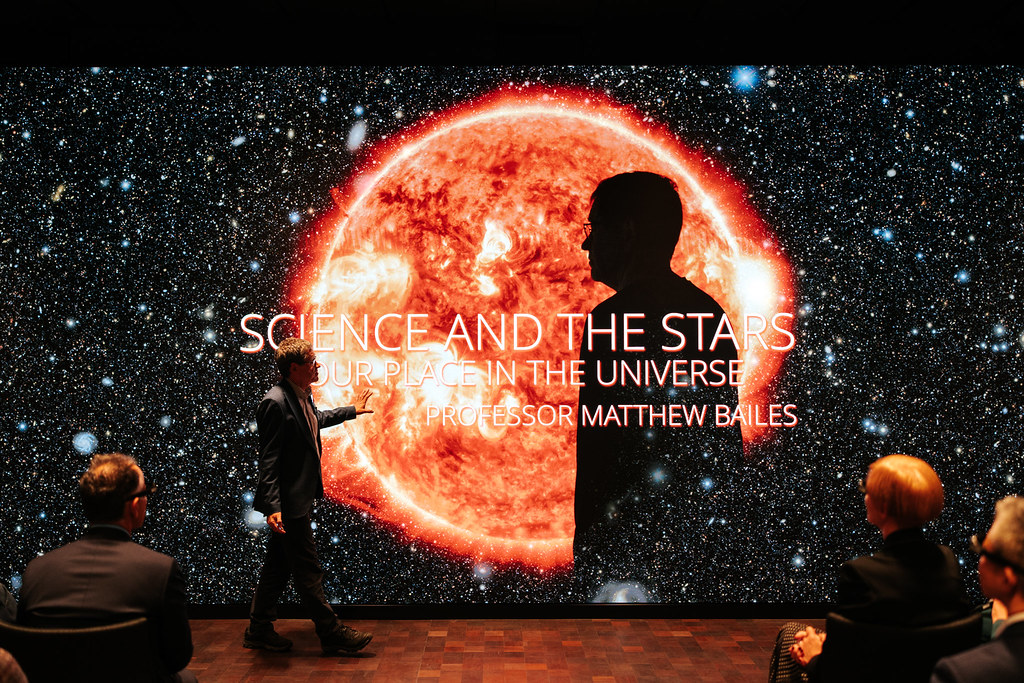
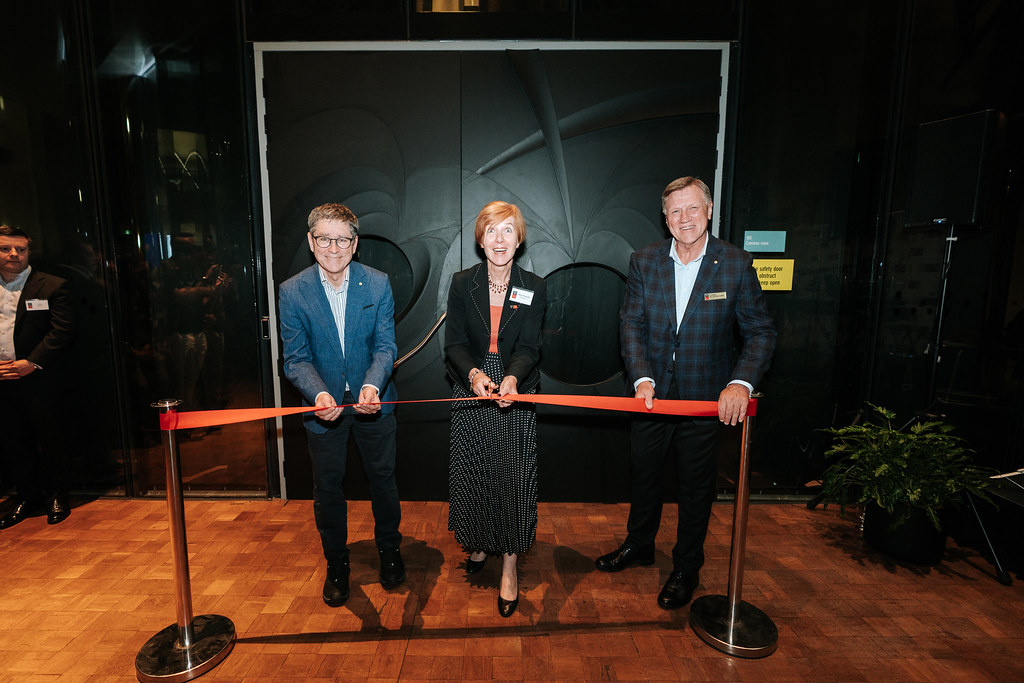
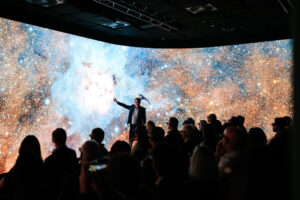
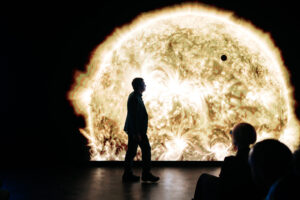
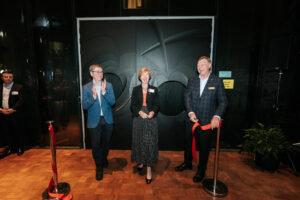
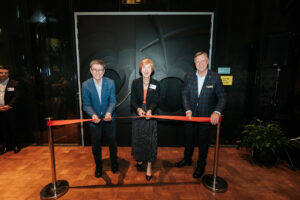
An awe-inspiring new chapter in science engagement has begun, with Professor Matthew Bailes, Director of the ARC Centre of Excellence for Gravitational Wave Discovery, officially launching Swinburne Virtual Universe.
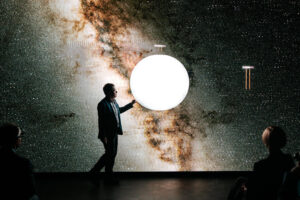
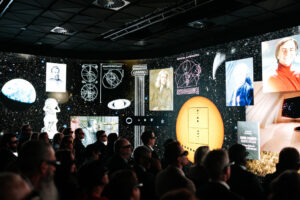
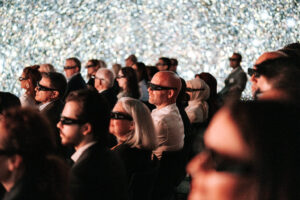
The space is exactly what it sounds like. A fully immersive room wrapped in more than 100 square metres of high-contrast LED screens, where you’re not just looking at the Universe, you’re inside it.
Visitors can move through a virtual solar system, guided in real time, with 3D visuals built from supercomputer simulations and real astrophysics data. It’s designed to make complex science feel intuitive, and honestly, a bit magical.
“It’s hard to describe that moment,” Professor Bailes said, reflecting on seeing Saturn’s rings stretch across the entire space. “You feel like you can walk along them and look out into infinity. That’s the feeling I want people to experience when they come in here.”
The idea for the Virtual Universe goes back much further. For Bailes, it traces all the way back to watching the Moon landing as a child and the sense of wonder that came with it. That same feeling is what this space is trying to recreate, not just for students, but for anyone who walks through the door.
Early reactions suggest it’s working.
From school students reaching out to grab floating moons, to adults completely absorbed in the experience, the Virtual Universe is already doing what it set out to do, connecting people to science in a way that sticks.
Built in partnership with OzGrav, the facility brings together research, technology and storytelling in one place. It also opens up new opportunities, not just for outreach, but for research translation and creative industries.
Now open, the Virtual Universe is already bringing in schools and the wider community, turning curiosity about space into something people can actually step inside and feel.