A Decade of Discovery: Celebrating 10 Years of Gravitational Waves

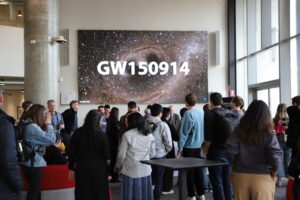
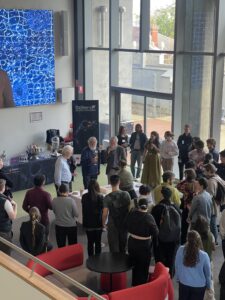
Last week, the Australian gravitational-wave community gathered at Swinburne University to celebrate a landmark moment in science, the 10-year anniversary of the first direct detection of gravitational waves (GW150914). This discovery, announced in 2016 from data recorded on 14 September 2015, confirmed Einstein’s prediction and opened an entirely new window on the Universe.

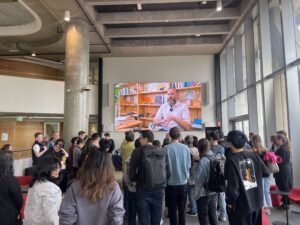
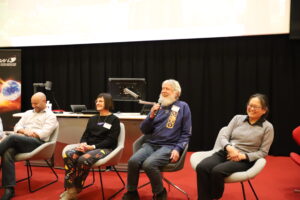
The two-day workshop, hosted by the Australian Research Council Centre of Excellence for Gravitational Wave Discovery (OzGrav), brought together more than 80 students, researchers, and leaders from across the country. The workshop was more than just a commemoration of GW150914, it was a chance to reflect on Australia’s pivotal role in that discovery, to celebrate the remarkable advances of the past decade, and to look forward to what the next decade of gravitational-wave science will bring.

OzGrav’s Director, Professor Matthew Bailes, reflected on the impact of that first signal: “When the first detection happened in 2015, it completely transformed the landscape. Suddenly, gravitational-wave astronomy was real, and Australia needed a Centre of Excellence dedicated to it and that’s how OzGrav was born in 2017.” He added, “Since then, we’ve captured neutron star mergers in both gravitational waves and light, pushed quantum noise limits, and pioneered squeezed-light technology.”

For many in the room, it was collaboration that defined the journey. As Distinguished Professor Susan Scott, from the Australian National University, reminded the audience, “The first detection was only possible through collaboration and that spirit continues to drive gravitational-wave science forward.”

The workshop program reflected that spirit, spanning technical advances, new discoveries, and emerging projects, while also acknowledging the teamwork and persistence that made it all possible.

The celebration was about the future as much as the past. Day two highlighted the next generation of detectors and discoveries with Professor Paul Lasky from Monash University summing up the mood with optimism, “The gravitational-wave future is loud, much louder than GW150914. Every increase in sensitivity lets us hear further into the universe.” He also issued a call to action: “If we want an observatory in Australia, we will need ambition and collaboration to make it happen.”

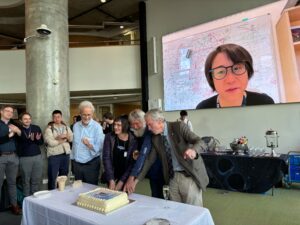
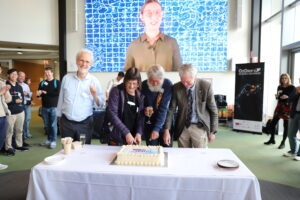
Over coffee breaks, panel discussions, and even a celebratory cake, there was a palpable sense of both gratitude and anticipation. The workshop marked not only ten years since a signal that changed the world but also the strength of a community that has grown around it, a community ready to take the next bold steps into the cosmos.

Thank you to the local organising committee:


Ten years after gravitational wave scientists proved Einstein’s theory, Stephen Hawking’s landmark prediction has also been proven to be true

A global team of astrophysicists, including Australians, has witnessed a collision between two black holes that was so loud, they were able to use it to test—and prove—Stephen Hawking’s Theory of Black Hole Thermodynamics.

The event, observed by the LIGO, Virgo, and KAGRA collaborations, involved two black holes merging to form a single, larger one, strikingly reminiscent of the historic first detection in 2015. But this time, thanks to a decade of instrumental upgrades and data analysis advances, the signal was captured with three times more clarity, enabling scientists to test two fundamental predictions of black hole physics:

  • Black holes obey the laws of thermodynamics — their surface areas always increase; never decrease.
  • Disturbed black holes behave exactly as predicted by Einstein’s theory of general relativity

“Excited black holes are known to ‘ring’ like cosmic bells at precise frequencies. This is the strongest and cleanest black hole ‘note’ we’ve ever heard,” said Neil Lu, a lead Australian author from the Australian National University and the ARC Centre of Excellence for Gravitational Wave Discovery (OzGrav).

“For the first time, we can clearly identify more than one of the predicted tones from the final black hole, and they match exactly what Einstein’s theory says they should.”

The discovery also tests a profound idea from Stephen Hawking and Jacob Bekenstein: that a black hole’s surface area encodes entropy, a measure of disorder that can only grow. Using this new observation, scientists measured the surface areas of the two original black holes and compared them to that of the final remnant. The result was unambiguous: the total area increased, confirming that entropy had indeed risen.

“We’ve just witnessed the laws of thermodynamics play out on the grandest scales imaginable,” explained Teagan Clarke, a lead Australian author from Monash University and OzGrav. “The final black hole area is bigger than the sum of the originals, just as Hawking predicted.

“This result represents a new step towards understanding the quantum properties of black holes.”

“This merger shows us that black holes obey both simplicity and chaos,” added Dr Ling Sun from the Australian National University and OzGrav. “They’re described only by mass and spin, yet their horizons grow in a way that encodes the disorder of the universe.”

The result marks the culmination of decades of international effort—perfecting ultra-sensitive instruments, pioneering new analysis techniques, and training a generation of scientists to listen for the faintest ripples in spacetime.

“This is a turning point,” said Dr Sun. “A decade after the first detection, gravitational-wave astronomy has evolved from discovery to precision testing of nature’s deepest laws. And with dozens of signals now being detected each year, we’re no longer hearing isolated notes; we’re beginning to hear the full symphony of spacetime.”

The latest discovery is both a celebration of human ingenuity and a glimpse of the transformative science that lies ahead.

Binary stars everywhere: Monash University scientists help rewrite cosmic origin story

Binary stars everywhere: Monash University scientists help rewrite cosmic origin story

A new international study, published in Nature Astronomy, reveals that massive stars are about as likely to form in close binary systems in the low-metal environments of the early Universe as they are today,  reshaping our understanding of stellar evolution and the origins of gravitational wave events.

The research, led by a global team of astronomers and using the European Southern Observatory’s Very Large Telescope in Chile, studied 139 O-type stars in the Small Magellanic Cloud, a nearby dwarf galaxy with just one-fifth the metallicity of our Sun. The findings challenge previous observations that low-mass stars are more likely to be found in binaries in metal-poor environments than in our Galaxy.

Professor Ilya Mandel, from the Monash University School of Physics and Astronomy, and the ARC Centre of Excellence for Gravitational Wave Discovery (OzGrav), co-authored the study, contributing to the statistical analysis testing whether the abundance of binary stars changes with metallicity, the chemical richness of the stars’ environment.

“Our analysis shows there’s no significant change in the fraction of massive stars in close binaries in metal-poor galaxies like the Small Magellanic Cloud,” said Professor Mandel. “That’s exciting, and it tells us that massive binary formation is a fundamental feature of star formation, even in the early Universe.”

The study found that around 70 per cent of the observed O-type stars are in close binaries, and two thirds of them will interact with a companion during their lifetimes, often leading to dramatic phenomena such as supernovae, black holes, or neutron star mergers.

“This is important because binary star interactions are a key pathway to producing exciting and rare outcomes, such as black holes and neutron stars that collide and emit gravitational waves,” Professor Mandel said. “Understanding how common these binaries are in different environments helps us predict how often we should expect to detect gravitational wave events, not just today, but across cosmic history.”

The discovery has far-reaching implications. It strengthens the case that many of the gravitational wave signals detected by LIGO and Virgo come from binary systems born in the early Universe. It also suggests that binary interactions likely played a large role in shaping galaxies and enriching them with heavy elements.

“By studying how stars evolve in environments that mimic the early cosmos, we get a clearer view of how black holes form, how galaxies evolve, and how the Universe became what it is today,” said Professor Mandel.

The research is part of the Binarity at LOw Metallicity (BLOeM) survey, and brings together more than 70 scientists across Europe, the US, Australia, and Israel.

Professor Mandel said the study exemplifies the power of international collaboration and big data analysis in unlocking the secrets of the cosmos.

“We’re in a golden age of discovery,” he said. “And what we’re learning now will echo in our understanding of the Universe for decades to come.”

Scientific paper
A high fraction of close massive binary stars at low metallicity. By: Hugues Sana, Tomer Shenar, Julia Bodensteiner, et al. In: Nature Astronomy, 2 September 2025. [original | preprint (pdf)]

Monash University media release: https://www.monash.edu/science/news-events/news/2025/binary-stars-everywhere-monash-university-scientists-help-rewrite-cosmic-origin-story