OzGrav Associate Investigator Matt Dodds awarded the 2025 Prime Minister’s Prize for Excellence in Science Teaching in Secondary Schools

Congratulations to OzGrav Associate Investigator Matt Dodds, recipient of the 2025 Prime Minister’s Prize for Excellence in Science Teaching in Secondary Schools.

The ARC Centre of Excellence for Gravitational Wave Discovery (OzGrav) proudly celebrates Matt’s national recognition for his creative and hands-on approach to science teaching, bringing physics to life for students in regional and remote communities.

“I’m passionate about teaching in regional Australia,” Matt says. “Just because we’re in rural areas doesn’t mean students shouldn’t have access to high-quality STEM experiences.”

Since 2018, Matt has worked closely with OzGrav’s Education and Outreach team, helping translate complex astrophysical concepts into engaging, real-world classroom experiences. Collaborating with OzGrav’s Senior Education and Outreach Manager, Jackie Bondell, he has co-developed national teacher workshops, student outreach programs, and public events that have reached thousands of participants across Australia.

“Matt’s passion for physics and astronomy is infectious,” says Bondell. “He’s taken OzGrav’s outreach tools, from VR experiences to LEGO® interferometers, and shared them with students and teachers across Australia. He has an extraordinary gift for making science accessible and exciting.”

Among his many innovations, Matt created a LEGO® DUPLO® Interferometer, a hands-on model that demonstrates the principles behind gravitational-wave detection. Developed in collaboration with OzGrav, the design has been adopted across OzGrav’s eight nodes and even features in outreach programs at LIGO in the United States and KAGRA in Japan.

“It’s amazing to see a simple LEGO model spark such curiosity,” says Matt. “It helps students visualise how instruments like LIGO detect ripples in spacetime and shows that anyone can explore big scientific questions with the right mindset.”

Matt, a Physics and Biology teacher at Glen Innes High School (NSW), has made contributions that extend well beyond his classroom. He established the Astronomy and Astrophysics Depth Study Program at Siding Spring Observatory, now in its seventh year and attended by more than 280 students from regional NSW schools. His inventive lessons, such as using data from NASA’s Kepler Telescope to calculate the mass of stars or designing solid-fuel rockets using CAD simulations, have been adopted by physics teachers worldwide. He also mentors educators across Australia, sharing creative approaches such as smartphone spectroscopes and Hot Wheels-based demonstrations of projectile motion.

“Students are inspired when they see their teachers still learning,” Matt says. “Science is about curiosity that never ends.”

Read the media release here: https://www.industry.gov.au/publications/prime-ministers-prizes-science-2025/2025-prime-ministers-prize-excellence-science-teaching-secondary-schools

Video Credit: Department of Industry, Science and Resources

Gravity Tests with the Double Pulsar Honoured

2025 Frontiers of Science Award for the international Double Pulsar research team

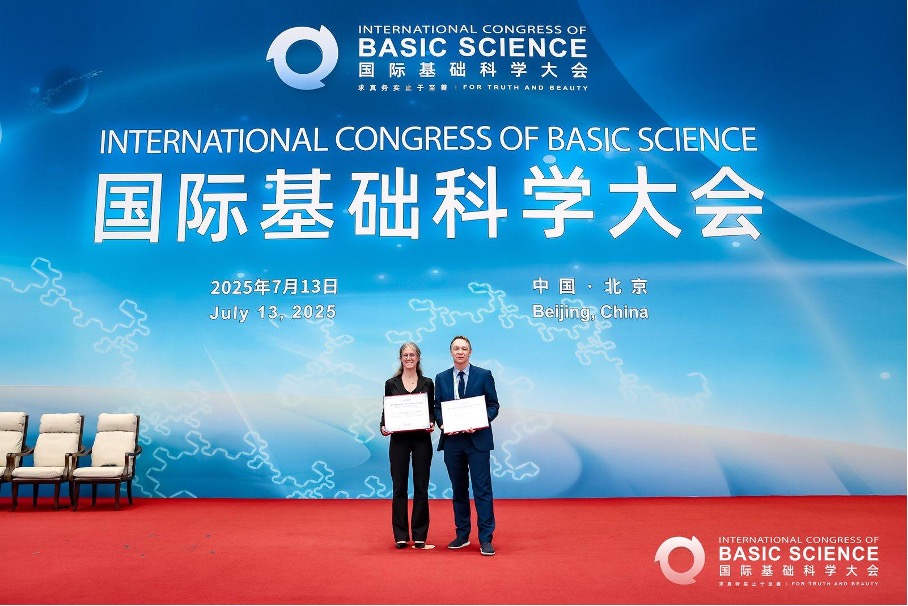
The research paper “Strong-Field Gravity Tests with the Double Pulsar” led by OzGrav Partner Investigator Michael Kramer (Max Planck Institute for Radio Astronomy, MPIfR) and including OzGrav Chief Investigator Adam Deller (Swinburne University) along with an international research team was published in the journal “Physical Review X” (Kramer et al. 041050, December 13, 2021). Their work received the Frontiers of Science award within the category “Astrophysics and Cosmology – theory” from the International Congress for Basic Science (ICBS). The award ceremony took place at the China National Conference Center (CNCC) – on July 13, 2025.

More than 100 years after Albert Einstein presented his theory of gravity, scientists around the world continue to search for tiny deviations from its predictions that would point the way to a new theoretical understanding of the laws that govern the Universe. Binary radio pulsars – rapidly spinning neutron stars whose beamed radio emission can be observed as precise clock ticks from the Earth – are ideal laboratories for searching for such deviations. The “double pulsar” system, which was the subject of the paper honoured by the ICBS, is the best such system currently known for making these ultra precise tests. “We studied a system of very compact stars to test gravity theories in the presence of very strong gravitational fields,”, states the research team’s leader, Michael Kramer from the Max Planck Institute for Radio Astronomy (MPIfR) in Bonn, Germany. “To our delight we were able to test a cornerstone of Einstein’s theory, the energy carried by gravitational waves, with a precision that is 25 times better than with the Nobel-Prize winning Hulse-Taylor pulsar.”

Apart from the loss of orbital energy through gravitational waves, other relativistic effects such as the periastron advance of the system (which has precessed around a full turn since its discovery over 20 years ago!), relativistic time dilation, and spacetime curvature have all been precisely measured in the double pulsar system, with every result agreeing with Einstein’s predictions to within the measurement uncertainty.

Such tests are only possible through careful calibration of the observed pulsar “clock ticks” for other effects that are unrelated to general relativity. As one example, the motion of the pulsar relative to the Earth, and its acceleration in the gravitational field of the Milky Way, contribute to the observed change in its orbital period. Fortunately, these effects can be calculated and corrected if the distance to the double pulsar and its motion on the sky are known. Prof Adam Deller led additional observations that measured tiny shifts in the position of the double pulsar system on the sky to provide these corrections. “By measuring how the double pulsar’s position shifted over the course of a year as the Earth orbits the Sun, we can infer how distant it is” said Prof. Deller. “But the position shifts are tiny – like seeing an ant crawl around a button from 5,000 km away!”

This combination of diverse effects produced by a system of two strongly self-gravitating bodies with extreme spacetime curvature makes the Double Pulsar a unique testbed — not only for general relativity but also for various competing theories, some of which have been significantly constrained or even excluded by this experiment.

“We are very pleased with the award honouring our work with the Double Pulsar which is the result of a collaboration with great colleagues, who together allowed us to combine our precision experiments with a rigorous theoretical understanding,” concludes Michael Kramer.

Marta Burgay (left) and Michael Kramer (right) receiving the 2025 Frontiers of Science Award on behalf of all the authors of the Kramer et al. (2021) Double Pulsar paper. Credit: ICBS


Original Paper

Kramer et al. Strong-Field Gravity Tests with the Double Pulsar, 2021, Physical Review X, December 13, 2021 (DOI: 10.1103/PhysRevX.11.041050).

https://journals.aps.org/prx/accepted/a7077K4fR4216c02853742f061ca5a31085788a3e

Further Information/Links:

Fundamental Physics in Radio Astronomy. Research Department at MPIfR

https://www.mpifr-bonn.mpg.de/research/fundamental

The 2025 Frontiers of Science Award

https://www.icbs.cn/site/pages/index/index?pageId=1fe7d1cf-c69c-47bd-a2fa-3d5731ca2610

Professor Matthew Bailes Awarded 2024 Prime Minister’s Prize for Science

OzGrav is proud to celebrate Professor Matthew Bailes, Director of the ARC Centre of Excellence for Gravitational Wave Discovery, as a 2024 recipient of the prestigious Prime Minister’s Prize for Science. This recognition follows his recent Shaw Prize in Astronomy, cementing his standing as one of the world’s foremost astrophysicists.

Reflecting on the prize, Professor Bailes said, “It’s an amazing honour to receive the 2024 Prime Minister’s Prize for Science. If you told me as a child that one day I would receive a prize from the Prime Minister, I don’t think I would’ve believed you.”

Professor Bailes and his team first discovered fast radio bursts (FRBs) in 2007, significantly advancing scientific understanding of the universe. FRBs are intense bursts of radio waves that can last from less than a millisecond to a few seconds and are considered one of the great mysteries of the cosmos. “Professor Bailes’ work on fast radio bursts has created a vital new area of astrophysics that is unlocking the Universe’s mysteries in ways we could not have previously predicted,” said Professor Virginia Kilborn, Chief Scientist at Swinburne University of Technology.

Using archival data from Murriyang, CSIRO’s Parkes radio telescope on Wiradjuri Country, and the Molonglo radio telescope, Professor Bailes and his team discovered 27 of the first 30 FRBs. These discoveries now serve as a cornerstone for scientists studying some of the universe’s most powerful objects. Professor Brian Schmidt remarked, “Professor Bailes was instrumental in building special hardware for Murriyang, CSIRO’s Parkes radio telescope, enabling novel techniques to study short-duration pulsar pulses.”  Professor Bailes now leads Australia’s research into FRBs, pulsars, and gravitational waves at OzGrav, testing gravity theories and advancing the scientific community’s understanding of the universe.

In addition to his groundbreaking research, Professor Bailes is a strong advocate for education and is dedicated to fostering the next generation of Australian scientists and engineers. “I get a lot of joy out of nurturing the next generation of scientists. I enjoy working with smart and passionate people,” he said, reflecting on his role as a mentor. “I love giving talks at schools and bringing students into the lab to see how scientists work.”

This year’s Prime Minister’s Prize for Science marks the 25th anniversary of Australia’s highest scientific honour, which celebrates groundbreaking achievements. Professor Bailes’ research exemplifies the global impact of Australian science and serves as an inspiration for future generations of scientists and innovators.

Watch the amazing video below where Matthew talks about the incredible discovery of Fast Radio Bursts! Hear the excitement behind the first detection and learn how these cosmic signals are reshaping our understanding of the universe.

Read the media release here: https://www.industry.gov.au/publications/prime-ministers-prizes-science-2024/2024-prime-ministers-prize-science

Video Credit: Department of Industry, Science and Resources