

Gravitational waves from record‑breaking black holes challenge current astrophysical models
The LIGO-Virgo-KAGRA (LVK) Collaboration has observed the heaviest black‑hole merger ever detected, registering gravitational waves from two rapidly spinning giants that coalesced into a single black hole about 225 times the mass of our Sun. Designated GW231123, “GW” for gravitational wave and “231123” for the detection date 23 November 2023, the signal was captured during the fourth LVK observing run and publicly released on Monday, 14 July 2025.
“This collision is so distant that the ripples we’re measuring began their journey billions of years ago, long before dinosaurs walked the Earth,” says Professor Eric Thrane, OzGrav Chief Investigator at Monash University. “Yet that tenth of a second blip forces us to rethink how very heavy, rapidly spinning black holes come to be.”
GW231123 involved black holes of roughly 100 M☉ and 140 M☉, far beyond the masses predicted by standard stellar evolution theory. Their extreme spin hints that these monsters may have grown through successive mergers rather than a single stellar collapse.
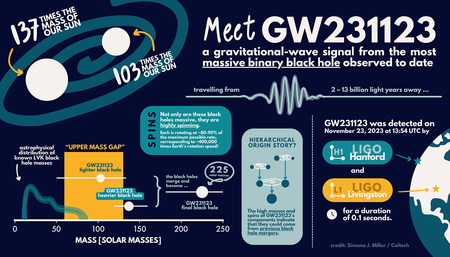
“Their spin is near the limit of what’s physically possible,” Thrane explains. “Observing two black holes whirling so fast when they merge tells us something, either they were born spinning like tops, or something in their lives wound them up to these incredible speeds.”
Unravelling the short, complex GW231123 signal stretched detection hardware and waveform modelling to their limits. Since LIGO’s first discovery in 2015, the LVK network has catalogued ≈300 black‑hole mergers, more than 200 of them in the current observing run alone.
“Gravitational wave astronomy is barely ten years old,” Thrane notes. “Each observing run delivers discoveries that would have been science fiction a decade ago, and this latest event is our most dramatic example yet.”
The calibrated data for GW231123 are now public via the Gravitational‑Wave Open Science Centre (GWOSC), enabling researchers worldwide to probe whether heavy, fast‑spinning black holes form a new population or point to physics beyond current models.
“Maybe this is just the tip of the iceberg,” Thrane says. “If these heavyweight speed demons are common, we could be on the verge of a major leap in our understanding of how the Universe makes, and remakes, black holes.”
Initial results, released on the arXiv, were presented at the joint GR24 and Amaldi16 gravitational-waves meeting in Glasgow, UK, on 14 July.
Information reproduced in part courtesy of Whitney Clavin, Caltech
Watch | Listen | Learn
- Watch: Prof Eric Thrane breaks down the discovery on ABC News – https://www.youtube.com/watch?v=ok0wvO9Yz-0
- Listen: Full interview on ABC Radio National Breakfast – https://www.abc.net.au/listen/programs/radionational-breakfast/black-holes/105532330
- Explore: Dr Kirsten Banks explains how LIGO “hears” black-hole collisions in her YouTube video – https://www.youtube.com/shorts/6gl_F-fgWNs