Research highlight: The High Time Resolution Universe Pulsar Survey

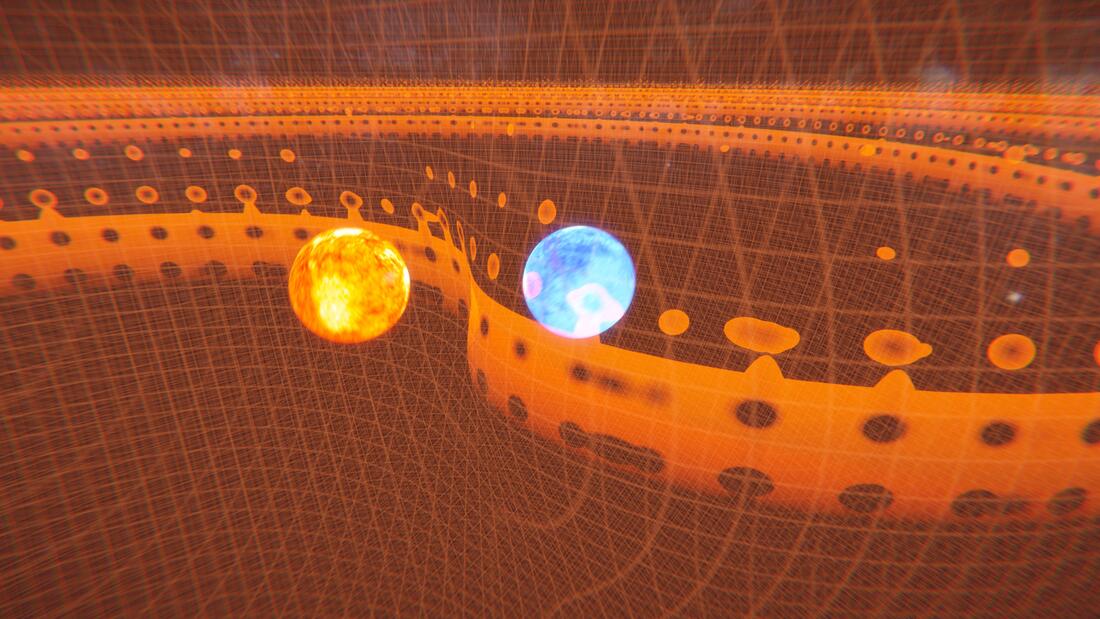
​​Artist’s illustration of a neutron star binary – Carl Knox, OzGrav-Swinburne University

Double neutron star (DNS) systems in tight orbits are fantastic laboratories to test Einstein’s general theory of relativity. The first such DNS system, commonly known as Hulse-Taylor binary pulsar, provided the first indirect evidence of the existence of gravitational waves and the impetus to build LIGO. Since then, discovering such binary systems has been a major impetus for large scale pulsar surveys.  Although over 3000 pulsars have been discovered in our Galaxy, we have only found 20 DNS systems. Why are they so rare?

DNS systems are the endpoints of complex and exotic binary stellar evolution. In the standard model, the two stars must survive multiple stages of mass transfer, including common envelope phases, and not one but two supernova explosions. Prior to the second supernova, the survival of the binary depends on the kicks imparted by the second supernova explosion and the amount of matter ejected. It appears that it’s quite rare for binaries to survive all of these events. Those that do leave behind many insights into binary stellar evolution.

Finding binary pulsars is more difficult than solitary ones. Acceleration makes their pure tones evolve in time due to the changing Doppler shifts, greatly increasing the complexity of the searches and the amount of computational time required. Fortunately, OzGrav scientists have access to the OzSTAR supercomputer at Swinburne University of Technology with its graphics processing accelerators (GPUs). We use OzSTAR to search the High Time Resolution Universe South Low Latitude pulsar survey (HTRU-S LowLat) for accelerated pulsars. In our recently accepted paper, we have presented the discovery and results from 1.5 years of dedicated timing of a new DNS system, PSR J1325-6253 using the Parkes 64m radio telescope (now also known as Murriyang).

By timing when the pulses arrived at Earth, we found that PSR J1325-6253 is in a small orbit of 1.81 d. Its orbit deviates from a circularity with one of the lowest orbital eccentricities known for a DNS system (e=0.064). The elliptical orbit advances its point of closest approach (periastron) to its companion star as predicted by the theory of general relativity. The advance of periastron enabled us to determine the total mass of the system, and we found it near that of other DNS systems. The low eccentricity of the orbit meant that there was almost no mass loss in the final supernova explosion beyond the energy carried off in neutrinos, and that it was a so-called ultra-stripped supernova. Such supernovae would be very sub-luminous, and usually invisible if too far from the Sun. This rare find provided a new insight into how stars explode, and the neutron stars they leave behind.

Written by OzGrav PhD student Rahul Sengar, Swinburne University of Technology

https://ui.adsabs.harvard.edu/abs/2022MNRAS.tmp..798S/abstract
Research highlight: Graphics processing unit implementation of the F-statistic for continuous gravitational wave searches

​One promising source of gravitational waves, not yet detected, is rapidly rotating neutron stars. Neutron stars are hyperdense leftovers from stellar evolution, formed from the core of stars of a certain weight class (not too light, not too heavy). Instead of collapsing all the way to a black hole, they stop just short, ultimately packing the mass of the Sun into a ball about 10 kilometers across. Neutron stars are known to spin rapidly, up to hundreds of revolutions per second, and they are so fantastically dense that even a small (millimeters high!) mountain will emit continuous gravitational waves (CWs) that are potentially detectable by LIGO.

However, detecting these gravitational waves is no mean feat. Although they are continuously emitted (as opposed to gravitational waves from merging neutron stars and black holes, which last no longer than a few minutes), they are very quiet, and digging these signals out of the noise is very challenging. The task is complicated by the fact that we often have to search over a wide range of gravitational wave frequencies and sky locations, since we do not know where a gravitational wave-emitting neutron star might be in the sky, or how fast it might be spinning. All of these facts combine to create a computational challenge which is formidable – many searches for these continuous gravitational waves are limited by the available computing power.

This motivates us to make these searches as computationally efficient as possible, and to take advantage of all resources available. One important resource which has so far been under-utilised in CW searches is graphics processing units (GPUs). Although initially designed, as their name suggests, for crunching numbers in service of producing 3D graphics, over the last twenty years they have proven themselves to be equally useful in many scientific applications, often providing significant speedups over CPUs. Most supercomputing clusters are now equipped with some number of high-powered GPUs for exactly this reason.

Our recent paper [1] presents the implementation of one very common method used in CW searches, the “F-statistic”, on GPUs. We show that, using our implementation, one GPU can do the work of 10–100 CPU cores, unlocking a significant new source of computational power to be used in analyses using the F-statistic. We also show that achieving these speeds does not require sacrificing sensitivity, which is extremely important given the faintness of the signal we’re looking for. Finally, as a demonstration of the utility of this new implementation in a real-world context we run a small search for continuous gravitational waves from four recently discovered neutron stars spinning between 200 and 400 times per second. The search consumes 17 hours of GPU time, in contrast to the 1000 hours of CPU time which would have been required to run the equivalent search.

This work will allow more CW searches to take advantage of the computing power offered by GPUs in the future and continue to push towards the first detection of continuous gravitational waves.

[1] https://dx.doi.org/10.1088/1361-6382/ac4616

Written by OzGrav PhD student Liam Dunn, the University of Melbourne.

Reseach Highlight: Continuous gravitational waves in the lab

Due to this complexity, explaining gravitational-wave searches in the undergraduate laboratory is difficult, especially because live demonstration using a gravitational-wave detector or supercomputer is not possible. Through simplification and analogy, table-top demonstrations are effective in explaining these searches and techniques.

A team of OzGrav scientists, across multiple institutions and disciplines, have designed a table-top demonstration with data analysis examples to explain gravitational-wave searches and signal processing techniques. The demonstration can be used as a teaching tool in both physics and engineering undergraduate laboratories and is to be published in the American Journal of Physics. Link to preprint here.

Lead author of the project James Gardner (who was an OzGrav undergraduate student at the University of Melbourne during the project and now a postgraduate researcher at the Australian National University) explains: “This demonstration offers some charming insights into a live field of research that students like me should appreciate for its recency compared to the age of most ideas they encounter”.

Table-top gravitational-wave demonstrations

Gravitational wave detectors are very complicated and huge — laser light is sent down tubes kilometres long! But the workings of a gravitational-wave detector can be demonstrated using table-top equipment. Researchers at the University of Adelaide have developed AMIGO to do just that! Deeksha Beniwal, co-author of this study and an OzGrav PhD student at the University of Adelaide explains: “With AMIGO, the portable interferometer, we can easily share how LIGO uses the fundamental properties of light to detect ripples from the most distant reaches of the universe.”

This work expands on the portable interferometer demonstration with a selection of examples for students in both physics and electrical engineering. Changrong Liu, co-author of this study and an OzGrav PhD student in electrical engineering at the University of Melbourne, explains: “This project offers a great opportunity for electrical engineering students like me to put some of their knowledge into the real and exciting physical world”.

Explaining the hunt for continuous gravitational waves 

To demonstrate searching for signals with the table-top set up, the team first needed to make some fake signals to find! This is where the analogy of sound comes in: audio signals are used to mimic gravitational waves interacting with the detector. The team focused on demonstrating the hunt for continuous gravitational waves, a type of gravitational wave that hasn’t been detected yet.

Hannah Middleton, co-author of the study and an OzGrav Associate Investigator (at the University of Birmingham), explains: “Continuous waves are long-lasting signals from spinning neutron stars. These signals should be present in the detector data all the time, but the challenge is to find them. This demonstration is directly inspired by the techniques developed by OzGrav physicists and electrical engineers in the hunt for continuous gravitational waves!“

A continuous wave signal can be slowly changing in frequency, so the audio signals used in this demonstration also change in frequency. ”We show, through using sound as an analogue to gravitational waves, what it takes to detect a wandering tone: a long signal that slowly changes pitch like whalesong,” explains Gardner.

Prof. Andrew Melatos, co-author of this study and leader of the OzGrav-Melbourne node explains: “We hope that undergraduate educators will emphasize the cross-disciplinary spirit of the project and use it as an opportunity to speak more broadly to students about careers at the intersection of physics and engineering. The future is very bright career-wise for students with experience in cross-disciplinary collaboration”

Written by OzGrav Assoc. Investigator Hannah Middleton (University of Birmingham) and OzGrav postgrad researcher James Gardner (ANU).

Research highlight: Simulating the complicated lives of stars, from birth until death

These stellar evolution simulations, called the BoOST project, can be used to predict how often gravitational waves should be detected—gravitational waves (ripples in space-time) are expected to happen when the death throes of two stars merge. The project can also help to study the birth of new stars out of dense clouds in space.

Not all stars are the same. Sure, they all look like tiny, shining points on the sky, but it’s only because they are all so far away from us. We only see stars that are close and bright enough. The rest, we may see with telescopes.

If you use a telescope to measure the colour of a star, it turns out that some stars are rather red, some are blue, and some are in between. And if you measure their brightness, it turns out that some are brighter than others. This is because a star’s colour and brightness depend on its heaviness and age, among other things. It’s a complex theory that has been developing since the age of the first computer simulations in the 1950’s.

The UNIVAC computer gave a boost to stellar evolution research in the 1950’s. Image credit: Mario Sturny

​Today, we have computer simulations that can predict how a star lives its complicated life, from birth until death. This is called ‘stellar evolution’ and applies to the stars that are close enough for us to observe with telescopes.

But there are stars so far away that even the largest telescopes can’t view them clearly; there are stars hiding inside thick clouds (yes, such clouds exist in space); and there are dead and dying stars that used to exist once upon a time. Is there a way to study these unreachable stars to observe similarities and differences from those that we can actually see?

Stellar evolution simulations can help here because we can simulate any star—even the stars we can’t see. For example, stars that were born soon after the Big Bang used to have a different chemical composition than those stars that we see today. From computer simulations, we can figure out how these early stars looked like: their colour, brightness etc.

What’s more, we can even predict what happens to them after they die. Some of them become black holes, for example, and we can tell the mass of this black hole based on how heavy the star had been before it exploded.

And this presents more opportunity for discovery! For example, it’s possible to predict how often two black holes merge. This gives us statistics about how many times we can expect to detect gravitational waves from various cosmic epochs. Or, when trying to understand how stars are born out of dense clouds, we can count the number of hot bright stars and the number of exploding stars around these cloudy regions. Both hot bright stars and explosions change the clouds’ structure and influence the birth of new stars in delicate ways.

The BoOST project predicts how stars live their lives. These diagnostic diagrams show stellar evolution simulations of massive and very massive stars (colourful labels in solar mass units). These are stellar lives in the Milky Way (left), in the Small Magellanic Cloud (middle) and in a metal-poor dwarf galaxy (right). One line on these diagrams belongs to one star’s whole life from birth to death. Their brightness is shown to change on the vertical axis, and their apparent ‘colour’ (surface temperature, with lower values meaning red and higher, blue) on the horizontal axis. These simulations can give a boost to research on how new stars are born and how old stars die.

Lead scientist on the study Dorottya Szécsi from the University of Cologne says: ‘Much like the theory of stellar life got a boost in the 1950’s from computerization, we hope our BoOST project will contribute to other research fields, because both the birth of new stars and the ultimate fate of old stars depend on how stars live their complicated and very interesting lives’.

“Given the importance of massive stars in astrophysics, from determining star formation rates to the production of compact remnants, it is essential that our theoretical models of stars keep pace with advancements in observations,” says OzGrav postdoctoral researcher and study co-author Poojan Agrawal.

Link to paper: https://www.aanda.org/articles/aa/full_html/2022/02/aa41536-21/aa41536-21.html

RESEARCH HIGHLIGHT: Unexpected changes in the most predictable of stars

If the conditions are right, the star will continue to collapse in on itself until what’s left is a remnant of what was there before, usually only about the size of the Melbourne CBD, but 1-2 times as heavy as our Sun, making these some of the densest objects in the Universe.

These stars don’t produce much visible light, but from their magnetic poles, they emit surprisingly bright beams of radio waves. If we’re lucky, as the star rotates, those beams will wash over the Earth and we observe ‘pulses’. While most pulsars spin around in about a second, there is a subclass of these stars that spin around in just a few thousandths of a second—they’re called ‘millisecond’ pulsars.

Observing the pulses from these millisecond pulsars gives physicists clues to many questions, including testing General Relativity and understanding the densest states of matter. But one of the main goals of observing these incredibly fast, dense stars is to detect ultra-long wavelength gravitational waves. And by long, we mean many light-years long. These gravitational waves distort space-time between us and the pulsars, causing the pulses to arrive earlier or later than expected. It’s likely that these gravitational waves come from a background produced by all the binary supermassive black holes in the Universe, which form from galaxies crashing into one another.

As part of OzGrav, we try and detect this gravitational wave background by looking at collections of the most predictable stars (called pulsar timing arrays) and measuring how they change over time. We did this by using the world’s most sensitive radio telescopes, including the Australian Murriyang telescope (also known as the Parkes telescope) and the ultra-sensitive MeerKAT array telescope in South Africa.

But it’s not quite that simple. From our observations with MeerKAT we found that the most precisely timed (read: predictable) pulsar, J1909-3744, was misbehaving. We found that the pulses were changing shape, with bright pulses arriving earlier and narrower than faint ones. This lead to greater uncertainty in its predicted emission. Fortunately, we were able to establish a method to account for this change and time tag the pulsar more precisely than ever before. This method could be of use for other pulsars and will be important when more advanced telescopes are available in the future.

​Written by OzGrav PhD student Matthew Miles, Swinburne University

MEDIA RELEASE: Searching for elusive continuous gravitational waves from the densest objects in the Universe

Key points:

  • A new international study, led by an Australian researcher from the ARC Centre of Excellence for Gravitational Wave Discovery, searched for elusive continuous gravitational waves from the densest objects in the Universe–neutron stars.
  • A detection of a continuous gravitational wave would allow scientists to peer into the hearts of these neutron stars–they are extremely dense, collapsed cores of massive supergiant stars.
  • The hunt for continuous gravitational waves is one of the top challenges in gravitational wave science, but Australia has a strong track record in this area of research.

​Take a star similar in size to the Sun, squash it down to a ball about twenty kilometres across and you’d get a neutron star: the densest object in the known Universe. Now set your neutron star spinning at hundreds of revolutions per second and listen carefully. If your neutron star isn’t perfectly spherical, it will wobble a bit, causing it to continuously send out faint ripples in the fabric of space and time. These ripples are called continuous gravitational waves.
So far, these elusive continuous gravitational waves haven’t been detected; however, in a recent study, an international collaboration of scientists, led by Australian OzGrav researcher Julian Carlin (from the University of Melbourne), searched for them from a specific category of neutron star: accreting millisecond X-ray pulsars (AMXPs).

To break it down, AXMPs are:

  • Pulsars ━ The Universe’s lighthouses; they are extremely dense collapsed cores of massive supergiant stars (called neutron stars) that beam out radio waves, like a lighthouse. As a pulsar rotates, we can see a pulse in radio telescopes every time the beam points towards the Earth.
  • Accreting pulsars ━  they have a companion star and this is called a binary star system. The accreting pulsar feeds off its companion star, sucking up matter from the star and accumulating it on their surface.
  • X-ray pulsars ━ they emit X-ray pulses. AMXPs have times of “outburst” where the X-ray pulses are observable and times of “quiescence” when X-ray pulses are either not emitted or are too weak to see.
  • Millisecond pulsars━ they spin very fast (a millisecond is one thousandth of a second). The fastest spinning AMXP takes just 1.7 milliseconds to do a full rotation. That means if you were standing on the surface you would be whipping around at 15% the speed of light (or about 45,000 km/s)!

As AMXPs accumulate matter from their companion star, they’re likely to send out stronger signals than a lone neutron star. This is because the strength of a neutron star’s signal is proportional to its asymmetry. Astronomers theorise that this build up of matter on the AMXPs could create small mountains on the surface as material is funnelled by the magnetic field onto the magnetic poles. This is illustrated by the artist’s impression shown in Figure 1.

This search uses data from the third observing run of LIGO, Virgo, and KAGRA which lasted from April 2019 to March 2020. The team searched for continuous gravitational waves from 20 AMXPs – 14 of which hadn’t been searched before.

The search method used in this work is the result of a collaboration between physicists and engineers at the University of Melbourne. “The methods we are using to search for continuous gravitational waves from spinning neutron stars are similar to those used in speech recognition software!” said Hannah Middleton (an OzGrav postdoc at both the University of Melbourne and Swinburne University).

Unfortunately, continuous gravitational waves were not convincingly detected this time. However, as detector technology and data analysis algorithms keep improving, it’s possible that a detection will be made in the next observing run.

Julian Carlin said: “It may turn out that the weak candidates we’ve spotted here are the first signs of a real signal, and we just need a little bit more data to pull it out of the noise”.

“If a detection were made, it’d allow us to peer into the hearts of neutron stars ━ teaching us how matter behaves in extremely dense environments,” he continues. “Detecting continuous gravitational waves from neutron stars would give us great insights into how these fantastic astronomical clocks really tick.”

“The hunt for continuous gravitational waves is one of the top challenges in gravitational wave science”, said Andrew Melatos, an OzGrav Chief Investigator whose research group at the University of Melbourne has been chasing these tiny signals for more than a decade. “Pulsars are one of Nature’s most bountiful gifts. Their radio signals revolutionised astronomy, shedding new light on everything from the gas between the stars to Einstein’s theory of gravity and the strongest magnetic fields in the Universe. Who knows what surprises their gravitational wave murmurs will reveal?”

Dr. Karl Wette, an OzGrav research fellow at The Australian National University and co-chair of the LIGO continuous wave working group, said: “Gravitational waves are becoming an essential tool for fundamental physics and astronomy. We’ve now heard the echoes of nearly 100 pairs of black holes and neutron stars smashing into each other. We’re keeping our ear to the ground, and hope to pick out the tell-tale hum of a rapidly-spinning neutron star in the coming years. Australia has a strong track record in this area of research, and it’s particularly pleasing to see Australian students and junior researchers making important contributions.”
“With improved detectors in the fourth observation run, the number of detections is expected to increase manifold,” said OzGrav PhD student Chayan Chatterjee at the University of Western Australia. “So, it will be extremely exciting to watch out for more continuous gravitational wave candidates as well as other ground-breaking discoveries!”

Read the full scientific article https://journals.aps.org/prd/abstract/10.1103/PhysRevD.105.022002
Link to the LIGO Science Summary: https://www.ligo.org/science/Publication-O3LMXBsAMXPs/.

RESEARCH HIGHLIGHT: The missing piece of the GW200115 puzzle

​So, is there something we’re missing? In our paper we show that the puzzling black hole spin is probably due to something that was added to the LIGO-Virgo measurements instead. It has to do with things called ‘priors’ which encode assumptions about the population of black hole-neutron star binaries based on our current knowledge. We argue that a better explanation for the GW200115 merger is that the black hole was not spinning at all, and consequently, we place tighter constraints on the black hole and neutron star masses.

What is a prior?
Imagine you want to know the probability of having drawn an Ace from a deck of cards, given that the card is red. You’d need to know the separate probabilities of drawing an Ace and a red card. The probability of drawing an Ace, independent of the data (“the card is red”) is the ‘prior’ probability of drawing an Ace. Astronomy is similar to a game of cards: we can think of observed gravitational-wave signals as having been dealt to us randomly by the Universe from a cosmic deck of cards. The prior should express our current best knowledge of this deck before we make a measurement, because it‘s used to calculate the probability of each possible black hole spin. In the LIGO-Virgo analysis of GW200115, it was assumed that all black hole spins are equally likely. This is fine if we have no strong preference for any value, but we do: observation and theory tell us we shouldn’t expect a rapidly spinning black hole to be paired with a neutron star. This information is key to accurately measuring the properties of  GW200115.

In our paper, we begin by demonstrating that if GW200115 originated from a black hole-neutron star binary with zero spin, the unrealistic LIGO-Virgo prior (which assumes the black hole can equally likely spin with any magnitude and direction) generates preference for a large misaligned black hole spin. We do this by simulating a gravitational-wave signal from a non-spinning binary, placing it into simulated (but realistic) LIGO-Virgo noise, and inferring its properties assuming any spin value is equally likely. Our simulated experiment yields a similar spin measurement to LIGO-Virgo’s and we’re able to explain analytically why signals from black hole-neutron star binaries with zero spin will generically yield such measurements when very broad spin priors are assumed. While this doesn’t prove that GW200115 is non-spinning, it suggests that the puzzling LIGO-Virgo spin measurement is probably due to their unrealistic priors.

Next, we look to astrophysics to figure out a more realistic prior. We use current theoretical modelling to suggest that there’s roughly a 95% probability that black hole-neutron star binaries do not spin at all, and only around 5% do spin. We use this astrophysical prior to update the LIGO-Virgo measurements of GW200115’s spins and masses. When we do this, we find that there is almost zero probability that the black hole had any spin at all. While this might seem circular at first glance—after all, we’re giving zero-spin almost 20 times more weight than non-zero spin—it’s also a reflection of the fact that the data don’t strongly support a rapidly spinning black hole. Additionally, we show that our prior reduces the uncertainty on the black hole and neutron star masses by a factor of 3. Reassuringly, the mass of the neutron star looks significantly more like those found in double neutron star systems in the Milky Way.

Written by Rory Smith and Ilya Mandel, Monash University

RESEARCH HIGHLIGHT: A new approach to rapidly localise gravitational waves

This field gained enormous recognition after the joint detection of gravitational waves and gamma ray bursts in 2017. Gravitational waves can be used to identify the sky direction of an event in space and alert conventional telescopes to follow-up for other sources of radiation. However, following up on prompt emissions would require a rapid and accurate localisation of such events, which will be key for joint observations in the future.

The conventional method to accurately estimate the sky direction of gravitational waves is tedious—taking a few hours to days—while a faster online version needs only seconds. There is an emerging capacity from the LIGO-Virgo collaboration to detect gravitational waves from electromagnetic-bright binary coalescences, tens of seconds before their final merger, and provide alerts across the world. The goal is to coordinate prompt follow up observations with other telescopes around the globe to capture potential electromagnetic flashes within minutes from the mergers of two neutron stars, or a neutron star with a black hole—this was not possible before. The University of Western Australia’s SPIIR team is one of the world leaders in this area of research. Determining sky directions within seconds of a merger event is crucial,as most telescopes need to know where to point in the sky. In our recently accepted paper [1], led by three visiting students (undergraduate and Masters by research) at the OzGrav-UWA node, we applied analytical approximations to greatly reduce the computational time of the conventional localisation method while maintaining its accuracy. A similar semi-analytical approach has also been published in another recent study [2].

The results from this work show great potential and will be integrated into the SPIIR online pipeline going forward in the next observing run. We hope that this work complements other methods from the LIGO-Virgo collaboration and that it will be part of some exciting discoveries.

Written by OzGrav PhD student Manoj Kovalam, University of Western Australia.

[1] https://doi.org/10.1103/PhysRevD.104.104008
[2] https://doi.org/10.1103/PhysRevD.103.043011
This work is now accepted by PRD: https://journals.aps.org/prd/abstract/10.1103/PhysRevD.104.104008