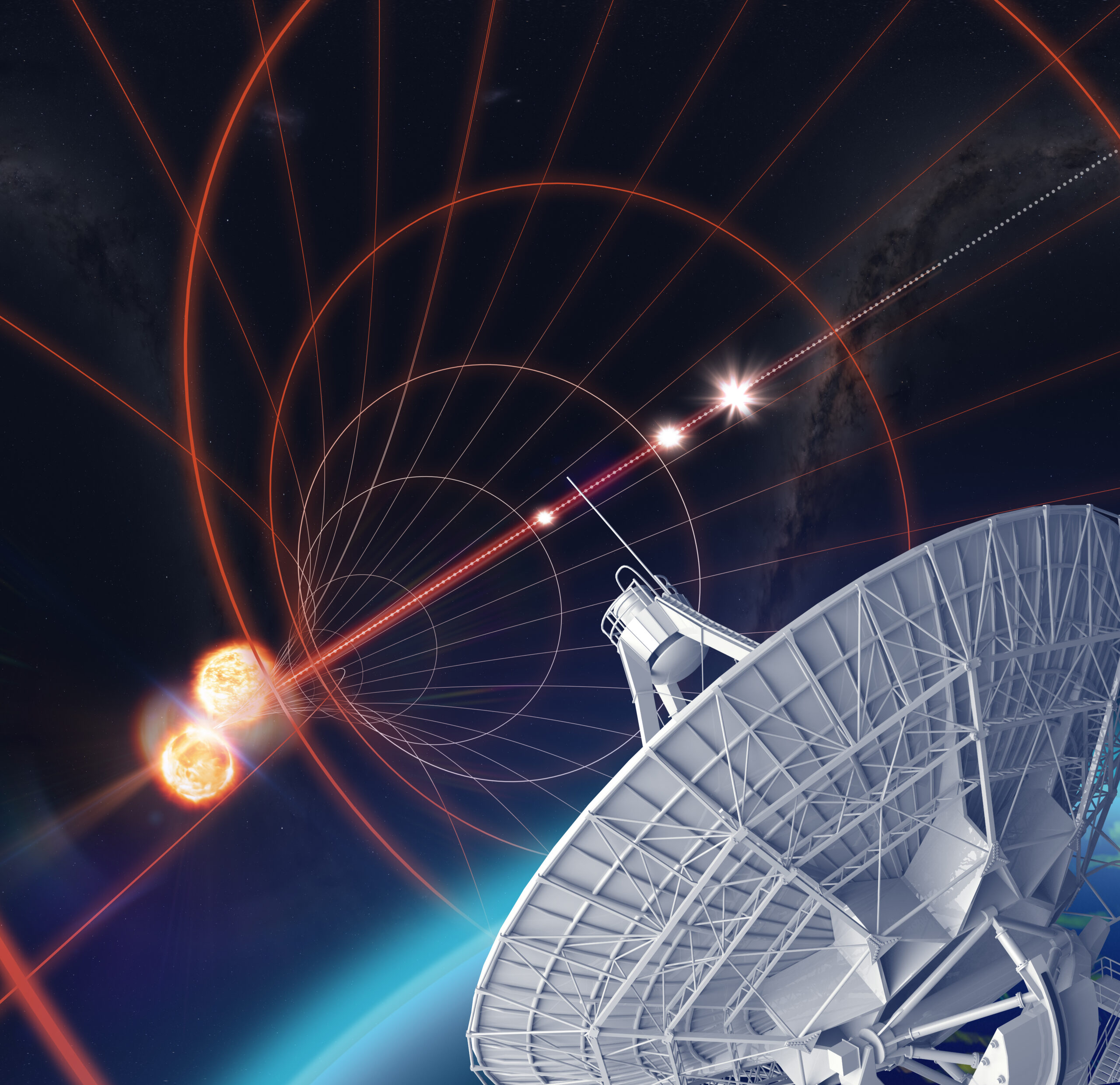
New measurement brings us closer to understanding the Universe’s rate of expansion

Researchers closely observing the fiery aftermath of an immense cosmic collision have made a new measurement of the speed at which the Universe is expanding.

The international team led by researchers from the ARC Centre of Excellence for Gravitational Wave Discovery (OzGrav) at Swinburne University of Technology and CSIRO, Australia’s national science agency, combined telescope and gravitational wave data in an attempt to unlock the true value of the Universe’s expansion, called the Hubble Constant.

Knowing how fast the Universe is expanding is extremely important, as it helps scientists to determine how large or far away objects are, the role of dark matter in the evolution of the Universe, as well as the Universe’s origin and ultimate fate.
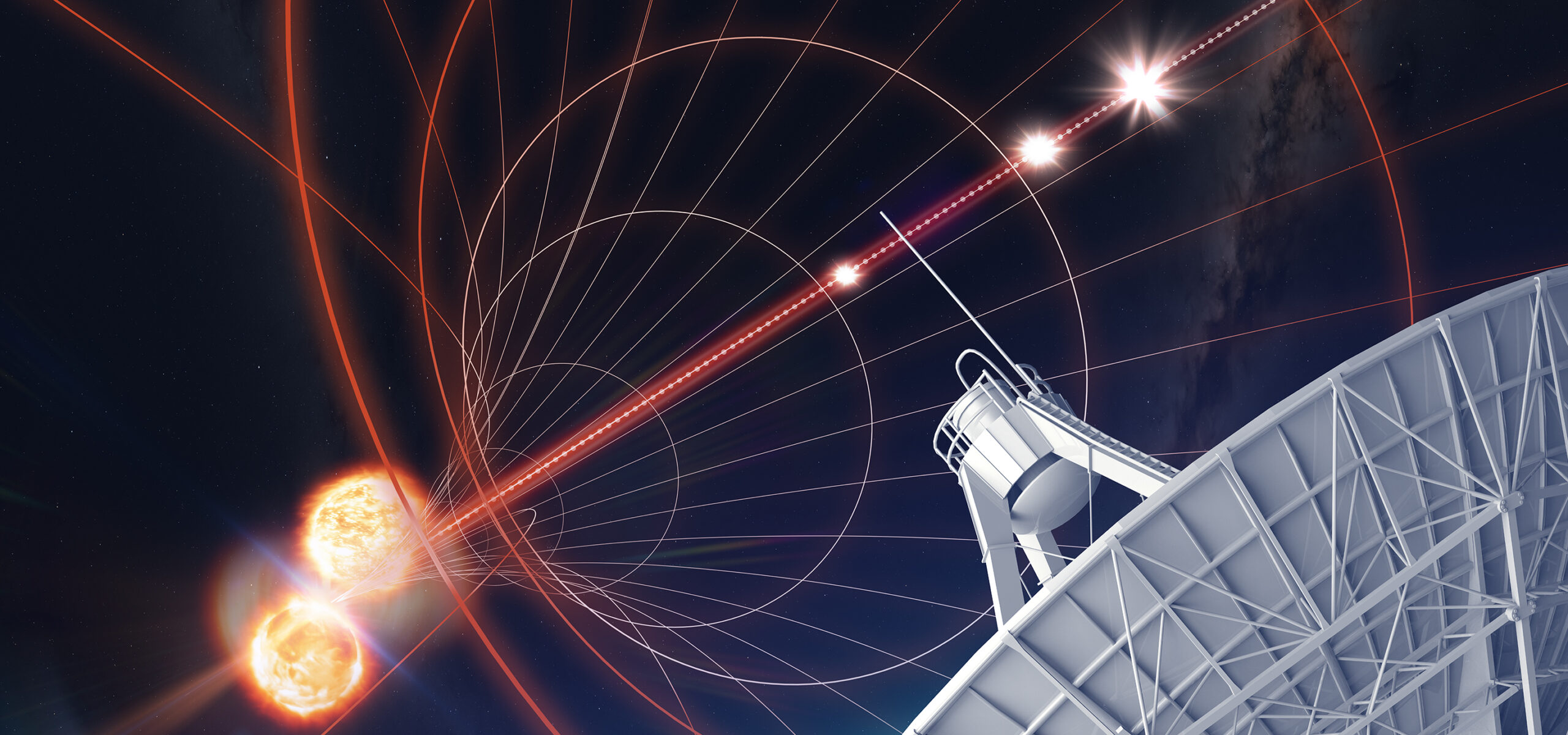
GW170817 Jet Afterglow. Credit: Carl Knox, OzGrav/Swinburne University

Two existing measurements of the Hubble Constant have split cosmologists for more than a decade.

Lead researcher, OzGrav Partner Investigator and CSIRO’s Dr Kelly Gourdji, said the two independent measurements are described as the ‘Hubble tension’.

“One method uses data from the very early Universe -the cosmic microwave background radiation – to make the measurement, while the other uses measurements from relatively nearby supernovae, making it data from the late Universe,” Dr Gourdji said.

These precise measurements disagree with one another: either one measurement is wrong, or our understanding of the physics that govern the Universe is wrong, leaving the true nature of the Hubble Constant shrouded in mystery.

“Our independent measurement using gravitational waves is a late Universe method, but the result is more consistent with the early Universe value,” Dr Gourdji said.

The dramatic collision of two neutron stars, which was visible to telescopes and caused a gravitational wave to be detected on Earth, provided an opportunity for the team to take this new measurement.

After black holes, neutron stars are the densest objects in the Universe with a huge amount of mass in a very small area. This density creates an intense gravitational field, more than 100 billion times stronger than the gravitational field on Earth.

The collision between these neutron stars was so powerful that it sent ripples through space and time – gravitational waves – whilst also sending jets of energetic particles into space.

Professor Adam Deller, OzGrav Chief Investigator from Swinburne University of Technology, who led the radio observations used in the research, said the jets caused by the collision were essential to making the measurement.

“These jets are launched for only a couple of seconds, but as they slam into the surrounding gas, they glow for months afterwards. We analysed almost a year of observations from the Hubble Space Telescope and two different arrays of radio telescopes spread across the USA and Europe,” Professor Deller said.

By combining all the data, the team revealed a new value for the Hubble Constant which, while not as precise as the more established measurements that underpin the Hubble tension, is more accurate than previous attempts made using gravitational waves. This is the strongest indication yet that gravitational waves could settle the debate.

Professor Deller said that the finding was significant.

“Some astronomers had proposed ways in which both measurements could be correct if our understanding of cosmology was changed – but our measurement argues quite strongly against that solution,” explained Professor Deller.

Dr Gourdji said more observations would be needed to confirm the finding.

“This would suggest that there is not something wrong with our understanding of cosmology, though we’ll need to examine more neutron star mergers like this one to be sure. For now, this result adds another data-point for cosmologists to consider in the lively Hubble tension debate,” said Dr Gourdji.

Published in The Astrophysical Journal
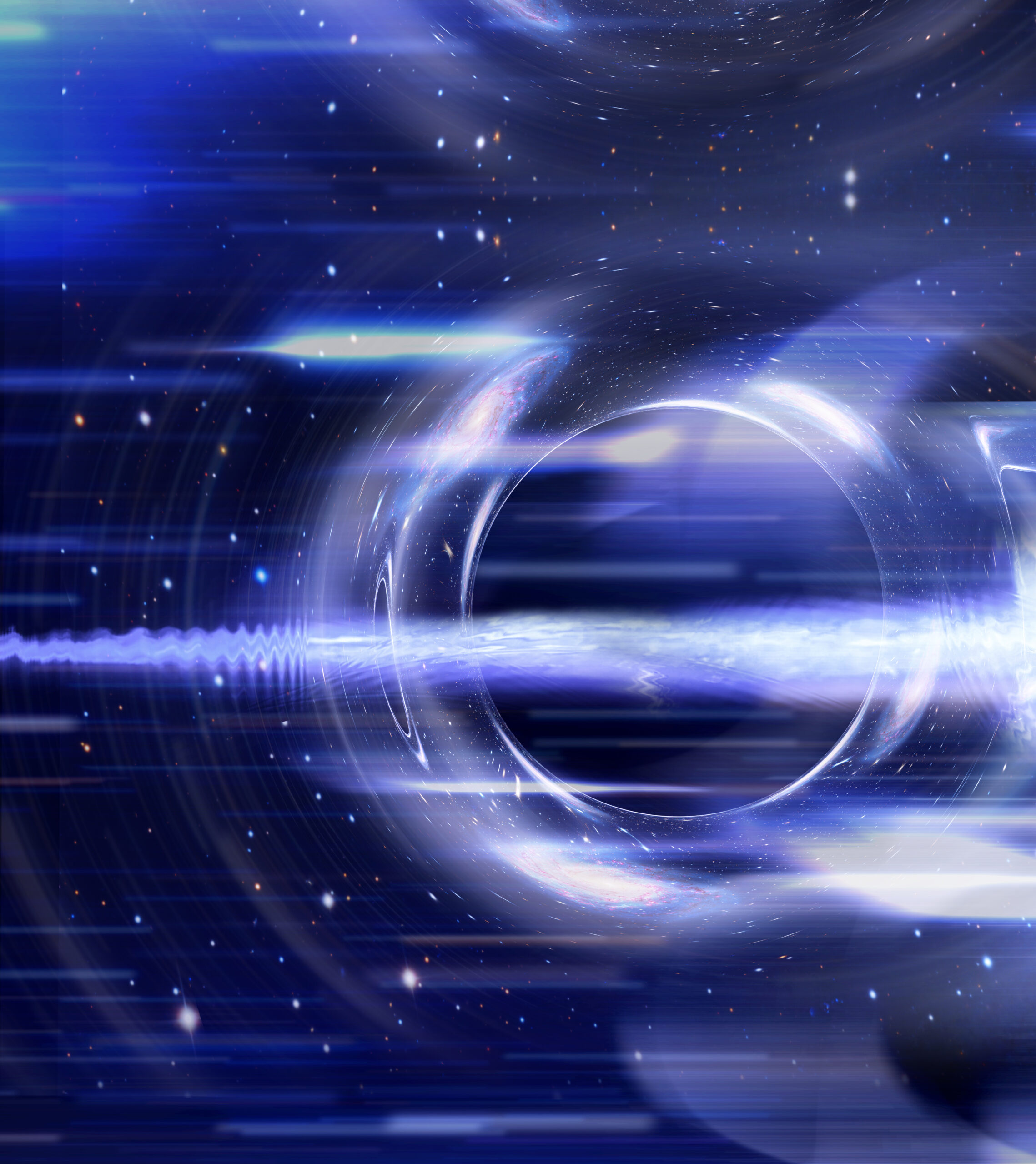
Scientists Find a Way to Study the Event Horizon Where Light & Sound Are Swallowed for Eternity

If, in space, no one can hear you scream – it seems that you can actually hear the sound of a crash when two black holes collide.  

Using the loudest gravitational wave ever heard, two Australian scientists and colleagues have been the first to witness the previously elusive “event horizon” – at the actual moment of collision, right before all light and sound are swallowed by the newly formed black hole for eternity.  

The discovery and the novel way to analyze the data, published today in Natureprovide a new observational window onto the region closest to a black hole’s event horizon where quantum physics and theories of general relativity intersect. 

The study, led by Dr Ling (Lilli) Sun and PhD candidate, Mr Neil Lu, from the ARC Centre of Excellence for Gravitational Wave Discovery (OzGrav) and the Australian National University, as well as colleagues in Canada, the US, and Spain, opens the doors for astrophysicists globally being able to observe the previously elusive event horizon of a black hole.  

Dr Ling (Lilli) Sun and PhD candidate, Neil Lu, from the ARC Centre of Excellence for Gravitational Wave Discovery (OzGrav) and the Australian National University.

“We measured the last sound the black holes made when they crashed. Hidden within that signal is a small component, called direct waves, that had not previously been well understood,” said Mr Lu. “Our new analysis allows us to decipher this component and extract unique information from close to the event horizon.” 

The event horizon is the boundary around a black hole beyond which nothing can escape, not even light. At this boundary, the speed required to break free from the black hole’s gravity equals the speed of light. Since nothing in the universe travels faster than light, anything that crosses the event horizon is permanently trapped. 

The scientists studied the gravitational-wave signal GW250114, recorded last year, the loudest yet, using the two Laser Interferometer Gravitational Wave Observatories in the United States. 

According to Dr Sun, black holes are extreme objects that sit at the intersection of general relativity and quantum theory.  

“We studied GW250114, the loudest binary black hole signal observed to date, about three times louder than the first gravitational-wave signal detected a decade ago,” said Dr Sun. “Our analysis shows that this exceptionally loud signal can be used as a powerful probe of the remnant black hole’s horizon, allowing us to measure its two fundamental properties: rotation frequency and surface gravity.” 

“These measurements mark a first step towards future tests of general relativity with direct waves,” Mr Lu added. 

The new analytical technique developed by Mr Lu, Dr Sun, and their collaborators means that astrophysicists will be able to study the strength of extreme gravity at the black hole’s horizon, and phenomena like frame dragging where black holes literally drag along the fabric of spacetime nearby, creating an environment where nothing is able to remain stationary relative to a distant observer like ourselves.

Watch the video below:

OzGrav congratulates Professor David Blair AO on King’s Birthday Honour

OzGrav is delighted to congratulate Professor David Blair, one of Australia’s pioneering gravitational-wave physicists, on being appointed an Officer of the Order of Australia (AO) in the 2026 King’s Birthday Honours.

Professor Blair was recognised for his distinguished service to physics, precision measurement science, gravitational-wave research and scientific education.

A founding figure in Australian gravitational-wave science, Professor Blair has spent decades advancing the technologies and scientific capabilities that helped position Australia as a global contributor to gravitational-wave astronomy. His work has inspired generations of researchers and played a significant role in shaping the field that ultimately led to the first direct detection of gravitational waves in 2015.

Throughout his career, Professor Blair has been a passionate advocate for science education and public engagement, helping to foster a deeper understanding of physics and astronomy among students, researchers and the broader community.

The recognition is a fitting tribute to a remarkable career dedicated to expanding humanity’s understanding of the Universe and advancing Australian scientific excellence.

Congratulations, David, on this well-deserved honour.

Check out the announcement here: https://govhouse.wa.gov.au/2026/06/the-2026-kings-birthday-honours-list/
Local news: https://www.uwa.edu.au/news/article/2026/june/outstanding-western-australians-honoured-in-kings-birthday-list
Australian Academy of Science announcement: https://science.org.au/news-events/news-views/fellows-celebrated-kings-birthday-honours-1

Student astronomer discovers ‘Rosetta stone’ for mysterious cosmic signals

White dwarf binary provides unique natural laboratory for extreme physics

An international team led by astronomers at the University of Sydney has uncovered the clearest evidence yet for the origin of an unusual class of cosmic signals. In doing so, they have identified a rare stellar system that is providing scientists with a natural laboratory to study extreme physics.

Using CSIRO’s ASKAP radio telescope, the team discovered a small, dense star, called a white dwarf, shredding material from its larger, but less dense, companion star. As this material spirals in, it produces powerful bursts of radio waves and X-rays in a cycle that repeats every 1.4 hours.

The findings are published in Nature Astronomy.

Lead author and PhD student Kovi Rose from the University of Sydney’s School of Physics and CSIRO said this provides the first confirmed identification of what astronomers call ‘long-period radio transients’: cosmic pulses discovered from just a few remote regions of our galaxy.

“For the first time we have pinpointed the origin of these signals, confirming the source to be a ‘cataclysmic variable’, or an accreting white dwarf star,” said Mr Rose.

“Long-period radio transients have puzzled astronomers for years,” Mr Rose said. “We’ve only found about a dozen, and their origins have been unclear. Now, we’ve been able to show that the source for one of these transients comes from a white dwarf actively pulling material from a companion star.”

A rare and revealing system

The newly identified system, named ASKAP J1745−5051, consists of a white dwarf – a dense stellar remnant roughly the size of Earth but with the mass close to that of the Sun – paired with a larger but lower-mass red dwarf star of about one-tenth the Sun’s mass. The two stars orbit each other extremely closely, completing a full orbit in just over an hour.

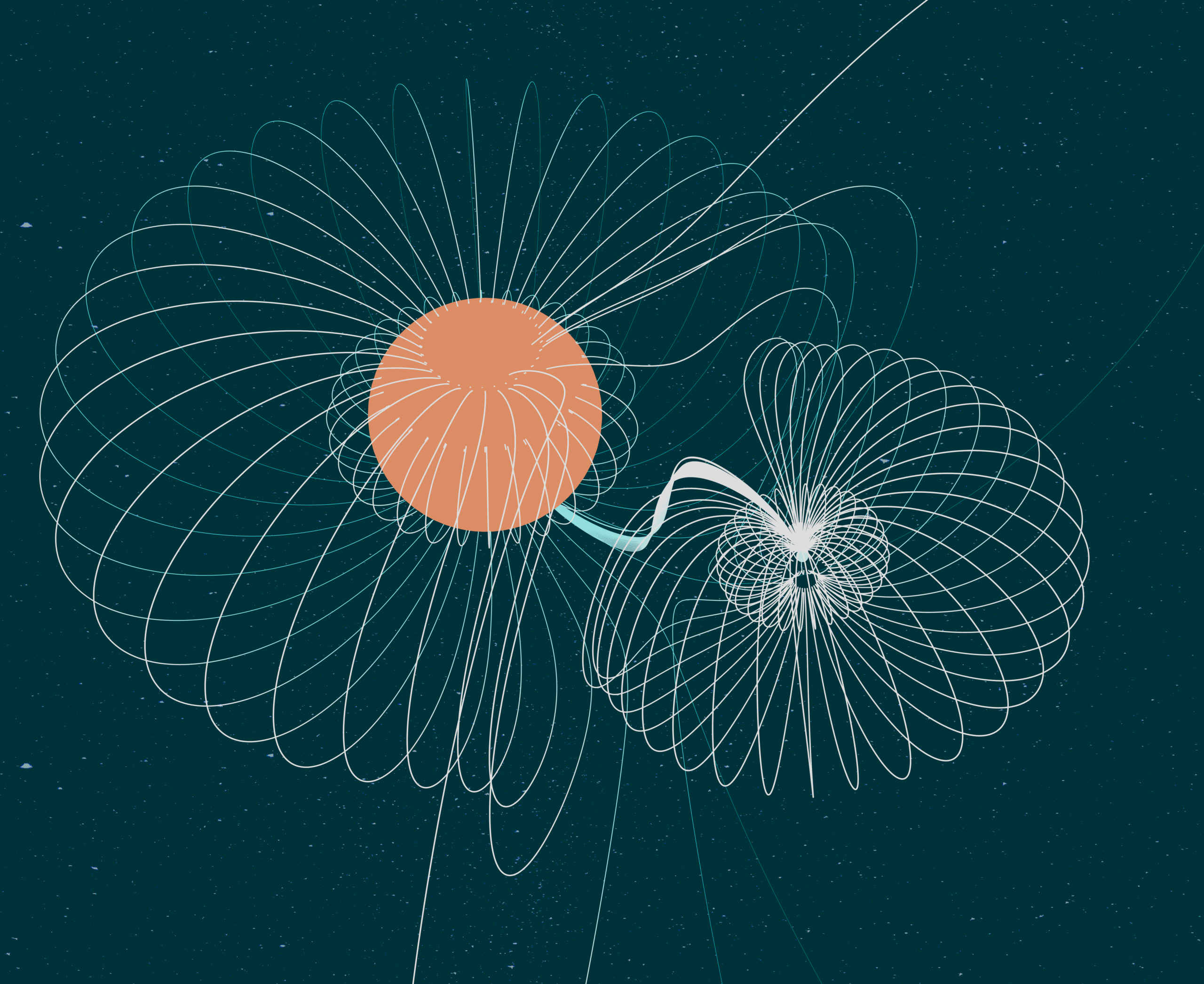
As material from the less massive star is drawn towards the white dwarf, it heats up and emits X-rays. At the same time, interactions between the stars’ magnetic fields generate regular radio bursts, meaning the signal occurs at specific intervals.

“These emissions are all tied to the orbital motion of the system,” Mr Rose said. “But interestingly, the radio and X-ray signals don’t peak at the same time, which tells us they’re being produced in different regions of the system.”

The team found that the radio emission likely originates where the magnetic fields of the two stars meet and interact with the charged material being ripped from the companion star, producing tightly beamed bursts of radiation.

Solving a cosmic mystery

Long-period radio transients were initially thought to be slow-spinning neutron stars, known as pulsars. However, current models suggest neutron stars rotating this slowly should not be able to produce such signals.

The new discovery strengthens an alternative explanation: that at least some of these mysterious bursts come from systems of two stars, involving white dwarfs.

“Some similar objects had been linked to binary systems before, but this is the first one where we can clearly see both stars and the accretion process in action,” said Professor Murphy, Head of School at the University of Sydney School of Physics and Chief Investigator at the ARC Centre of Excellence for Gravitational Wave Discovery (OzGrav).

The system is also only the second known long-period radio transient to emit regular X-rays – and the first where the cause of the regularity has been confirmed.

A ‘Rosetta stone’ for future discoveries

This unique system was discovered using the ASKAP radio telescope, owned and operated by CSIRO, Australia’s national science agency. ASKAP’s mix of coverage, resolution, and sensitivity is unparalleled in radio astronomy, allowing for such unusual signals to be detected that would otherwise be missed.

The researchers say that ASKAP J1745-5051 could act as a reference point for understanding other long-period radio transients.

“This system gives us a way to decode these signals. It could help us determine whether other long-period transients are more like pulsars or like white dwarf systems, acting like a stellar Rosetta stone,” said Mr Rose, referring to the archaeological object discovered in Egypt that helped translate ancient hieroglyphics.

The discovery also provides a unique opportunity to study extreme plasma physics and magnetic interactions under conditions that cannot be replicated on Earth.

“These systems are natural laboratories,” Mr Rose said. “They allow us to test our understanding of how matter behaves in strong magnetic fields and under intense gravitational forces.”

Future research

The team plans further observations combining radio, optical and X-ray telescopes to better understand how these emissions are generated and whether similar mechanisms can explain the full population of long-period radio transients.

“Each new discovery is helping us piece together the bigger picture,” Mr Rose said. “We’re only just beginning to understand this new class of cosmic events.”

The international team included astronomers from the United States, China, Canada, Spain, Israel and Australia. The team used CSIRO’s Australia Telescope Compact Array and ASKAP radio telescopes in Australia, the MeerKAT radio telescope in South Africa, the SOAR and Magellan optical telescopes in Chile, and the space-based Swift (UV/X-ray) and Einstein Probe (X-ray) telescopes.

MEDIA ENQUIRIES: media.office@sydney.edu.au

Media Release prepared by Ivy Shih, Media and PR Adviser | University of Sydney

RESEARCH: Rose, K. et al ‘Periodic radio and X-ray emission from an accreting white dwarf binary’ (Nature Astronomy 2026). DOI: 0.1038/s41550-026-02882-x

Watch the explainer video below: