An international team of scientists from the LIGO, Virgo, and KAGRA collaborations, including researchers from the ARC Centre of Excellence for Gravitational Wave Discovery (OzGrav), has detected two remarkable black hole collisions that are offering new insights into both the evolution of the cosmos and the nature of dark matter.
The pair of gravitational-wave events, named GW241011 and GW241110, were detected in late 2024, just one month apart, during the O4b observing run of the global detector network. Each signal was produced by the violent merger of two black holes, forming an even more massive remnant and sending ripples through space-time, each travelling for hundreds of millions to billions of years before reaching Earth.
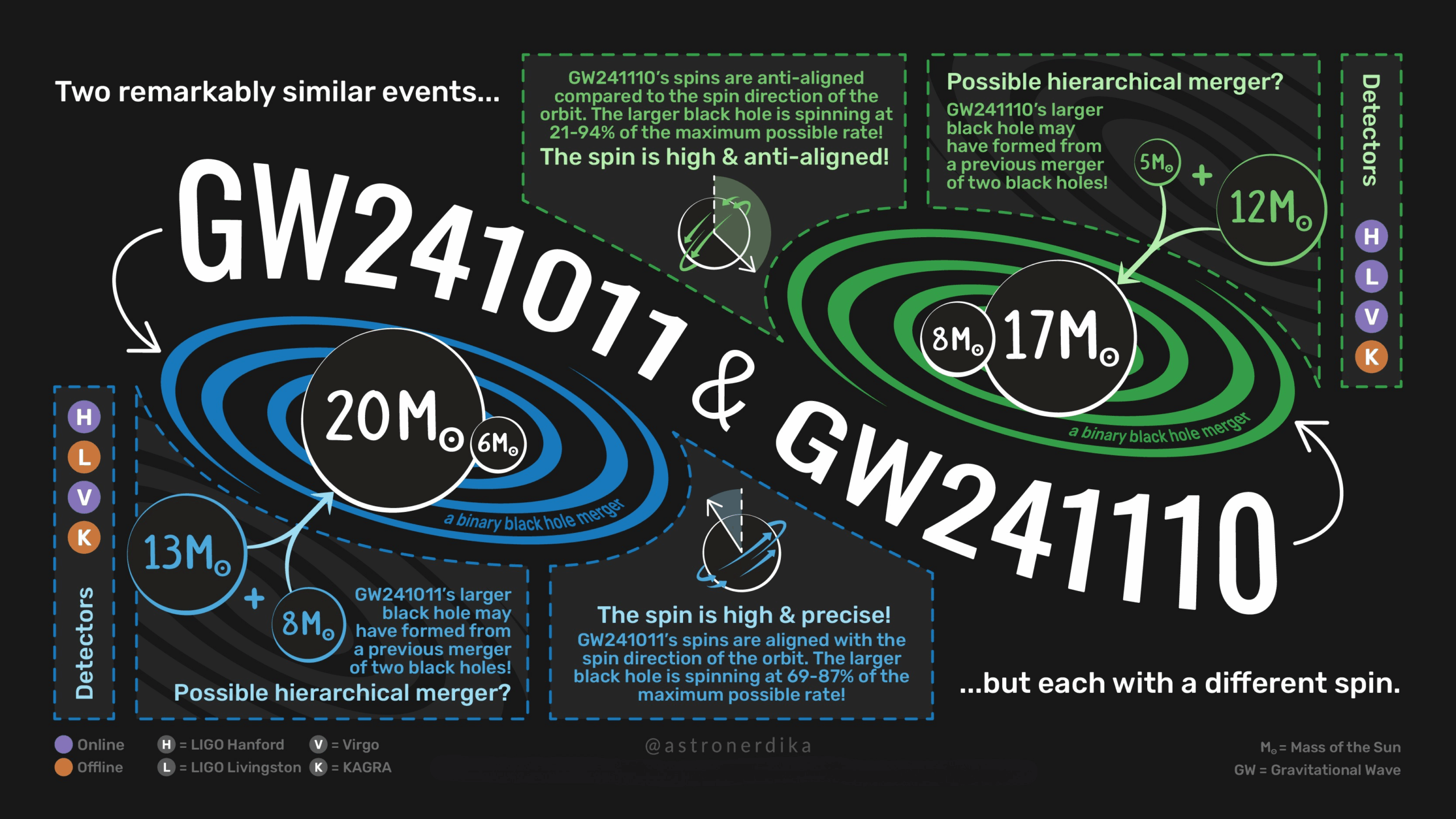
Both events involved unequal-mass, rapidly spinning black holes, an unusual combination that provides a window into how black holes form and evolve, and how they can be used to test new physics. Using these signals, researchers from OzGrav and the Australian National University (ANU) investigated whether the black holes’ spins could reveal hints of previously undiscovered particles.
OzGrav PhD student Aswathi Pampurayath Subhash from the Australian National University led the analysis focusing on ultralight bosons, hypothetical particles that could make up dark matter. Certain theories suggest these particles might gradually drain rotational energy from black holes over time. But since the black holes in GW241011 and GW241110 were still spinning rapidly when they merged, scientists were able to rule out a wide range of possible boson masses, tightening the constraints on dark matter theories.
“Rapidly spinning black holes like those in GW241011 and GW241110 are more than just astrophysical curiosities; they can be used to test the existence of new particles,” said Aswathi Pampurayath Subhash. “By remaining highly spinning over their long lifetimes, they allow us to rule out a wide range of possible ultralight boson masses, placing new constraints on dark matter and theories beyond the Standard Model.”
The data also shed light on how black holes grow and evolve. Both mergers involved one black hole roughly twice as massive as the other, and both showed signs that their spins were tilted compared to the direction of their orbits. This misalignment hints that the systems may not have formed from two stars evolving together, but instead through repeated mergers inside dense star clusters, a process known as hierarchical merging.
“These two black hole mergers give us a remarkable glimpse into how black holes grow and evolve,” said Dr Ling (Lilli) Sun from the Australian National University and Chief Investigator at OzGrav. “Their high spins and unequal masses suggest that they may be second-generation black holes, the products of earlier mergers in dense stellar environments, such as star clusters. Each detection adds a new piece to the puzzle of how the most extreme objects in our universe come to be.”
The detections highlight the extraordinary sensitivity of the LIGO, Virgo, and KAGRA observatories, which continue to uncover the hidden stories of the Universe’s most extreme objects. “Each new discovery not only deepens our understanding of black hole formation but also transforms these cosmic collisions into laboratories for fundamental physics,” says OzGrav Chief Investigator Professor Eric Thrane from Monash University.
Together, GW241011 and GW241110 showcase the remarkable progress of gravitational-wave astronomy in revealing the hidden lives of merging black holes. Each detection brings us closer to understanding how these cosmic giants form and evolve, while offering a powerful way to test the fundamental laws that govern the Universe itself.
Check out the explainer video below about the twin black hole mergers:
Information about OzGrav and gravitational-wave observatories:
The ARC Centre of Excellence for Gravitational Wave Discovery (OzGrav) is funded by the Australian Government through the Australian Research Council Centres of Excellence funding scheme. OzGrav is a partnership between Swinburne University of Technology (host of OzGrav headquarters), the Australian National University, Monash University, University of Adelaide, University of Melbourne, University of Western Australia, University of Queensland, and University of Sydney, along with other collaborating organisations in Australia and overseas.
This material is based upon work supported by NSF’s LIGO Laboratory which is a major facility fully funded by the National Science Foundation. NSF’s LIGO Laboratory is a major facility fully funded by the National Science Foundation and operated by Caltech and MIT, which conceived of LIGO and led the Initial and Advanced LIGO projects. Financial support for the Advanced LIGO project was led by the NSF with Germany (Max Planck Society), the U.K. (Science and Technology Facilities Council) and Australia (Australian Research Council-OzGrav) making significant commitments and contributions to the project. More than 1600 scientists from around the world participate in the effort through the LIGO Scientific Collaboration, which includes the GEO Collaboration. A list of additional partners is available at https://my.ligo.org/census.php.
The Virgo Collaboration is currently composed of approximately 880 members from 152 institutions in 17 different (mainly European) countries. The European Gravitational Observatory (EGO) hosts the Virgo detector near Pisa in Italy, and is funded by Centre National de la Recherche Scientifique (CNRS) in France, the Istituto Nazionale di Fisica Nucleare (INFN) in Italy, and the National Institute for Subatomic Physics (Nikhef) in the Netherlands. A list of the Virgo Collaboration groups can be found at: https://www.virgo-gw.eu/about/scientific-collaboration/. More information is available on the Virgo website at https://www.virgo-gw.eu.
KAGRA is the laser interferometer with 3 km arm-length in Kamioka, Gifu, Japan. The host institute is Institute for Cosmic Ray Research (ICRR), the University of Tokyo, and the project is co-hosted by National Astronomical Observatory of Japan (NAOJ) and High Energy Accelerator Research Organization (KEK). KAGRA collaboration is composed of over 400 members from 128 institutes in 17 countries/regions. KAGRA’s information for general audiences is at the website https://gwcenter.icrr.u-tokyo.ac.jp/en/. Resources for researchers are accessible from http://gwwiki.icrr.u-tokyo.ac.jp/JGWwiki/KAGRA.
Media Contacts:
Diana Haikal
Senior Communications and Engagement Advisor
ARC Centre of Excellence for Gravitational Wave Discovery
Email: dhaikal@swin.edu.au | ozgrav.comms@swin.edu.au
Available For Interview:
Aswathi Pampurayath Subhash
PhD student, Australian National University
Email: u8099525@anu.edu.au
Dr Ling (Lilli) Sun
Chief Investigator, Australian National University
Email: Ling.Sun@anu.edu.au