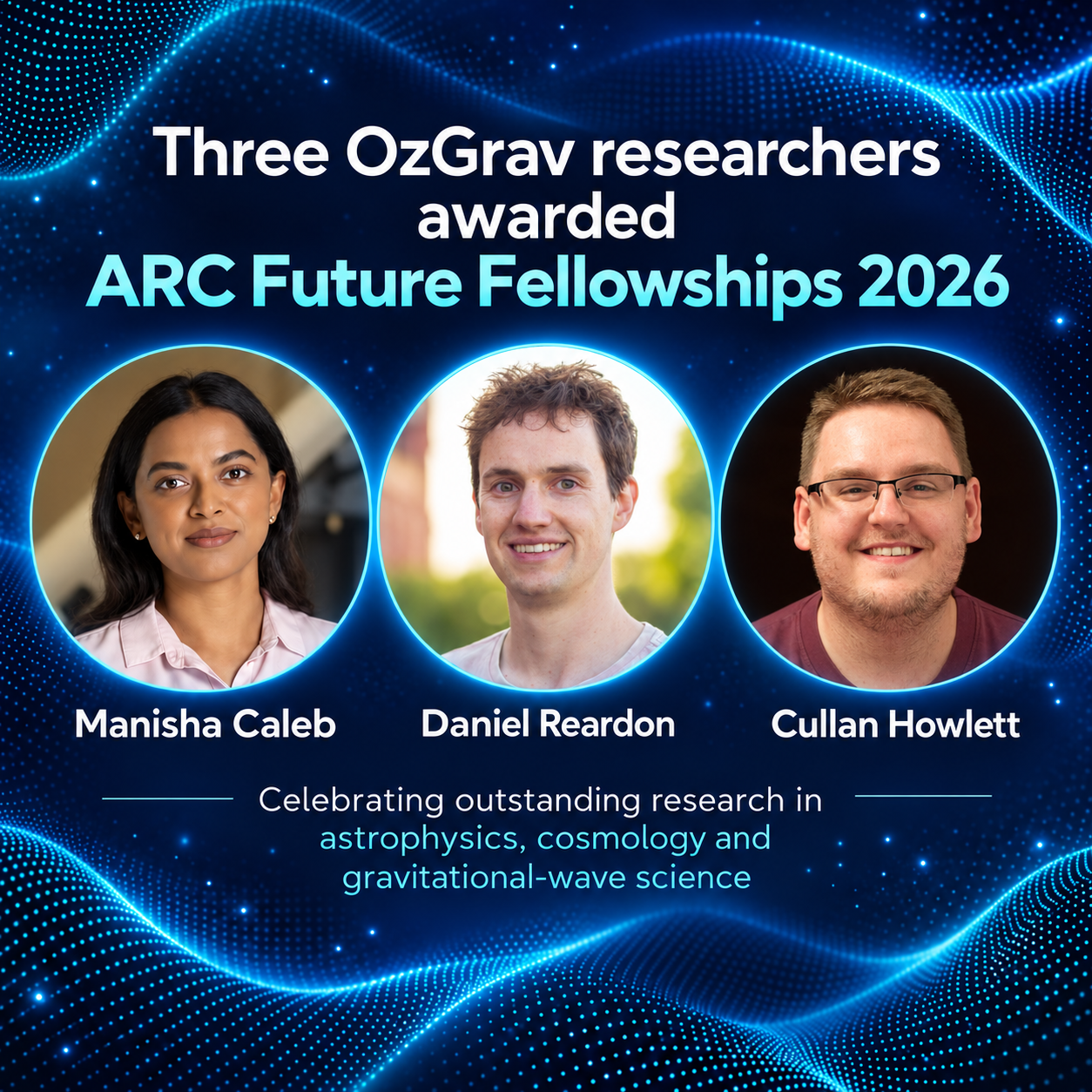
Three OzGrav researchers awarded 2026 ARC Future Fellowships

Three OzGrav researchers have been awarded prestigious Australian Research Council (ARC) Future Fellowships, supporting ambitious research across fast radio bursts, gravitational waves and dark energy.

Congratulations to Dr Manisha Caleb, Dr Daniel Reardon and Dr Cullan Howlett, who were named among the recipients of the 2026 Future Fellowships funding round.

ARC Future Fellowships support outstanding mid-career researchers to undertake high-quality, innovative research and build Australia’s research capability.

Fast radio bursts as tracers of baryons, galaxies and the evolving Universe

Dr Manisha Caleb, University of Sydney

Fast radio bursts (FRBs) are extremely bright, short-lived flashes of radio waves originating from across the Universe. Manisha’s project will use these powerful signals as cosmic probes to investigate how ordinary matter is distributed throughout the Universe and how galaxies evolve.

By connecting FRBs with their host galaxies and studying the matter their signals encounter as they travel through space, the research will provide new insights into both the origins of these mysterious bursts and the large-scale structure of the Universe.

Tuning a Galactic Gravitational-Wave Detector using Pulsar Scintillation

Dr Daniel Reardon, Swinburne University of Technology

Daniel’s project will develop new methods to detect ultra-low-frequency gravitational waves by using pulsar signals to better understand and correct for the effects of the interstellar medium.

The research will improve the sensitivity of pulsar timing arrays to gravitational waves, advance radio astronomy and strengthen Australia’s contribution to next-generation radio astronomy, including the Square Kilometre Array.

Illuminating Dark Energy In the Nearby Universe

Dr Cullan Howlett, The University of Queensland

Cullan’s project will investigate one of the biggest unanswered questions in modern physics: the nature of dark energy, the mysterious phenomenon driving the accelerating expansion of the Universe.

Using the positions and motions of galaxies in the nearby Universe, together with data from major galaxy surveys and advanced statistical techniques, the research will test our current understanding of cosmology and search for clues that could point towards new physics.

Together, the three Future Fellowships highlight the breadth of research across OzGrav, from using pulsars as a galaxy-scale gravitational-wave detector to probing the matter and fundamental forces that shape our Universe.

Congratulations Manisha, Daniel and Cullan on this fantastic achievement!

We also want to acknowledge the OzGrav researchers who were not successful in this highly competitive round. Preparing a Future Fellowship application takes an enormous amount of work, and we’re proud of the ambition, ideas and persistence of everyone who put themselves forward.
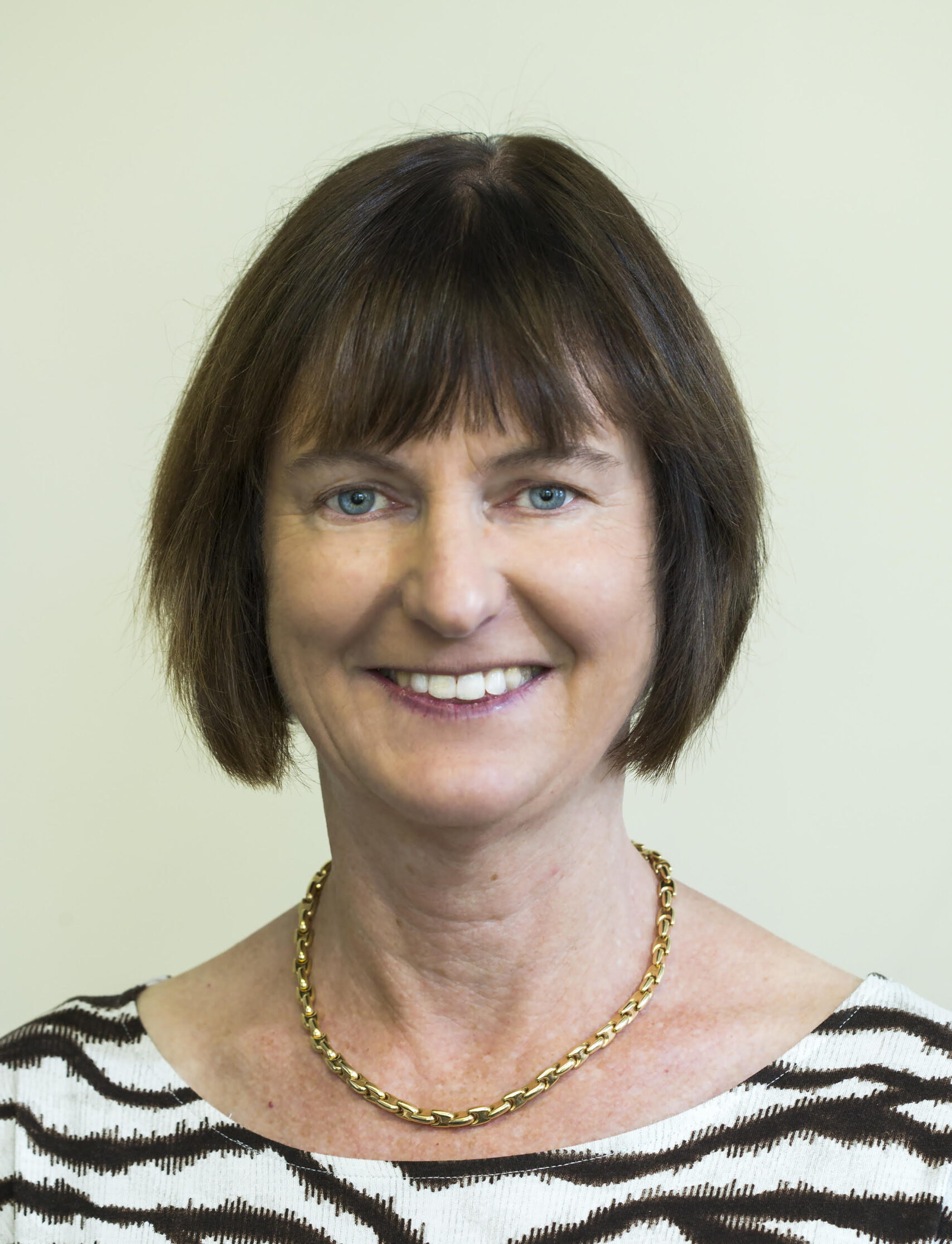
Professor Susan Scott awarded prestigious Harrie Massey Medal

OzGrav Chief Investigator Distinguished Professor Susan Scott has been awarded the 2026 Harrie Massey Medal and Prize, one of Australian physics’ most prestigious honours. 

The Australian Institute of Physics (AIP), jointly with the UK Institute of Physics (IoP), awarded Professor Scott the Medal in recognition of her “groundbreaking discoveries in the fields of general relativity, cosmology and gravitational wave science, and for her leading role in Australia’s participation in the first detection of gravitational waves.” 

The biennial award recognises outstanding contributions to physics by an Australian citizen working anywhere in the world, or an Australian resident for work undertaken in Australia. 

Established in 1990, the Harrie Massey Medal has been awarded to some of Australia’s most distinguished physicists. Susan is only the second woman to receive the honour in its 36-year history. 

A career helping Australia make gravitational wave history 

A theoretical and mathematical physicist, Susan’s research spans general relativity, cosmology, gravitational waves, black holes and the fundamental nature of spacetime. 

At The Australian National University (ANU), she leads the General Relativity Theory and Data Analysis Group and has played a major role in establishing and advancing Australia’s contribution to the international effort to detect gravitational waves. 

That decades-long effort culminated in 2015 when the Laser Interferometer Gravitational-Wave Observatory (LIGO) made the first direct detection of gravitational waves, produced by the collision of two black holes more than a billion years ago. 

The discovery confirmed a major prediction of Albert Einstein’s general theory of relativity and opened an entirely new way of observing the Universe. 

Susan was an Australian leader in the international team behind the discovery, with her team at ANU contributing vital components to the LIGO Data Analysis System through which the first detection signal was processed. 

“It really is a great honour to be awarded the Harrie Massey Medal jointly by the AIP and the IoP. Having spent four years working with the research group of Roger Penrose in Oxford in the UK and then coming to The ANU and commencing Australian activities in gravitational-wave data analysis, I feel that the formative part of my career had its roots in both countries. 

Through OzGrav and our contributing universities, Australia now plays a leading role internationally in gravitational-wave detection and gravitational-wave physics. This is an achievement of which we can all be proud. We plan to build on this important role, and to pursue our goal of siting a gravitational wave detector at home in Australia.” 

Her contribution to the first detection was recognised in 2020 when she was one of four Australian gravitational wave scientists jointly awarded the Prime Minister’s Prize for Science. 

Since that first detection, gravitational wave astronomy has transformed scientists’ ability to study some of the most extreme events in the Universe, including collisions between black holes and neutron stars. 

Susan has remained at the forefront of the field, continuing her research into gravitational waves, general relativity and the structure of spacetime, while helping build Australia’s capability and international leadership in gravitational wave science. 

A highly decorated career in Australian physics 

The Harrie Massey Medal adds to an extensive list of national and international recognition for Susan’s contributions to physics. 

She was elected a Fellow of the Australian Academy of Science in 2016 and a Fellow of the American Physical Society in 2020. 

Her honours include the 2020 Dirac Medal in Theoretical Physics, the 2020 Prime Minister’s Prize for Science, the Royal Society of New South Wales’ Walter Burfitt Prize and the Australian Institute of Physics’ Walter Boas Medal in 2022. 

In 2023, she received the Australian Academy of Science’s Thomas Ranken Lyle Medal for her contributions to gravitational physics, followed by the Australian Mathematical Society’s George Szekeres Medal in 2024. 

Susan has also received significant international recognition, including becoming the first Australian elected as a Fellow of the International Society on General Relativity and Gravitation and the first Australian to receive the European Academy of Sciences’ Blaise Pascal Medal in Physics. 

As the 2026 Harrie Massey Medal and Prize recipient, Susan will be invited to present a plenary talk on her research at the next AIP Congress and write an article for publication in Australian Physics. The President of the IoP will present the award to her at the AIP Congress in Sydney in December. 

The Harrie Massey Medal was established in 1990 as a gift from the Institute of Physics in the United Kingdom to mark the 25th anniversary of the Australian Institute of Physics becoming a separate institution. Only one Medal is awarded in each round.